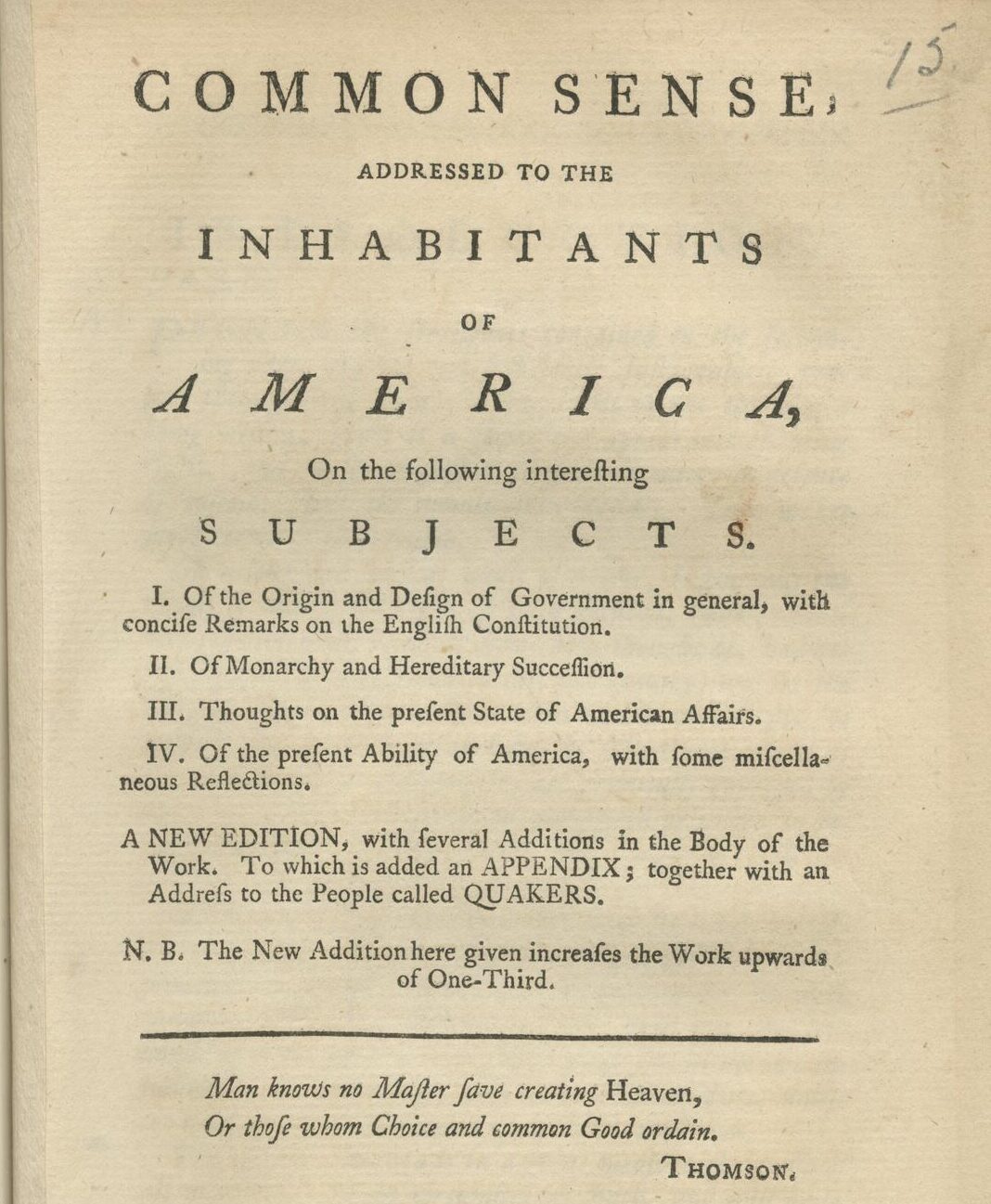
January 10: Thomas Paine’s Common Sense argues a “declaration for independence” will smooth the way for alliances with European powers.
In what would become the best-selling pamphlet of the American Revolution, first printed in Philadelphia, Paine recommended the publication of a diplomatic “manifesto” addressed “to foreign Courts”: a “declaration for independence” that would set forth “the miseries we have endured, and the peaceful methods which we have ineffectually used for redress; declaring at the same time, that not being able any longer to live happily or safely under the cruel disposition of the British Court, we had been driven to the necessity of breaking off all connections with her; at the same time, assuring all such Courts of our peaceable disposition towards them, and of our desire of entering into trade with them.” The Declaration of Independence, a document of international law drafted by the Continental Congress five months later, included each of the elements Paine outlined in January.
March 9: Adam Smith concludes The Wealth of Nations with a reflection on the costs of empire.
The final pages of Adam Smith’s landmark work of economics, published in London, addressed an imperial crisis rooted in issues of taxation and trade, charges that would appear at the center of the Declaration’s indictment of the King. Smith asked British readers and policy makers if Britain had ever in reality had “a great empire on the west side of the Atlantic”—or had that empire existed “in imagination only”? If the British American colonies could not be made to contribute towards the support of the whole empire, then perhaps it was time for Britain to “free herself” from the costs of defending the colonies in war or supporting them in peace, Smith suggested in his closing sentence.
March 31: Abigail Adams tells John Adams “I long to hear you have declared an independency” and to “Remember the Ladies” in creating new laws.
Writing from her home just outside of Boston, Abigail Adams sent a private letter to her husband John Adams (a delegate to Congress) telling him that she eagerly awaited news of an official declaration of independence. Her letter also mounted a defense of woman’s rights (though she did not use that word) set against the background of the imperial debate between the colonies and Britain: “in the new Code of Laws which I suppose it will be necessary for you to make I desire you would Remember the Ladies, and be more generous and favourable to them than your ancestors.” “Do not put such unlimited power into the hands of the Husbands,” Adams counseled. “Remember all Men would be tyrants if they could,” she suggested, and if “perticuliar care and attention is not paid to the Ladies we are determined to foment a Rebelion, and will not hold ourselves bound by any Laws in which we have no voice, or Representation.” Adams’s revolutionary words, laughed at by her husband, would not be printed or widely circulated until 1875, a century after she wrote them.
May 15: Virginia instructs its delegates in Congress to declare the colonies “FREE AND INDEPENDENT STATES.”
Meeting in Williamsburg, the Virginia Convention unanimously resolved that its delegates in Congress “propose to that respectable body TO DECLARE THE UNITED COLONIES FREE AND INDEPENDENT STATES, absolved from all allegiance to, or dependence upon, the Crown or Parliament of Great Britain.” These words, the source of the words Congress would debate in early July and would repeat in the Declaration of Independence, were drafted by Edmund Pendelton, the president of the Virginia Convention. On May 16, the day after the vote, the resolution was read to the army and soldiers toasted the “American independent states,” “the Grand Congress of the United States,” and General George Washington. Characterizing the states as “FREE AND INDEPENDENT” derived in part from European writings on natural law and the law of nations. Emerich de Vattel’s Les Droit du Gens—a legal treatise first published in 1758, translated as The Law of Nations in 1759, and read by some delegates to Congress in a new edition in 1775, was premised on the twin ideas that states were “composed of men naturally free and independent” who “before the establishment of civil societies, lived together in the state of nature” and that by analogy nation states were “absolutely free and independent” with respect to other states.
May 27: In a draft rights declaration, Virginia proclaims “all Men are born equally free and independent.”
Chiefly written by George Mason, the draft Virginia Declaration of Rights opened by stipulating that “all men are born equally free and independent, and have certain inherent natural rights, of which they cannot by any compact, deprive or divest their posterity; among which are the enjoyment of life and liberty, with the means of acquiring and possessing property, and pursuing and obtaining happiness and safety.” The draft rights declaration, with its link between the rights of “free and independent” men and “FREE and INDPENDENT STATES,” was reprinted in Philadelphia on June 8, one week after first appearing in a Virginia newspaper. But by June 12, the Virginia Convention had officially revised its radical claim that “all men are born equally free and independent,” drawing a distinction between a state of nature where “all men are by nature equally free and independent” and a “state of society,” a loophole designed in part to exclude the enslaved in Virginia. Many other new declarations of rights and revolutionary state constitutions did not make the same theoretical distinction. Mason’s revolutionary draft influenced the language of the second paragraph of the Declaration of Independence and would ultimately shape conceptions of rights in other states.
June 7: Virginia delegate Richard Henry Lee proposes independence in Congress.
Following on the May 15 resolution from Virginia, Lee proposed (and John Adams likely seconded) that Congress should consider the following resolution: “Resolved, That these United Colonies are, and of right ought to be, free and independent States, that they are absolved from all allegiance to the British Crown, and that all political connection between them and the State of Great Britain is, and ought to be, totally dissolved.” Lee’s resolution removed the Virginia Convention’s reference to the British Parliament. Congress would elect not to recognize Parliament’s jurisdiction or directly name that legislative body in the text of the Declaration itself, choosing instead to refer to the many acts of Parliament that had been sources of imperial tension as “Acts of pretended Legislation.”
June 11: Congress receives representatives of the Haudenosaunee Confederacy and elects Thomas Jefferson, John Adams, Benjamin Franklin, Roger Sherman, and Robert Livingston to prepare a declaration.
Congress was eager to extract promises of alliance or neutrality from Native nations, especially as delegates considered the risks of a formal declaration of independence. On June 11, delegates of Congress held a diplomatic meeting with representatives of the Haudenosaunee Confederacy in Philadelphia. In a prepared speech, delegates in Congress addressed their guests as “Brothers” and said they hoped “the friendship that is between us and you will be firm, and continue as long as the sun shall shine, and the waters run; that we and you may be one people, and have but one heart.” Congress explained that the “king of Great Britain, harkening to the evil counsel of his foolish young men, is angry with us, because we will not let him take away from us our land, and all that we have and give it to them.” “We shall order all our warriors and young me not to hurt you or any of your kindred,” Congress relayed, “and we hope you will not suffer any of your young men to join with our enemies.” Later that same day, having postponed a vote on Lee’s resolution until July 1 to provide time to gather further authorizations for independence from some colonies, delegates elected five members to the declaration committee (sometimes called the “committee of five,” though several other committees had five members). Thomas Jefferson of Virginia received the most votes and was designated as the chair of the committee. It was the declaration committee’s job to craft a document to announce and justify the resolution in favor of independence.
June 13: Jefferson’s proposed preamble to a new constitution for Virginia includes many of the charges against King George III later repeated in the Declaration.
In early May, Congress encouraged each colony to begin to form new governments that would better ensure “Happiness and Safety.” By June 13, Jefferson had drafted a preamble for a new Virginia constitution that began by indicting King George III for vetoing “laws the most wholesome & necessary for the public good” and included over a dozen charges that would subsequently appear in the final Declaration. In creating his indictment, Jefferson drew inspiration from the charges made against King James II in by the Convention Parliament nearly ninety years earlier, a document known as the English Declaration of Rights (or Bill of Rights) of 1689. The Declaration of Independence against George III would in fact ultimately echo the English Declaration of Rights against James II in two specific charges: both kings were held to be guilty of suspending the operation of laws and keeping a standing army during a time of peace.
June 20: To provide more time for committee work, including work on the Declaration, Congress agrees not to hold meet on Saturdays.
Each member of the declaration committee served on multiple other important committees dealing with the war and with political reorganization. By mid-June, committees were at work drafting a fundamental governing document for a confederation and a model for a treaty with a foreign power. A vote on June 20 allowed the delegates to suspend general discussions and to hold time on Saturdays for committee meetings.
June 21: Jefferson sends a draft of the Declaration to Benjamin Franklin.
Benjamin Franklin suffered from an illness that kept him from attending Congress during much of the period of the Declaration’s composition. One day before a committee meeting on Saturday, June 22, Jefferson circulated a draft of the Declaration to Franklin and noted that the draft had been “read and with some alterations approved of by the committee.” Would Doctor Franklin, Jefferson deferentially asked, “be so good as to peruse it and suggest such alterations as his more enlarged view of the subject will dictate?” A surviving copy of the “original rough draught” of the Declaration preserved by Jefferson includes some small suggestions in the handwriting of both Franklin and John Adams. Jefferson’s initial draft for the famous opening of the second paragraph reveals just how much the language of the document charged as committee members made suggestions and as Jefferson himself had second thoughts: “We hold these truths to be sacred & undeniable,” Jefferson initially wrote, “that all men are created equal & independant, that from that equal creation they derive rights inherent & inalienable, among which are the preservation of life, & liberty, & the pursuit of happiness.” The manuscript of the remainder of that now famous paragraph, with language that paraphrased and, in some cases, exactly echoed passages from the political writings of the late seventeenth-century philosopher John Locke, reveals comparatively fewer instances of revision.
June 28: The committee submits a draft declaration that indicts King George III for supporting the slave trade, a charge Congress will ultimately delete.
The artist John Trumbull’s famous painting of The Declaration of Independence, installed in the Rotunda of the Capitol in Washington, DC in 1826, depicts a scene set not on July 4 but on June 28, when the five members of the declaration committee submitted its draft report to colleagues. That draft, approved by Adams and Franklin, included among its final charges an indictment of the King for both supporting the slave trade and for allowing his royal governor in Virginia to strategically emancipate enslaved individuals:
he has waged cruel war against human nature itself, violating it’s most sacred rights of life & liberty in the persons of a distant people who never offended him, captivating & carrying them into slavery in another hemisphere, or to incur miserable death in their transportation thither. this piratical warfare, the opprobrium of infidel powers, is the warfare of the christian king of Great Britain. determined to keep open a market where MEN should be bought & sold, he has prostituted his negative for suppressing every legislative attempt to prohibit or to restrain this execrable commerce: and that this assemblage of horrors might want no fact of distinguished die, he is now exciting those very people to rise in arms among us, and to purchase that liberty of which he has deprived them, by murdering the people upon whom he also obtruded them; thus paying off former crimes committed against the liberties of one people, with crimes which he urges them to commit against the lives of another.
Congress did not adopt this language in the final document, but Jefferson circulated the committee’s draft privately to friends in Virginia in July 1776 and ultimately the deleted passage on slavery entered the public sphere when one of those copies was printed in a Richmond newspaper in 1806. By 1829, Americans could encounter a facsimile of Jefferson’s handwritten draft alongside the printed publication of his memoirs and other private letters.
July 2: Congress votes independence, and a newspaper reports the colonies are “FREE and INDEPENDENT STATES.”
After restarting debate on Monday, July 1, Congress finally approved the Lee resolution on independence. Congress then turned to revising and approving the committee draft of the Declaration. Later that day, the Pennsylvania Evening Post became the first newspaper to report that Congress had declared the colonies “FREE and INDEPENDENT STATES.” This short revolutionary notice appeared on the back page of the paper, sitting beside an advertisement offering a reward for the recapture of a Black man named Ishmael who had run away from his enslaver.
July 4: Congress approves the wording of the Declaration and sends the text to a printer.
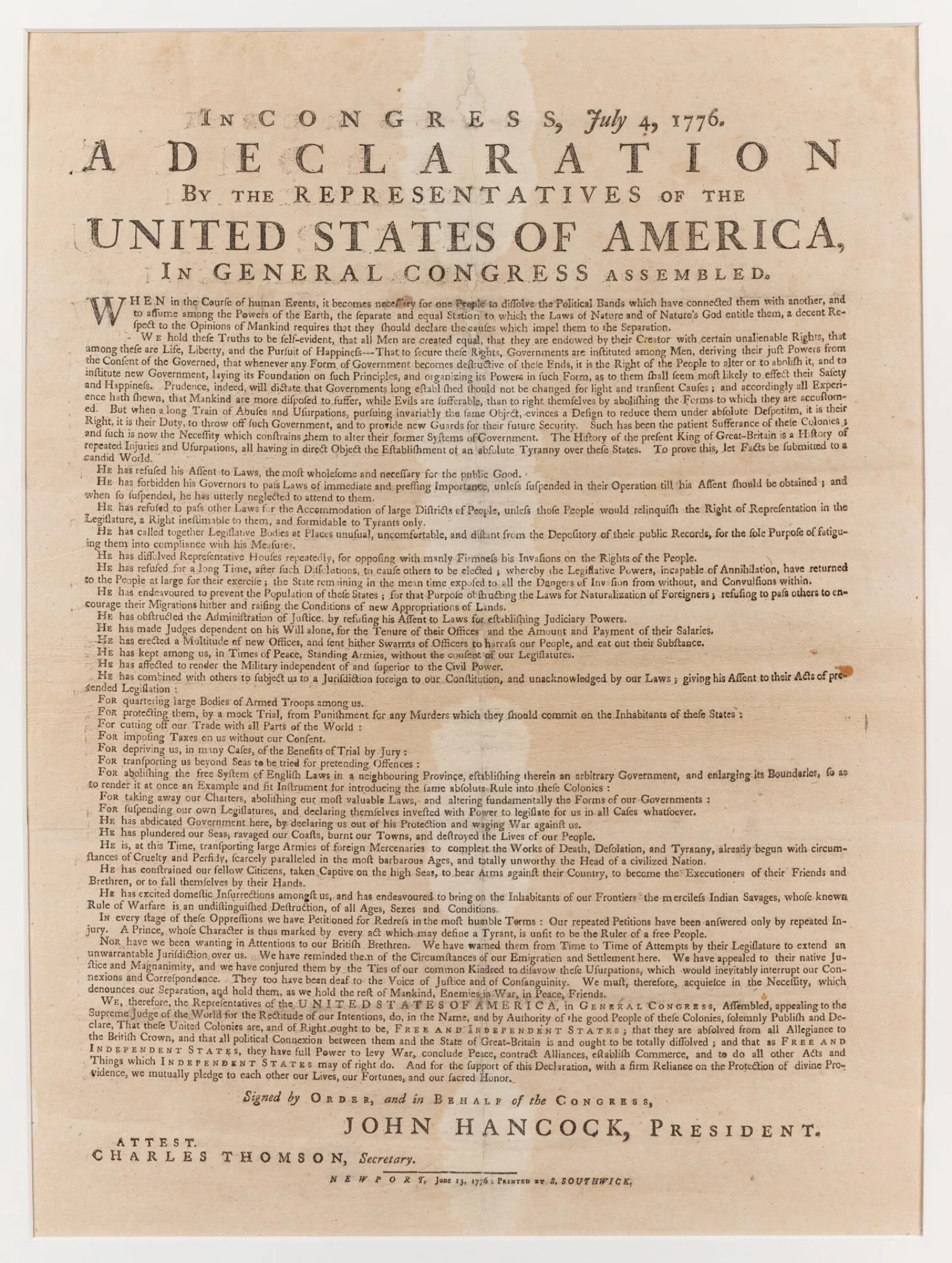
Congress made many verbal alterations and excisions across the committee’s draft Declaration before approving the final text on July 4. The delegates then asked the committee to oversee the printing of the document, working with Irish-born printer John Dunlap. Dunlap produced perhaps 200 copies for Congress to distribute but only 26 of the single-sheet posters (known as broadsides) are known to have survived.
July 6: The Declaration appears in a newspaper, followed soon by a German translation.
John Dunlap’s Pennsylvania Packet printed the Declaration on Monday, July 8, the same day the words were proclaimed from the Pennsylvania State House (now Independence Hall), but the text had already started to appear in newspapers on the afternoon of Saturday, July 6. By August 2, the Declaration had been reprinted in 30 other newspapers across the new United States. The first translation of the Declaration, made for German readers in Pennsylvania, appeared in a newspaper on July 9.
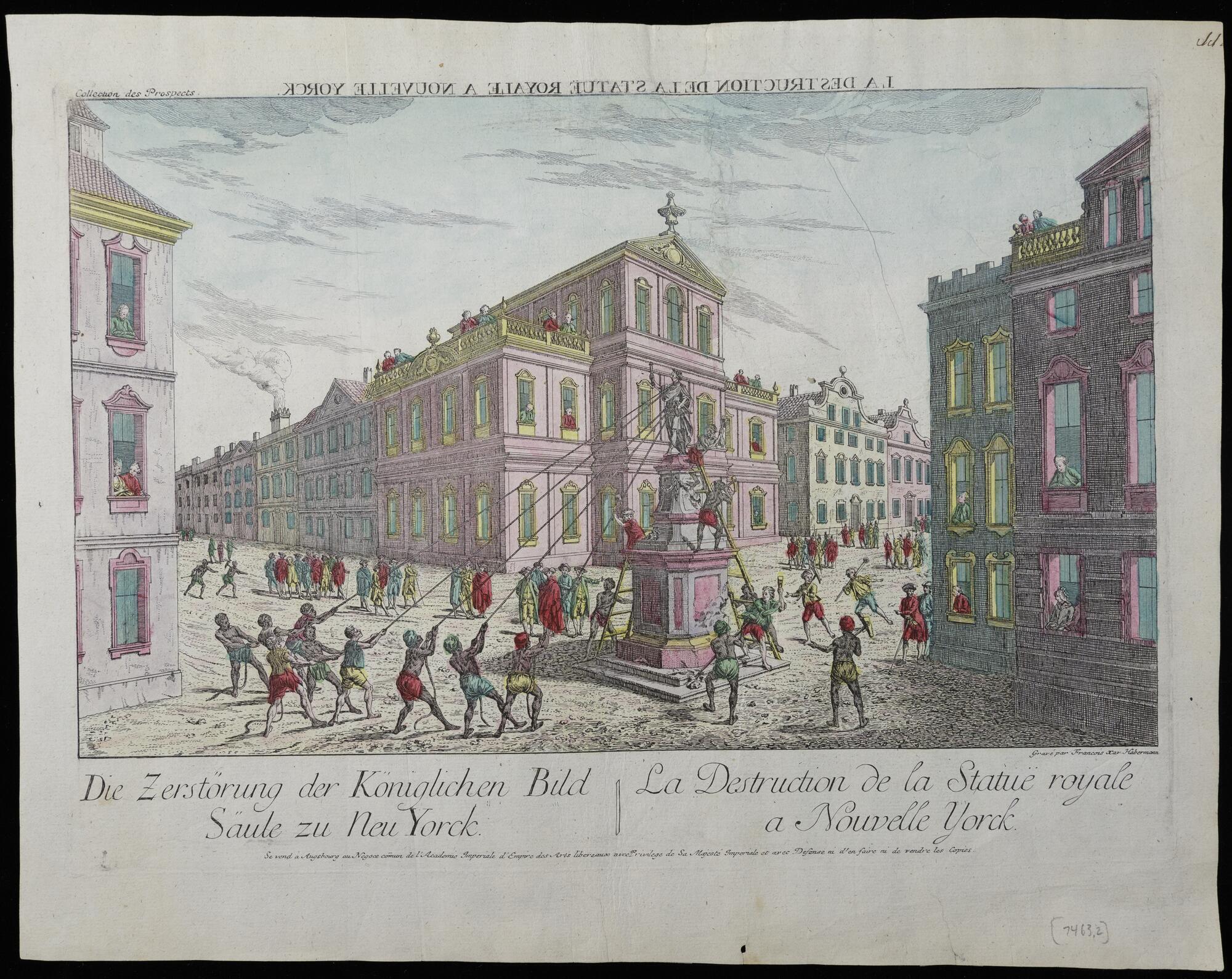
July 9: General George Washington orders the Declaration be proclaimed in New York and a crowd topples a statue of the King.
General George Washington, explaining that the Continental Congress had been “impelled by the dictates of duty, policy and necessity…to dissolve the Connection which subsisted between this Country, and Great Britain, and to declare the United Colonies of North America, free and independent STATES,” ordered a public proclamation of the before the Army “with an audible voice” of “the declaration of Congress, shewing the grounds & reasons of this measure.” In the wake of the reading of the Declaration a crowd proceeded to tear down a statue of George III, a scene that artists who had not witnessed the event imaginatively reconstructed for European audiences.
July 13: Solomon Southwick reprints the Declaration in Newport, Rhode Island.
A printer for Rhode Island’s government, Solomon Southwick produced an official version of the Declaration of Independence to be sent to each town in the state. As an advertisement in Southwick’s newspaper indicates, the printer sold additional copies at his printshop. All contemporary broadside copies of the Declaration are rare. Only a single copy of a broadside printed south of Philadelphia has survived. Southwick’s broadside, mistakenly dated June 13 at the bottom of the page but otherwise a faithful reprinting of Dunlap’s text, is among the very small handful of surviving large-scale versions of the Declaration specifically marketed to readers who may have wished to show their political allegiances by posting the Declaration in their homes or businesses.
July 19: The United States and the Mi’kmaq Nation sign a treaty of alliance and friendship.
The Declaration enabled the new United States to negotiate treaties with foreign powers and, despite the slur against Indigenous people in the text of the Declaration, Congress remained eager to negotiate alliances with Native nations. Just over two weeks after July 4, “A Treaty of Alliance and Friendship entered into and concluded by and between the Governors of the State of Massachusetts Bay, and the Delegates of the St. John’s & Mickmac Tribes of Indians” was signed in Watertown, Massachusetts with representatives of the Mi’kmaw and Wolastoqiyik peoples. During the negotiations, James Bowdoin, speaking on behalf of Massachusetts, produced a copy of the Declaration of Independence, and explained that the “St. John’s and Micmack Tribes are now our brothers and become one people with the United 11 Colonies” and that the “Colonies have lately, by their great Council at Philadelphia, declared themselves free and independent states, by the name of the United States of America.” After the Declaration was explained with the help of an interpreter, Chief Ambrose Bear (Maliseet) spoke for his delegation: “We like it well.” “You and we, therefore,” Bowdoin continued, “have now nothing to do with Great Britain” and are both “wholly separated from her and all the former friendship and connection with her are now dissolved.” “The United States now form a long and strong chain,” Bowdoin concluded, “and it is made longer and stronger by our brothers of the St. John’s and Micmack Tribes joining with us.” The language of the resulting treaty of alliance opened with a repetition of the most important words of the Declaration to most contemporaries: the official resolution on independence from the final paragraph.
August 2: Delegates sign a copy of the Declaration on parchment, later asking Mary Katherine Goddard to print a copy with the signers’ names.
After the New York delegation received authorization to vote for independence the Declaration could now be styled the “Unanimous Declaration of the Thirteen United States of America.” Congress commissioned Timothy Matlack, a clerk to Congress, to produce a handwritten version of the Declaration on an animal skin with that title. Delegates, including those who were not present on July 2 or July 4, signed their names in groupings by states, an attestation of their loyalty to the new United States. In early 1777, Congress contracted with Baltimore printer Mary Katherine Goddard to print copies of the signed version. The copies of the Declaration that derived from John Dunlap’s printing had only carried the name of only one delegate: John Hancock, who as President of Congress signed on behalf of the other representatives.
August 10: The Declaration reaches London; British reprints suppress the words “King” and “Tyrant.”
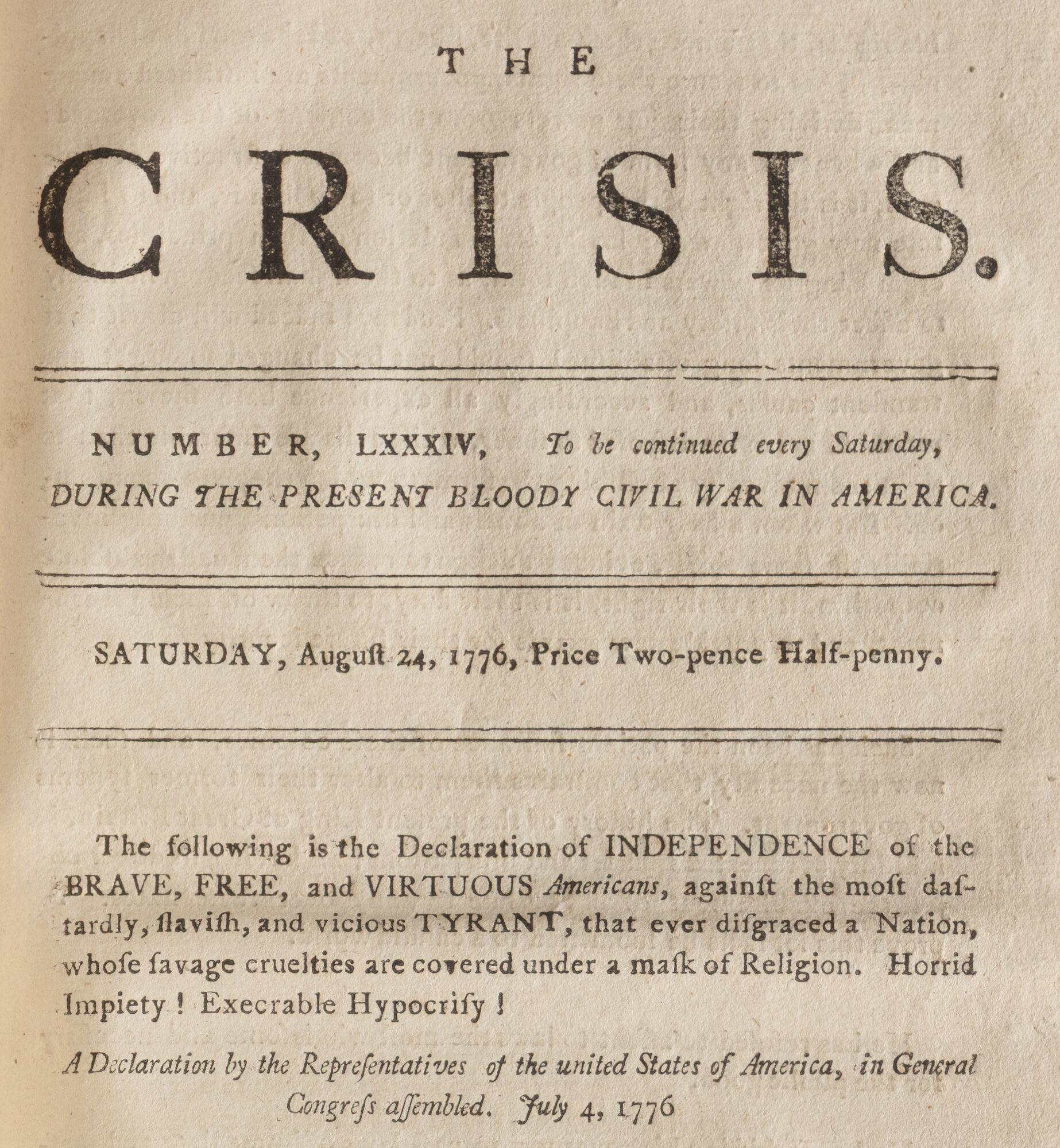
British readers frequently saw redacted versions of the Declaration, a document indicting their king for acts described as “tyranny.” Printers could be charged with seditious libel for such explicit statements, though most readers could easily fill in the blanks. “The history of the present ---- of Great Britain,” readers of London’s Gentleman’s Magazine learned in August 1776, “is a history of repeated injuries and usurpations; all having in direct object the establishment of an absolute t------ over these states.” Nevertheless, two weeks after the Declaration reached London, The Crisis, a radical newspaper and an inspiration for Thomas Paine’s American Crisis, reprinted the Declaration in full. The editors even doubled down, referring to George III in a preface to their reprinting as “the most dastardly, slavish, and vicious TYRANT that ever disgraced a Nation.”
October 2: A Boston newspaper invokes the Declaration against slavery, a connection made by Black soldier Lemuel Haynes among others.
The Declaration was quickly taken up by opponents of slavery. Noting that Congress had declared “that all men are created equal, that they are endowed by their Creator with certain unalienable rights, that among these are life, liberty and the pursuit of happiness,” Reverend William Gordon of Roxbury, Massachusetts asked readers of the Independent Chronicle whether these were “our general sentiments”—or was Congress provoking the Deity, by acting hypocritically”? Congress had concluded the Declaration by “appealing to the Supreme Judge of the World for the Rectitude of our Intentions,” and so the charge of hypocrisy concerned saying one thing before God while meaning another. But if Congress meant what it said, then Gordon insisted these truths must be acted upon and legislators in Massachusetts should devote themselves “earnestly and heartily to the extirpation of slavery.” While Gordon may have been the first to put his thoughts in print he was likely anticipated by others with antislavery sentiments in the days, weeks, and months following the publication of the Declaration. An undated antislavery manuscript by Lemuel Haynes, a young Black soldier and future minister, suggests he may well have been the first to apply the Declaration as a cudgel against the institution of slavery, inaugurating a long line of activists and helping to elevate the self-evident truths of the second paragraph above the claims of sovereignty and independence in many modern readers’ understandings of the document.
October 15: Loyalist Thomas Hutchinson criticizes Congress for claiming “all Men are created equal” while holding slaves.
Thomas Hutchinson, a Loyalist former governor of Massachusetts who fled America and took refuge in London, provided an analysis of the Declaration for the British Prime Minister Lord North. Like many who wrote responses to the Declaration, Hutchinson focused most of his attention on the charges against the King, but he nevertheless found space to ask a pointed question: if it was true that “all Men are created equal,” Hutchinson wished to ask delegates of Congress from Maryland, Virginia, and the Carolinas, how could “their Constituents justify the depriving more than an hundred thousand Africans [of] their rights to liberty, and the pursuit of happiness, and in some degree to their lives, if these rights are so absolutely unalienable”?
October 31: An Answer to the Declaration of the American Congress, an unofficial response drafted by John Lind and Jeremy Bentham, is published in London.
To compose an official response to the Declaration of Independence, the British administration reasoned, would be to recognize an equality between Great Britain and the so-called United States. An Answer to the Declaration, written primarily by lawyer John Lind, served as the unofficial response, a charge-by-charge rebuttal and defense of the British position across nearly one hundred and twenty printed pages. In the final passages philosopher Jeremy Bentham took direct aim at the idea that “all Men are created equal.” “This is surely a new discovery,” Bentham joked, since it suggested that “a child, at the moment of his birth, has the same quantity of natural power as the parent” and “the same quality of political power as the magistrate.” He was not surprised, Bentham remarked, that “men who are engaged in the design of subverting a lawful Government” would choose to veil their intentions with “a cloud of words.”
December 21: Benjamin Franklin arrives in Paris to help negotiate financial assistance, a military alliance, and formal recognition by France of the independence of the United States.
At the beginning of 1776, Thomas Paine had envisioned a declaration of independence as primarily an instrument to help secure foreign assistance. Benjamin Franklin’s arrival in Paris in December signaled just how crucial Congress believed French support and recognition would prove to be. In 1778, after a decisive American victory at Saratoga and after John Adams had joined Franklin in the diplomatic corps in Paris, France recognized the independence of the United States through a Treaty of Amity and Commerce and a Treaty of Alliance. Franklin and Adams, fellow members of the declaration committee, were both on hand in 1783 when Britain officially recognized American independence through the Treaty of Paris, marking the end of the American Revolutionary War.
Free and Independent: The Declaration of Independence and the Words That Made the United States runs now through July 18, 2026