This program will be held in-person at the Newberry.
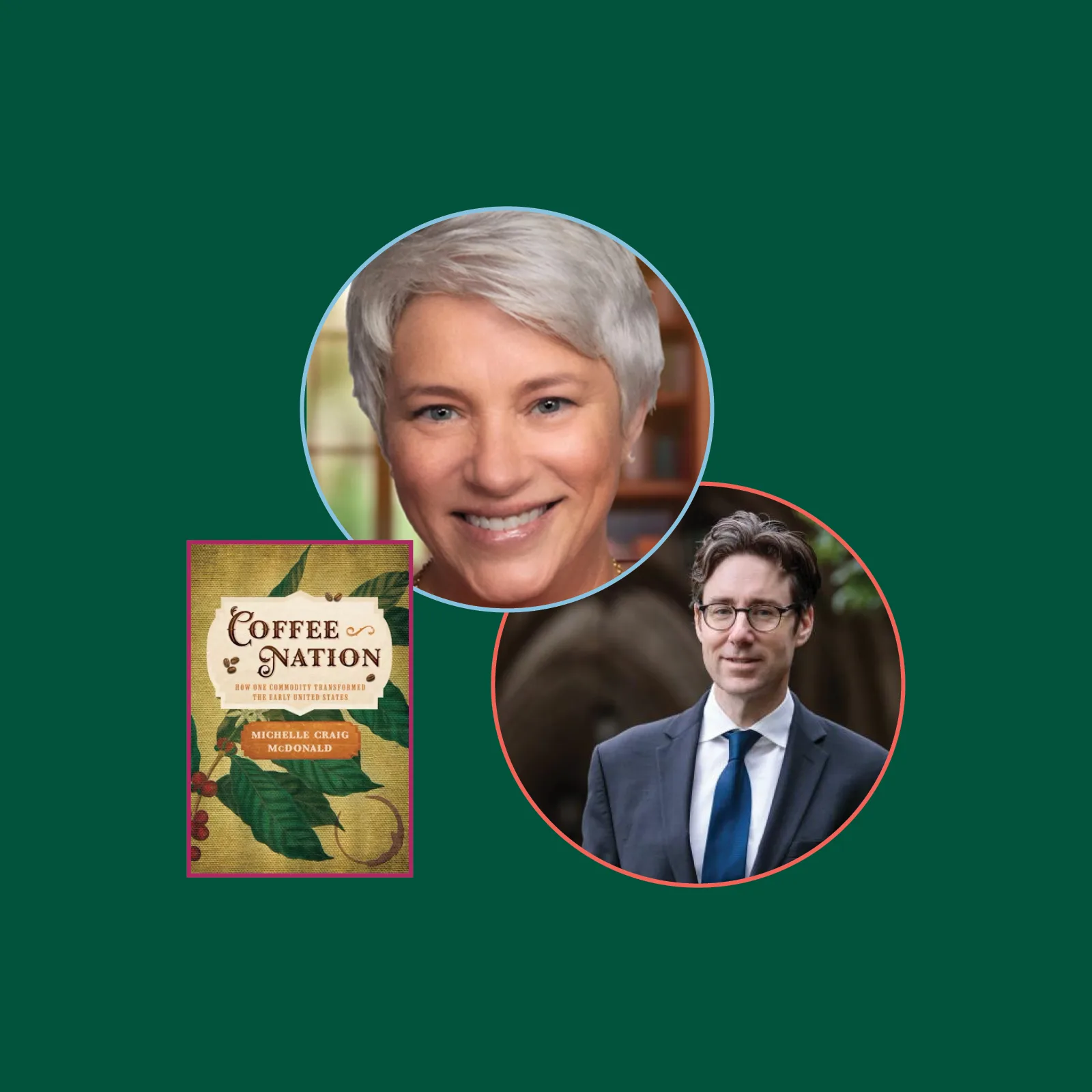
Coffee is among the most common goods traded and consumed worldwide, and so omnipresent its popularity is often taken for granted. But even everyday habits have a history. When and why coffee become part of North American daily life is at the center of Coffee Nation: How One Commodity Transformed the Early United States. Using a wide range of archival, quantitative, and material evidence, Michelle Craig McDonald follows coffee from the slavery-based plantations of the Caribbean and South America, through the balance sheets of Atlantic world merchants, into the coffeehouses, stores, and homes of colonial North Americans, and ultimately to the growing import/export businesses of the early nineteenth-century United States that rebranded this exotic good as an American staple. The result is a sweeping history that explores how coffee shaped the lives of enslaved laborers and farmers, merchants and retailers, consumers, and advertisers.
Coffee Nation also challenges traditional interpretations of the American Revolution, as coffee’s spectacular profitability in US markets and popularity on the new nation’s tables by the mid-nineteenth century was the antithesis of independence. From its beginnings as a colonial commodity in the early eighteenth century, coffee’s popularity soared to become a leading global economy by the 1830s. The United States dominated this growth, by importing ever-increasing amounts of the commodity for drinkers at home and developing a lucrative re-export trade to buyers overseas. But while income generated from coffee sales made up an expanding portion of US trade revenue, the market always depended on reliable access to a commodity that the nation could not grow for itself. By any measure, the coffee industry was a financial success story, but one that runs counter to the dominant narrative of national autonomy. Distribution, not production, lay at the heart of North America’s coffee business, and its profitability and expansion relied on securing and maintaining ties first with the Caribbean and then Latin America.
Speaker
Michelle Craig McDonald has worked for nearly three decades as an educator and administrator in university settings as well as museums and historic sites. Her research focuses on trade and consumer behavior in North America and the Caribbean during the eighteenth and nineteenth centuries—especially the history of coffee. Her most recent book, Coffee Nation: How One Commodity Transformed the Early United States, came out with the University of Pennsylvania Press in 2025.
Eric Slauter is Deputy Dean of the Humanities at the University of Chicago, where he is an associate professor in the Department of English, an associate faculty member in the Divinity School, and serves as the founding director of the Karla Scherer Center for the Study of American Culture. He is also the curator of the Newberry’s exhibition, Free and Independent: The Declaration of Independence and the Words that Made the United States.
Cost and Registration
This program is free and open to all. Advance registration required.
Registration opens April 1.
Register NowInterested in learning More?
Take a look at related Adult Education courses:
Support the Newberry
Your generosity is vital in keeping the library’s programs, exhibitions, and reading rooms free and accessible to everyone.
Make a GiftPast Public Programs
Check out video recordings of past Newberry public programs on our YouTube channel.
Watch