Description
In 1594, the young Florentine merchant, Francesco Carletti (1573-1636) set out from Seville, accompanied by his father Antonio, on an illicit slaving voyage to Cape Verde; the experience induced a moral crisis in Francesco. Arrested in Cartagena and released through Medici intervention, the Carletti crossed Panama to Peru to acquire silver before heading to Mexico City. Bribing their way onto a Manila galleon, from Manila the Carletti surmounted the barrier between the Spanish and Portuguese empires by taking Japanese ships, the first headed to Nagasaki where they saw the 26 martyrs and acquired five enslaved Koreans. Befriending the Jesuits aboard the second Japanese ship, on its way to Vietnam, they were dropped illicitly at the Jesuit College in Macao at midnight. Arrested by the Portuguese authorities, fined, and released, Antonio died there, but Francesco made a fortune. He then set off for Goa, by way of Malacca, freeing the Koreans in India; one returned with him to Italy. The Portuguese carrack on which they sailed home was intercepted by the Dutch at St. Helena, but Carletti used his Medici connections to sue the nascent Dutch East India Company and secure a settlement in an important test case. Returning to Florence in 1606, he made a series of presentations to his Medici patrons of this first private circumnavigation on existing routes, which is the subject of our new edited volume Trading at the Edge of Empires: Francesco Carletti’s World c. 1600 and a forthcoming exhibition at the Biblioteca Medicea Laurenziana on Global Florence due to open in October.
About the Speaker
Brian Brege is Associate Professor of History and O’Hanley Faculty Scholar at Syracuse University. His first book, Tuscany in the Age of Empire (Harvard University Press, 2021) was awarded the 2021 American Association for Italian Studies Book Prize. He co-edited Trading at the Edge of Empires: Francesco Carletti’s World c. 1600 (I Tatti Research Series, 2026) with Paula Findlen, Giorgio Riello, and Luca Molà and is co-organizing, with Paula Findlen and Giorgio Riello, the exhibit Global Florence: Francesco Carletti’s World, 1573-1636, which is due to open at the Biblioteca Medicea Laurenziana in Florence in October. He has been a Fulbright and an I Tatti fellow and received his Ph.D. in History from Stanford University. Presently, he is the Stanley Pargellis Fellow at the Newberry Library where he is at work on his second monograph Staying Rich: Florentine Patricians, Intergenerational Wealth, and Global Trade. This spring, he will head to Venice as a Delmas Foundation Venetian Research Program Fellow. |
About Colloquium
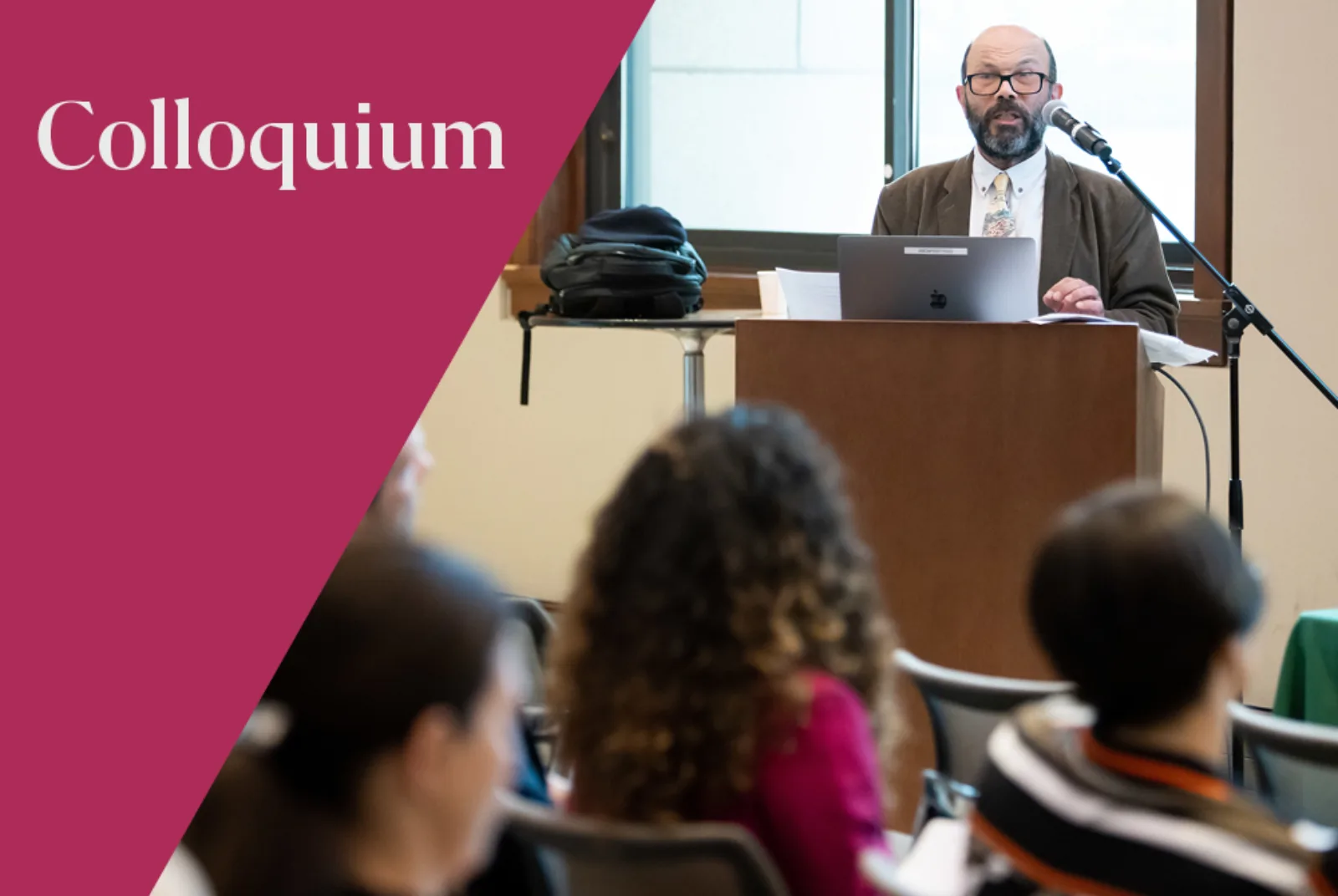
Colloquium is a weekly series of talks featuring staff, fellows, and scholars who are working with the library’s vast collections. These events bring together experts from various fields to share their research on a wide range of topics, followed by an opportunity for the audience to ask questions and engage in conversation.
Colloquium is open to the public and offers a chance to explore fascinating ideas and new discoveries. No advance registration is required.