Description
Scholars of medieval books regularly borrow from or share with archeology a vocabulary for investigating material culture. In this talk, I discuss why the archeological principle of stratigraphy – the accumulation of orderly, layered deposits – has attracted historians of the book and explain why this linear concept of time risks erasing from the codicological record certain histories of use. Adapting an approach from landscape archeology, I argue that studying codicological persistence enables manuscript scholars to investigate readerly engagements with books over long periods of time.
About the Speaker
Zachary Hines is Assistant Professor of English at Ohio State, where he specializes in Middle English literature, manuscript culture, and the history of books. His scholarship investigates how metaphors of materiality (and the materiality of metaphors) emerge in antiquarian and scholarly discourses about medieval manuscripts. His current project, called Edifying Books, narrates the forgotten histories of four canonical vernacular books, uncovering evidence of adaptation and reconfiguration by Renaissance readers who sought to improve them. The subjects of recent publications include the history of the Sir Gawain and the Green Knight manuscript; the production of William Caxton’s Chronicles of England (1480); and the intersections of book history and “Dark Academia.” With Arthur Bahr and Thomas C. Sawyer, Zach also edited an interdisciplinary special issue of English Language Notes, forthcoming this Spring, on “Metaphors of Compilation.” He is a Senior Fellow in the Andrew W. Mellon Society of Fellows in Critical Bibliography and helps to lead the Board of Directors for TEAMS, the Teaching Association for Medieval Studies.
About Colloquium
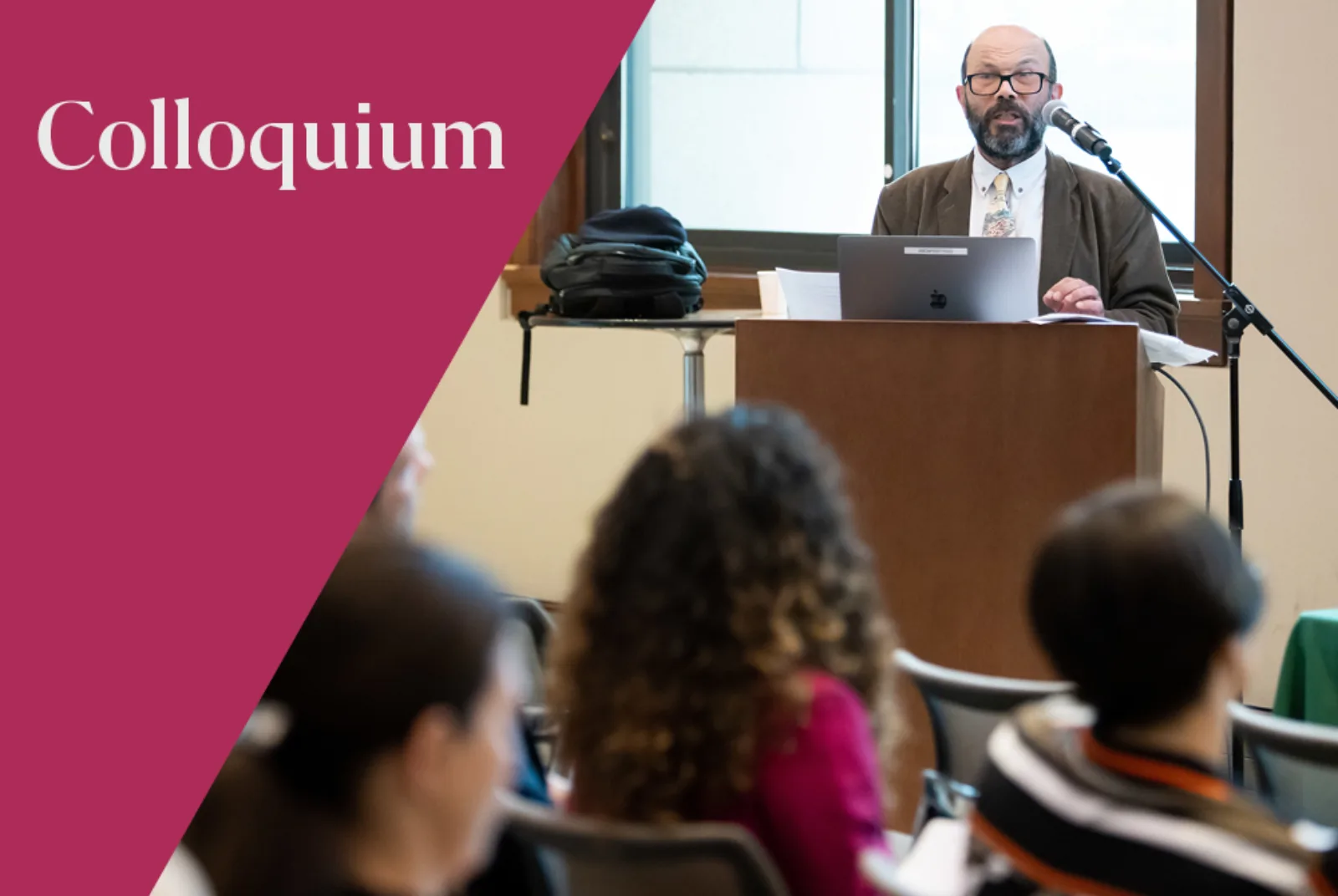
Colloquium is a weekly series of talks featuring staff, fellows, and scholars who are working with the library’s vast collections. These events bring together experts from various fields to share their research on a wide range of topics, followed by an opportunity for the audience to ask questions and engage in conversation.
Colloquium is open to the public and offers a chance to explore fascinating ideas and new discoveries. No advance registration is required.