Description
Several scholars of twentieth-century American legal history have recently argued that originalism—a method of constitutional interpretation commonly associated with the conservative legal movement—first emerged as southern Republicans and conservative Democrats (many of who were evangelical Protestants) reacted to the U.S. Supreme Court’s 1954 decision in Brown v. Board of Education. But southern opponents of Brown were not the only figures to have self-consciously introduced originalist ways of thinking about the Constitution into the nation’s legal vocabulary at mid-century. Indeed, this article reveals that, nearly a decade before Brown, Catholics hundreds of miles away from Selma and Little Rock similarly sought to convince their neighbors that the Constitution ought to be understood according to the intentions of its eighteenth-century drafters (or, when appropriate, its nineteenth-century amenders). And importantly, they did so not to undermine the Civil Rights Movement, but rather to ensure that the Court’s 1947 decision in Everson v. Board of Education would not stymie the American Catholic Church’s efforts to obtain public financial assistance for parochial schools.
In encouraging jurists, scholars, and voters to understand the First Amendment’s Religion Clauses through the lens of founding-era history, post-Everson Catholics became as responsible as anyone outside of the Supreme Court for originalism’s decisive (re-)shaping of the Religion Clauses during the next half-century. But this triumph of First Amendment originalism ultimately proved troubling to some as the conservative legal movement began to capture the federal judiciary in the 1980s. From the perspective of these critics, God’s natural law, not Thomas Jefferson’s metaphorical “wall of separation” between church and state, should determine the First Amendment’s meaning. In concluding, this article therefore suggests that Catholics initially turned to originalism to pragmatically vindicate their background philosophical and theological conceptions of religious liberty, but increasingly came to realize that originalism—to the extent that it relied on positivist assumptions about the nature of individual rights—was inadequate.
About the Speaker
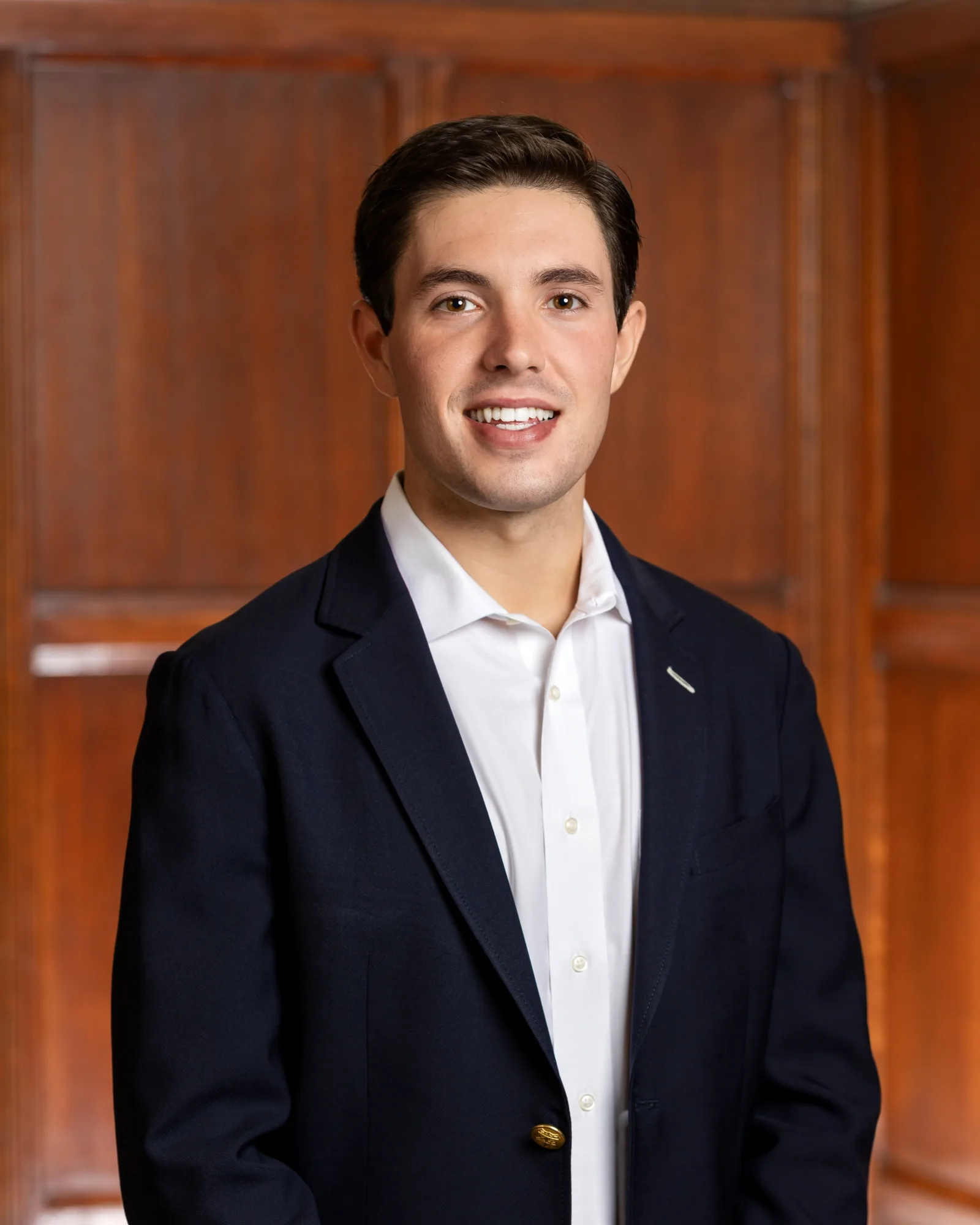
Dennis Wieboldt is a J.D./Ph.D. student in history at the University of Notre Dame, where he is a Richard and Peggy Notebaert Premier Fellow at the Graduate School and Edward J. Murphy Fellow at the Law School. The first Notre Dame student to concurrently pursue a J.D./Ph.D. in history, Dennis has authored more than a dozen scholarly articles and book chapters on religious liberty, civil rights, constitutional interpretation, and related subjects.
Dennis earned his B.A. summa cum laude and Phi Beta Kappa from Boston College, where he was recognized as a Dean’s Scholar and Scholar of the College. Among other undergraduate honors—including the Cardinal O’Connell Theology Award, History Czar Award, and Nicholas H. Woods Award for Student Leadership—Dennis received the 2022 McCarthy Prize in the Humanities, a distinction conferred upon the best thesis in the humanities by Boston College’s Morrissey College of Arts and Sciences. After earning his B.A., Dennis earned an M.A. in history from Boston College.
Commentator
Eric Wang, Emory University
About the Religion and Culture in the Americas Seminar Series
The Religion and Culture in the Americas Seminar explores topics in religion and culture including social history, biography, cultural studies, visual and material culture, urban studies, and the history of ideas. We are interested in how religious belief has affected society, rather than creedal or theological focused studies. Seminars are conversational and free and open to faculty, graduate students, and members of the public, who register in advance to request papers.
Registration
This event is free, but all participants must register in advance and space is limited. To register and request a copy of the pre-circulated paper, click below. Please do not request a paper unless you plan to attend.
Register and Request Paper