Description
In 1560 the God of the Geneva Bible declares Cain a “vagabond” as punishment for the murder of his brother Abel. Two years later Queen Elizabeth I issues the first anti-vagrancy statute of her reign, punishing runaway servants with branding and forced labor for the crime of not having a master to serve. In the early modern, to be masterless was to be like Cain, outside society, outside “the great chain of service."
My talk will attempt to tell part of the story of how an idea once synonymous with social death—"masterlessness"—transformed into something like "freedom." This is a story of rogues, rebels, servants, soldiers, beggars, devils, history’s first free-wage workers, and of writers grappling with the changing conditions of their own literary production at the moment of capitalism’s emergence. I explore “masterlessness” as the central challenge confronting early modern society as structures of service and patronage gave way to increasingly contingent modes of market-dominated labor. I recover the critically understudied early modern vocabulary of masterlessness as one of the period’s vital modes for theorizing order beyond feudal notions of service, and trace the evolution of this discourse to the modern and ubiquitous value of “freedom.”
Speaker
Juan Pedro Lamata is an Associate Professor in the Department of English at California State University-Los Angeles. He received his Ph.D. in Literature from Stanford University in 2020. Dr. Lamata specializes in early modern literature in English and Spanish, with a special focus on the interplay between emergent capitalist social relations and literary form.
He is currently working on a manuscript titled Masterless Renaissance: Freedom in the Double Sense from Utopia to Hell. This project attends to the undertheorized event and discourse of "masterlessness," the early modern period's central vocabulary for understanding the rise of an itinerant, wage-laboring proletariat. Dr. Lamata's work has appeared in Renaissance Studies and Intersectionalities of Class in Early Modern English Drama. He has taught courses such as "Shakespeare/Marx," "Renaissance Boderderlands," "Early Modern Literature and Early Capital," and "Shakespeare and Popular Culture." A one-time community organizer and current union and community activist, Dr. Lamata is committed to the right of all people to study, work, research, and live with dignity, and he hopes to one day see our very own CSULA leading the way as a true "People's University."
About Colloquium
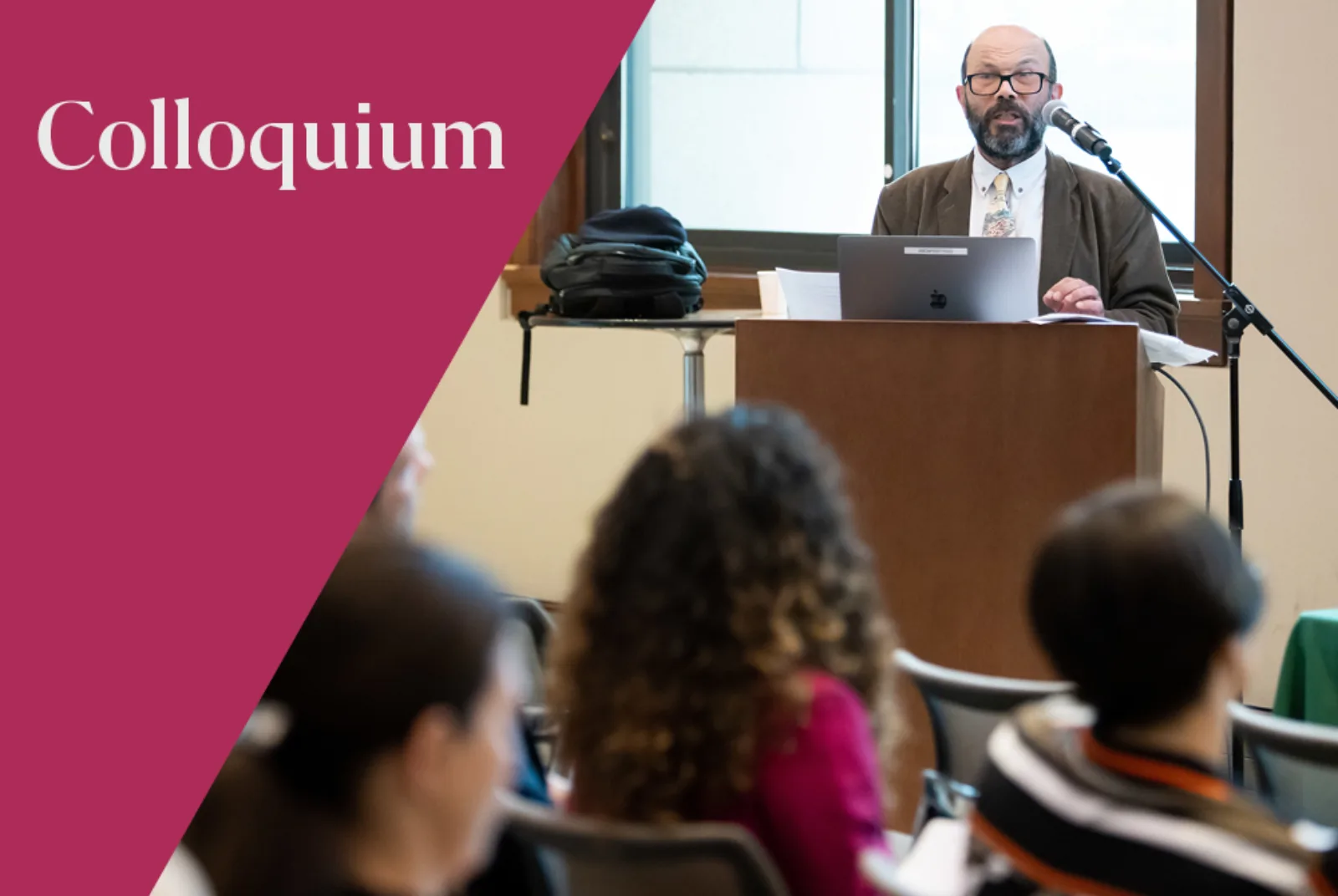
Colloquium is a weekly series of talks featuring staff, fellows, and scholars who are working with the library’s vast collections. These events bring together experts from various fields to share their research on a wide range of topics, followed by an opportunity for the audience to ask questions and engage in conversation.
Colloquium is open to the public and offers a chance to explore fascinating ideas and new discoveries. No advance registration is required.