Description
Syrian-Palestinian poet Ghayath Almadoun's 2017 Al-Halīb Al-Aswad (Black Milk) borrows its title from a master trope of the concentrationary university depicted in Paul Celan's "Todesfuge." In Al-Halīb Al-Aswad, Celan returns as phantom revenant among the Syrians marching from the Mediterranean coast northward on to Germany. His ghost confronts us with a range of questions about how genocide and its spectral afterlives continue to haunt the Arab present and how a certain strand of Holocaust remembrance has been exploited as a tool for unseeing global catastrophes—from the ongoing Nakba to the thousands of migrants left to drown in the Mediterranean. My essay—part on an ongoing suite of publications on the Arabic-language, particularly Palestinian, reception of Paul Celan—seeks to query the chronopolitics implied in the "after Auschwitz" episteme as well as the weaponization of its memory politics. How might the extravagant temporal figurations of an Arabic poem written "before" the Gazan genocide put into question the historical scissions that serve as an alibi for genocidal violence?
About the Speaker
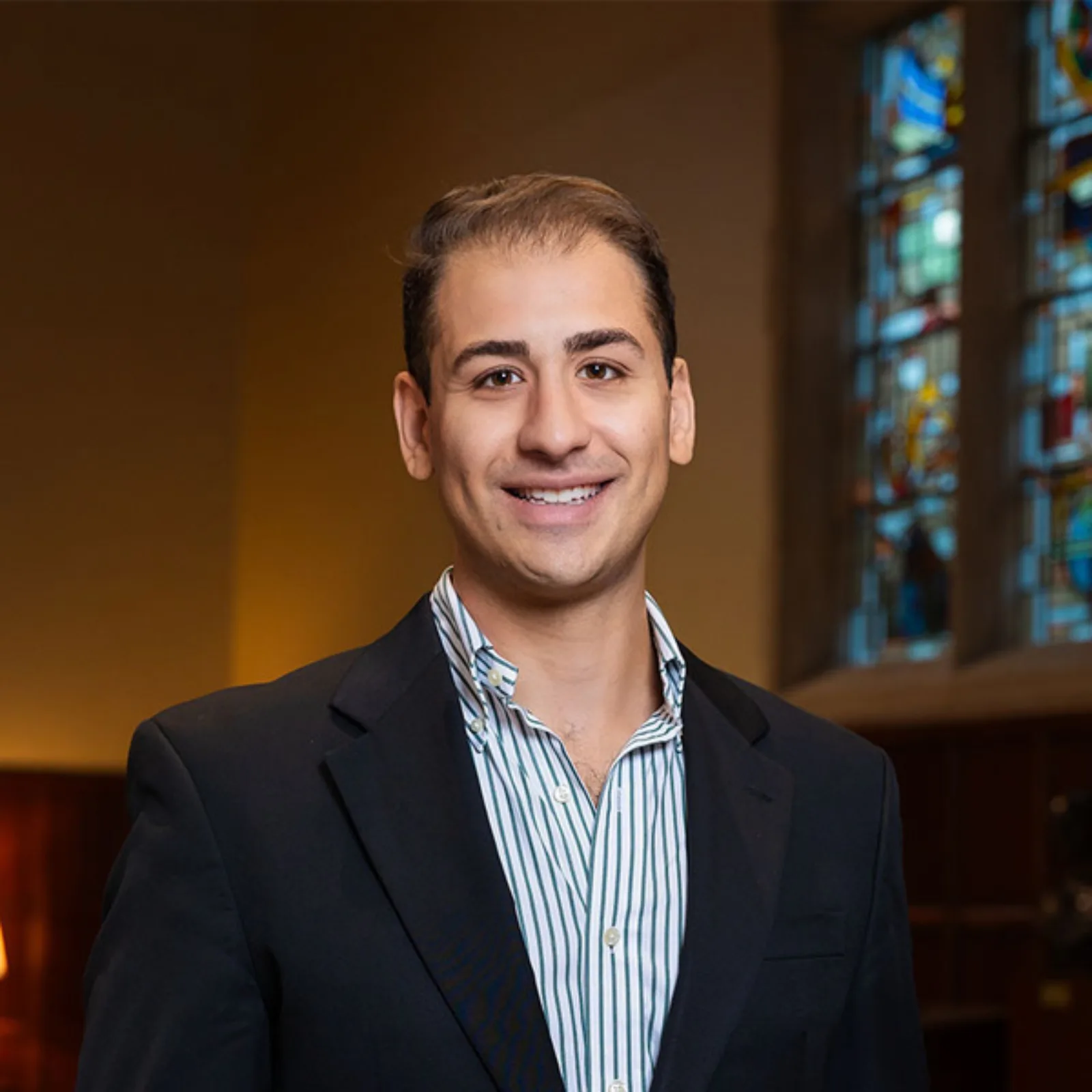
Peter Makhlouf is currently the Provost's Postdoctoral Fellow in the University of Notre Dame's Department of German, Slavic and Eurasian. Recent talks and publications (forthcoming in German Quarterly, Middle Eastern Literatures, and Jewish Currents) span the intersection of Palestinian literature and thought and the German-Jewish tradition. He has published widely on topics ancient, medieval and modern in both scholarly and public venues, and is currently completing his first monograph: Declinations: Stefan George's Secret Empire.
About the German Studies Seminar Series
The Newberry Library German Studies Seminar series provides a forum for scholarship-in-progress in the area of German studies. The seminar is particularly interested in papers that cross disciplinary boundaries and that reconceptualize the materials and conventions of German Studies as a field, including beyond the frames of the German language and nation state. Like all Newberry Scholarly Seminars, meetings are conversational and free and open to faculty, graduate students, and members of the public, who register in advance to request papers.
Register and Request Paper
This event is free, but all participants must register in advance. Space is limited, so please do not request a paper unless you plan to attend.
Register and Request Paper