Printing on Fabric
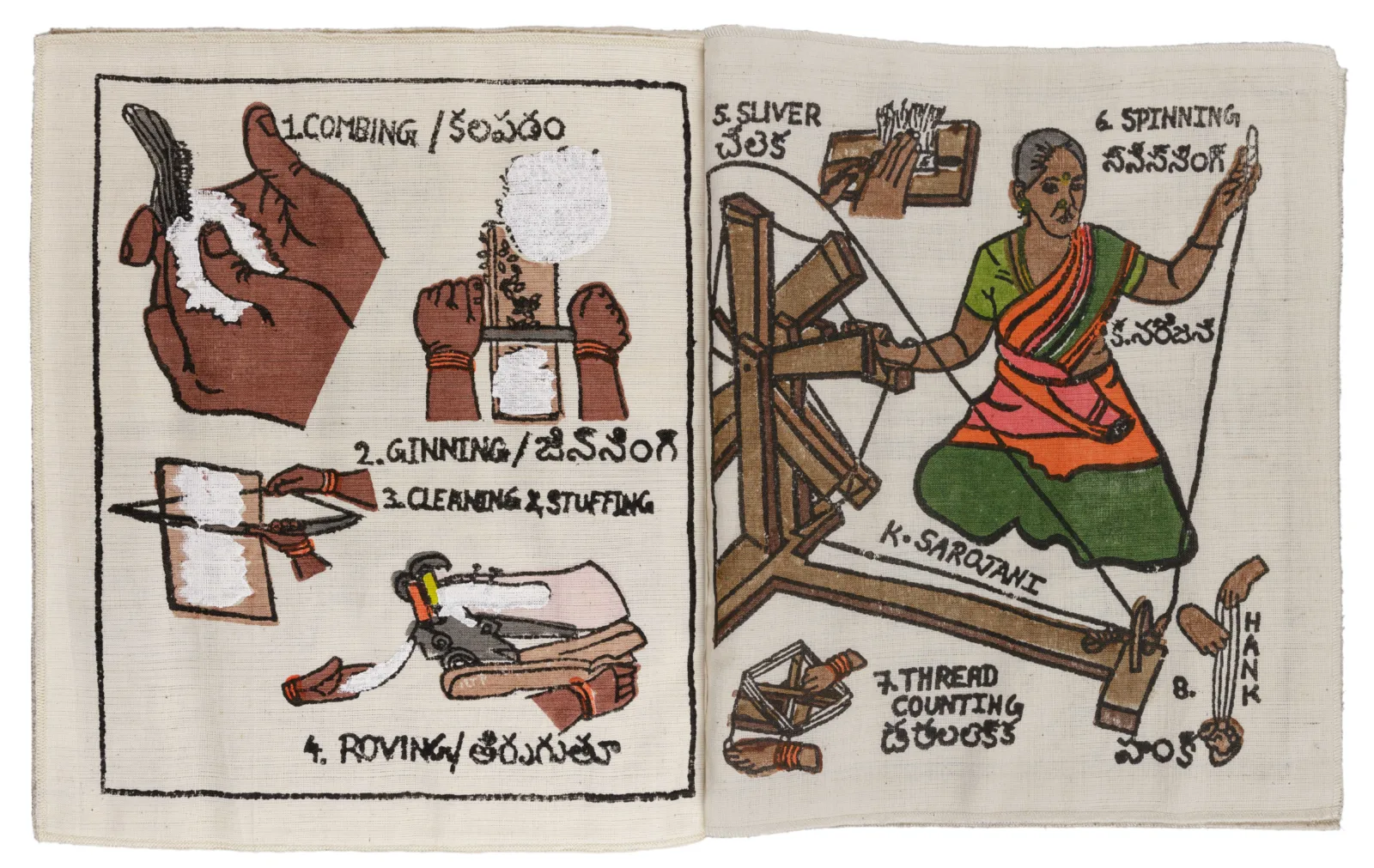
The Newberry holds primary and secondary sources related to the centuries-old art of printing images and text on textiles (instead of paper), including books, bindings, broadsides, textile sample books, handkerchiefs, maps, postcards, ribbons, Stevengraphs, and other ephemera.
Use the sections below to explore. Please call the reference desk at (312) 255-3512 with questions about our holdings, or contact a librarian with research questions.
(Illustrated above: Sinift, Aaron in collaboration with Kahakashan Khan, Jitendra Kumar, and Mr. Vijay Kumar Handa, Dreaming it Forward, 2024. Call number: Wing oversize ZPP 2063 .F49)
Newberry Library Catalog:
Search the online catalog by author, title, or keyword such as: fabric, textile, textile printing, cloth, silk, cotton, linen, Jacquard, Stevengraph, etc.
Choose “Held by Library” to find physical items held at the Newberry and Sort By to see the newest or oldest materials. Use the Advanced Search to search for multiple terms or phrases in different fields and to search for materials created during a specific year or range of years. For more information about searching the online catalog, please see our Guide to PrimoVE.
Modern Manuscripts & Archives at the Newberry: Search finding aids
Search by the keyword(s) suggested above or browse by topic or subjects and filter results for relevant terms, also including: John High Collection
Newberry Digital Collections: Search digitized collection items
Browse all and use relevant filters or search by the keyword(s) listed above.
Impressive Textiles: Printing on Fabric exhibition
Karr Schmidt, Suzanne, ed. Impressive Textiles: Printing on Fabric, Arizona Center for Medieval and Renaissance Studies Press, 2026. [Call number and Open Access links TBD.]
Speelberg, Femke, Fashion & Virtue: Textile Patterns and the Print Revolution, 1520-1620,
New York: The Metropolitan Museum of Art, 2015. Call number: Baskes folio NK8809.3 .S64 2015
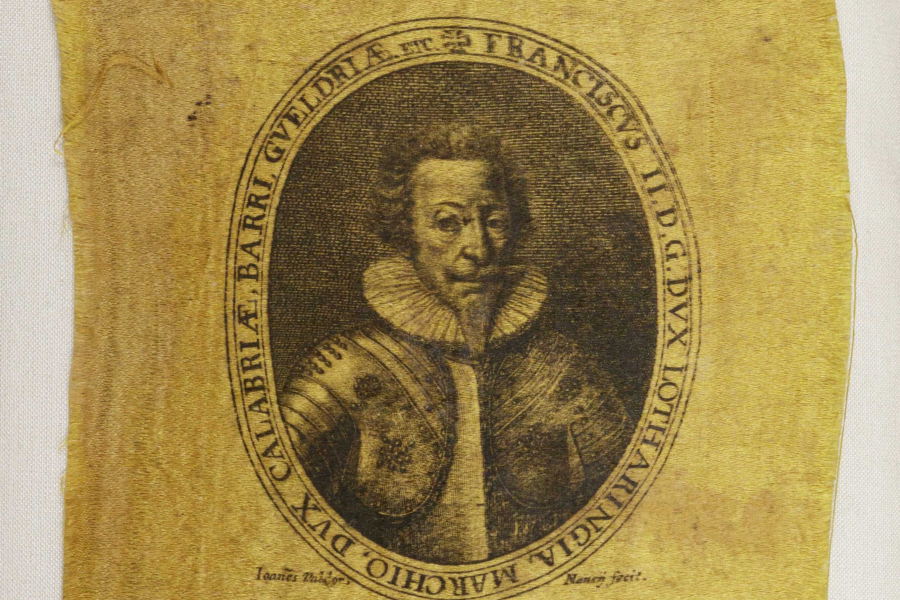
Silk Satin
Valdor, Jean. Parade Badge Portrait of the Duke of Lorraine, Nancy, France, 1625. Call number: Case oversize DC122.9.F67 V35 1625 (Illustrated above.)
Manuela Cerezo, PhD Thesis, Puebla, Mexico, 1746. Call number: Ayer artifacts cage oversize BC60 .F74 1746
FABS Postcards with chromolithographic silk satin swatches for quilts and other crafts. Bradford, United Kingdom, c. 1905: John High Collection
Linen
Dutch, Chalice veil with engraving of the Virgin and Child with Apostles, Netherlands, c. 1600-1620. Case oversize BX1925 .C43 1600
Cicero, De amicitia dialogus (On Friendship), Glasgow: Foulis Brothers, 1748. Call number: Wing ZP 743 .F805
Cotton
George Washington handkerchiefs, Germantown, Pennsylvania, c. 1806:
The Love of Truth: Mark the Boy (Young George with a Hatchet). Call number: Case oversize E312.2 .L68 1806
The Effect of Principle: Behold the Man (Elder Statesman George.) Call number: VAULT oversize Ruggles 578
Women's Rights “1981” scarf, Scotland, 1881. Call number: Case oversize HQ1236.5.G7 W66 1881
Sinift, Aaron in collaboration with Kahakashan Khan, Jitendra Kumar, and Mr. Vijay Kumar Handa, Dreaming It Forward, India, 2024. Call number: Wing oversize ZPP 2063 .F49
Note that this guide is not meant to be exhaustive; additional materials may be discovered and accessed via the Newberry’s catalogs.
Many collection materials have been digitized and can be viewed directly in our Digital Collections and Spotlight. For access to physical materials, please refer to guidelines for using the collections in person on the Newberry’s website.
The following definitions are from the Glossary, in Karr Schmidt, Suzanne, ed. Impressive Textiles: Printing on Fabric, Arizona Center for Medieval and Renaissance Studies Press, 2026. Open Access link TBD.
Printmaking
Print: An image or text produced in multiple by inking a matrix (surface), covering it with paper, fabric, vellum, or other materials, and adding pressure so the image is transferred to the substrate (material) through direct contact. While letterpress and woodblock printing practices originated in Asia, European techniques developed before 1800 include relief, intaglio, and lithography. Printing on fabric remains experimental, often designed without repeat patterning.
Intaglio: the printing of mainly images from metal plates with lines engraved, etched, or burnished into them (Engraving/Etching/Mezzotint)
Platemark: an impression of the printing plate edge, visible on paper, and sometimes on fabric
Relief: the printing from woodblocks, metalcuts, or letterpress
Fabric
Textile/Fabric/Cloth: Commonly used, interchangeable terms to describe materials made from fibers and yarns, constructed by means of weaving, felting, knitting, and other techniques.
Cotton: a cellulosic seed fiber from the boll of cotton plants, with many global and historical varieties
Linen: a cellulosic bast fiber from the stems of flax plants, with many global and historical varieties
Silk: a proteinaceous filament fiber from silk moths, most typically from the domesticated silk moth
Weave patterns
Plain weave: a structure where each yarn passes over one yarn before going under the next yarn, with an identical appearance on both sides
Satin: a structure where each yarn passes over four or more yarns before going under one yarn in a stepped pattern, creating a surface of long floats on one side of the fabric, and, especially with silk satin, a more matte surface on the other
The following definitions are from A Glossary of Archival and Records Terminology copyrighted by the Society of American Archivists. Consult the glossary for 2,000+ additional entries.
Archives: 1. Materials created or received by a person, family, or organization, public or private, in the conduct of their affairs and preserved because of the enduring value contained in the information they contain or as evidence of the functions and responsibilities of their creator, especially those materials maintained using the principles of provenance, original order, and collective control; permanent records. - 2. The division within an organization responsible for maintaining the organization's records of enduring value. - 3. An organization that collects the records of individuals, families, or other organizations; a collecting archives. - 4. The professional discipline of administering such collections and organizations. - 5. The building (or portion thereof) housing archival collections. - 6. A published collection of scholarly papers, especially as a periodical.
Archival description: 1. The process of analyzing, organizing, and recording details about the formal elements of a record or collection of records, such as creator, title, dates, extent, and contents, to facilitate the work's identification, management, and understanding. - 2. The product of such a process.
Administrative Records: A document that has been preserved because it facilitates the operations and management of an agency, but which does not relate directly to programs that help the agency achieve its mission.
EAD (encoded archival description): A standard used to mark up (encode) finding aids that reflects the hierarchical nature of archival collections and that provides a structure for describing the whole of a collection, as well as its components.
Ephemera: Materials, usually printed documents, created for a specific, limited purpose, and generally designed to be discarded after use.
Finding aid: 1. A tool that facilitates discovery of information within a collection of records. -2. A description of records that gives the repository physical and intellectual control over the materials and that assists users to gain access to and understand the materials.
Inventory: 1. A list of things. - 2. Description · A finding aid that includes, at a minimum, a list of the series in a collection. - 3. Records management · The process of surveying the records in an office, typically at the series level.
Primary source: Material that contains firsthand accounts of events and that was created contemporaneous to those events or later recalled by an eyewitness.
Provenance: 1. The origin or source of something. - 2. Information regarding the origins, custody, and ownership of an item or collection.
Rights management: A system that identifies intellectual property rights relevant to particular works and that can provide individuals with access to those works on the basis of permissions to the individuals.
Secondary source: 1. A work that is not based on direct observation of or evidence directly associated with the subject, but instead relies on sources of information. - 2. A work commenting on another work (primary sources), such as reviews, criticism, and commentaries.
Scope and Content: A narrative statement summarizing the characteristics of the described materials, the functions and activities that produced them, and the types of information contained therein.