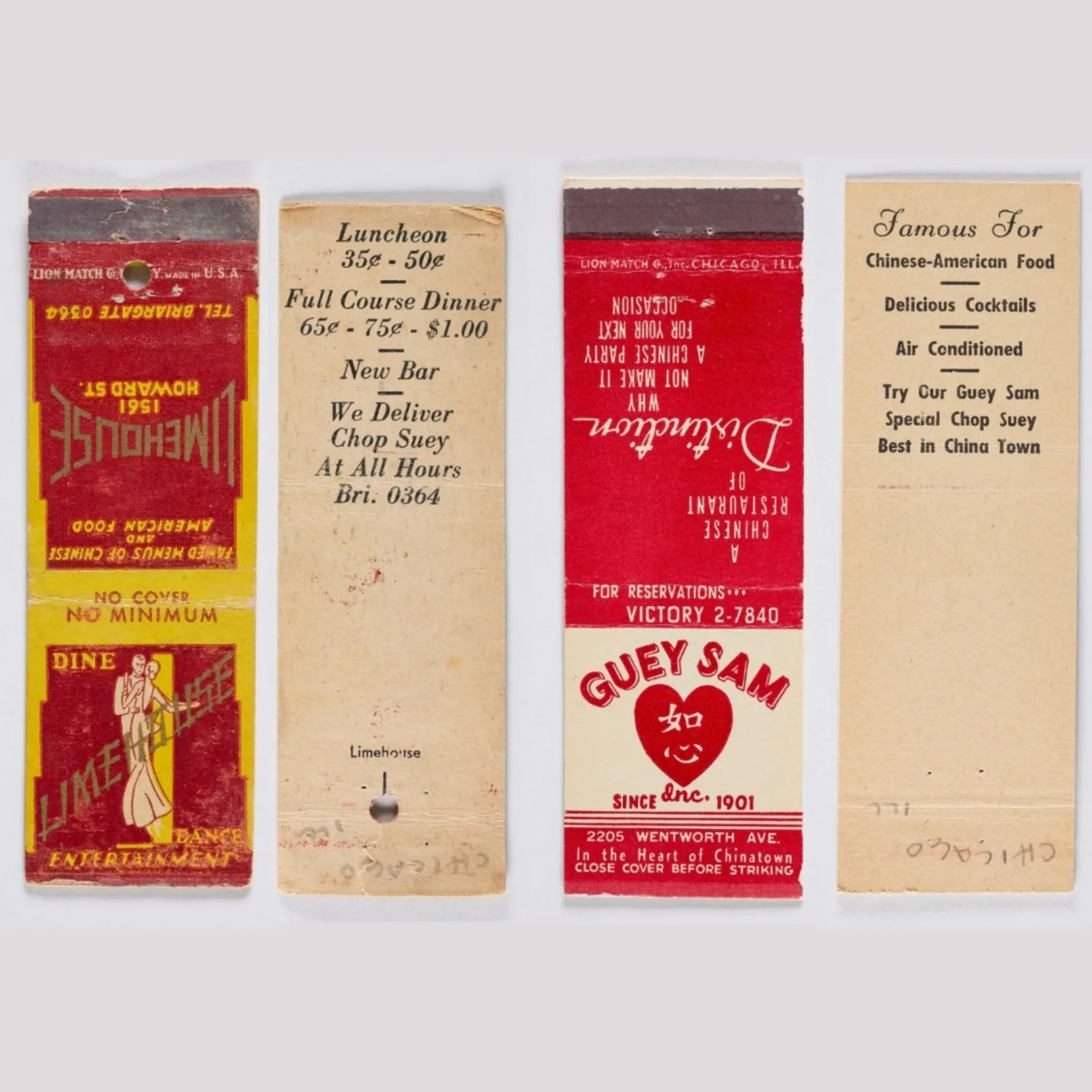
Around 1940, a night out at the Limehouse on Howard Street could mean dinner, dancing, and a live orchestra. The restaurant’s matchbook promised “famed menus of Chinese and American food,” luncheon for 35 cents, a full-course dinner for as little as 65 cents, and chop suey delivered “at all hours.”
The name was borrowed from Limehouse, London’s original Chinatown, which by then had become shorthand for exotic and slightly dangerous nightlife. But the restaurant itself was reportedly co-owned by Benjamin Joe, who had immigrated from China in 1917. On a few square inches of cardboard, the Limehouse matchbook captures both a real business and the image it chose to sell, and it’s one of thousands in the Newberry’s Asian American and Pacific Islander Restaurant Matchbook Collection, acquired by the library in 2025. In fact, The New York Times featured the collection in a piece on the New York Antiquarian Book Fair in 2024.
A tiny archive of American dining
The collection holds more than 3,000 matchbook covers from restaurants across the United States and Canada, dating from roughly the 1920s through the 1970s, and the vast majority come from Chinese American restaurants. Some are simple ads. Others are miniature works of graphic design, with colorful lettering, restaurant illustrations, maps, and portraits of proprietors. Together, they show how restaurants promoted themselves, drew in customers, and became fixtures of their neighborhoods, and they preserve traces of many businesses that have long since closed.
For many American families, the holidays now include a meal at a Chinese restaurant, often one of the few places open on Thanksgiving and Christmas. But that familiar place in American dining was hard-won. In “The War Against Chinese Restaurants,” legal scholars Gabriel J. Chin and John Ormonde document a national campaign in the late nineteenth and early twentieth centuries to drive Chinese restaurants out of business. Labor unions organized boycotts and pushed for laws barring white women from working in Asian restaurants, and cities used licensing and zoning against them. Chicago was among them. Most of these efforts failed: as one union organizer complained, many union men had “a fancy for chop suey.”
Chinese restaurants’ holiday hours are part of that story. Many early restaurateurs weren’t Christian and had little reason to close on Christmas, and for decades their dining rooms welcomed customers turned away elsewhere, including Jewish and African American diners.
A note about historical imagery
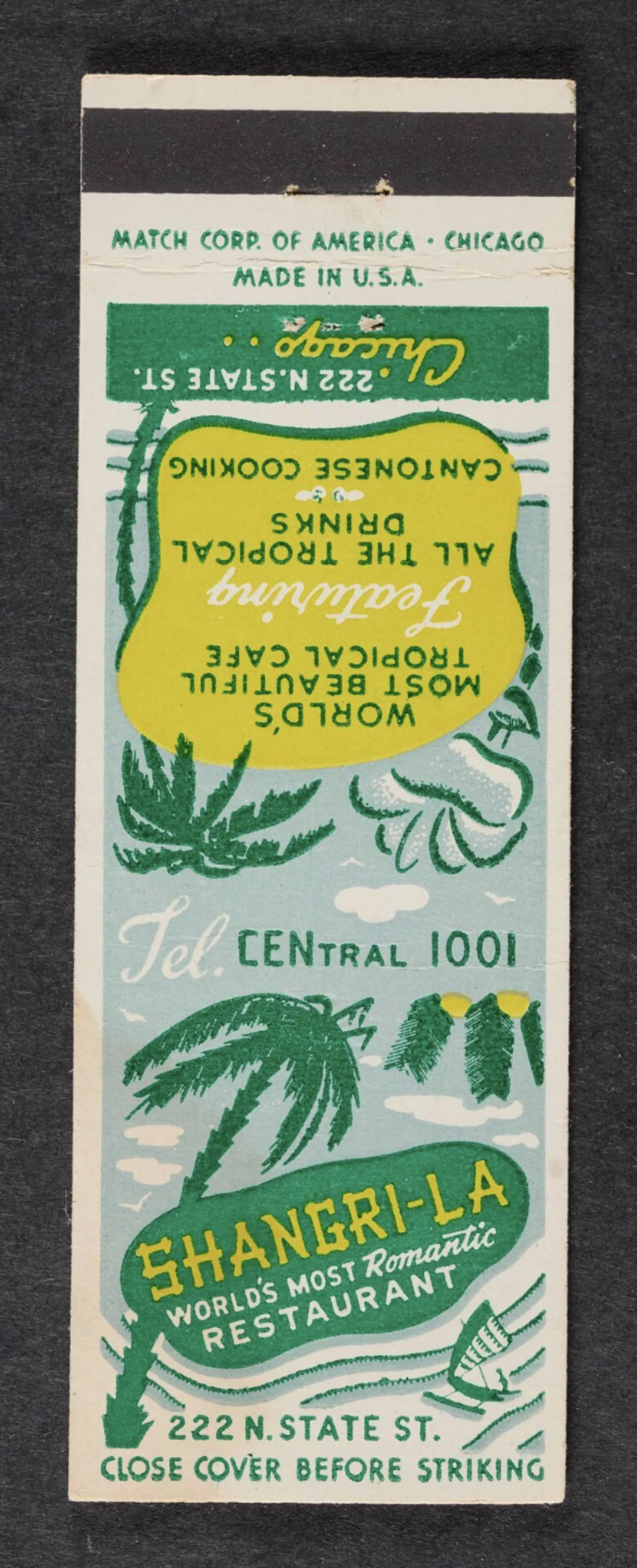
Some matchbooks contain racial stereotypes or generalized representations of Asian and Pacific cultures. Their designs often blend visual traditions: a Chinese restaurant might use Japanese-associated imagery such as geisha or kimono-clad women, or mix Chinese, Japanese, Polynesian, and other motifs. The Limehouse name is one example. Shangri-La on State Street, which called itself “the World’s Most Romantic Restaurant,” paired Cantonese food with palm trees and tropical branding.
These combinations reveal how restaurants, advertisers, designers, and printers used a generalized visual language of “Asianness” to appeal to American customers. Rather than treating them as mistakes or passing over them, we ask volunteers to identify and describe these features, because the representations are themselves important historical evidence for studying advertising, restaurants, race, ethnicity, and visual culture. Our approach follows the Newberry’s Statement on Harmful Content and Descriptions.
Help us uncover the details
The collection has been digitized, but it isn’t yet searchable by restaurant. Right now, the only detail recorded for each matchbook is its state or province. The names, addresses, and other details are printed right there on the covers, but transcribing them for more than 3,000 matchbooks is more than our staff can take on alone.
That’s where Newberry Image Tag comes in. Our new crowdsourcing project on Zooniverse launches November 20, starting with a pilot focused on Illinois restaurants. Volunteers look at a matchbook cover, transcribe details like restaurant names, addresses, and phone numbers, and add tags describing the images. We’ll use their contributions to make individual matchbooks searchable in the Newberry’s digital collections, and after the pilot, we’ll expand to the rest of the collection.
What’s in a phone number?
Most of the matchbooks aren’t dated, but many carry a clue in plain sight. Chicago phone numbers changed format in 1948, from a three-letter exchange plus four digits to two letters plus five digits, and later to all numbers. A 1945 Chicago nightlife guide lists Guey Sam’s number as “Vic. 7840”; the matchbook above reads “Victory 2-7840,” so it was printed after the switch. ZIP codes, which arrived in 1963, offer another clue.
That’s why we ask volunteers to type phone numbers exactly as printed. With enough of them, we hope to estimate dates for individual matchbooks across the collection.
Join in
Participating is free and takes just a few minutes. No Zooniverse account or special experience is needed. You might recognize a long-gone neighborhood favorite, discover an unfamiliar piece of local history, or simply enjoy some wonderfully inventive mid-century design. The project also works well as a classroom activity, giving students hands-on experience with historical sources.
Whether you’re interested in food history, graphic design, or solving small historical mysteries, we’d love your help!
Join Newberry Image Tag on Zooniverse
Explore the Asian American and Pacific Islander Restaurant Matchbook Collection
About the Author
Jen Wolfe is the Newberry's Digital Scholarship and Outreach Librarian.