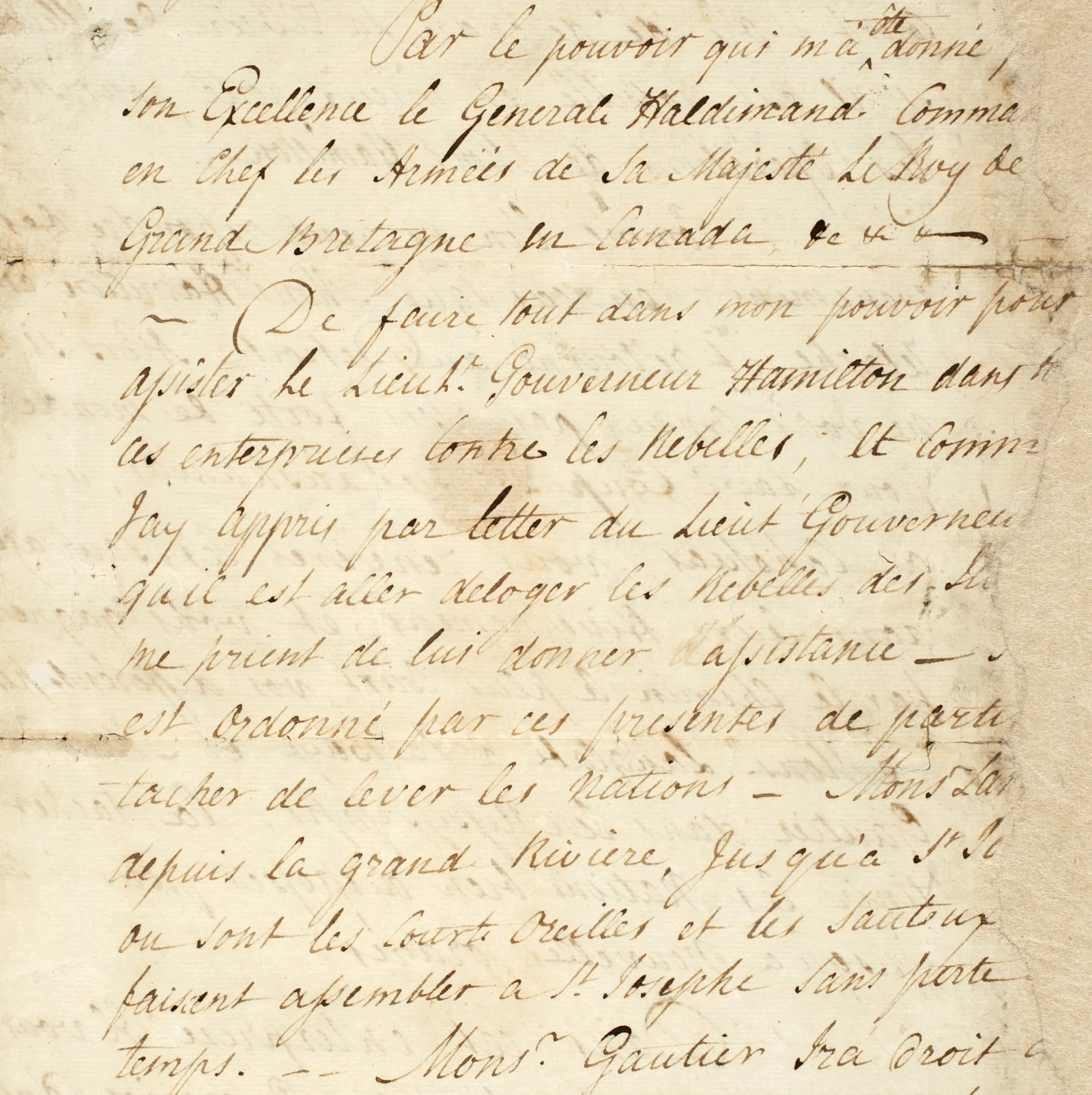
Though hardly a household name, Arent Schuyler De Peyster was an important figure in the Revolutionary War—and especially for the western theater of war in the Great Lakes region. Born into a wealthy, aristocratic family in 1736 in the colony of New York, he became a British military officer and maintained his allegiance to the British throughout the Revolutionary conflict.
As commandant of Fort Michilimackinac, where Lakes Michigan and Huron meet, De Peyster played a critical role in maintaining and strengthening the British alliances with Indigenous peoples in the region—especially the Neshnabék (Potawatomi, Odawa, and Ojibwe) and Očeti Šakówiŋ (or Sioux). These alliances were crucial to the British presence on the continent, given the strategic and economic importance of the Great Lakes and Mississippi River, and given that Indigenous people vastly outnumbered British, American, and French colonists in the region.
In a letter of instruction dated October 26, 1778 and held by the Newberry, De Peyster, in French, orders Captain Charles Langlade (formerly a French officer and fur trader) and his nephew, Lieutenant Charles Gautier de Verville, to help assemble a force of Potawatomi warriors at Fort St. Joseph, Michigan (present-day Niles, Michigan), and to travel to Illinois to join Henry Hamilton, Lieutenant Governor of Detroit, in rooting out rebel sympathizers there. Among those accused of (and eventually imprisoned for) sympathizing and supporting the Americans was Jean Baptiste Pointe de Sable, later to become famous as the first permanent non-Indigenous settler in Chicago.
Many years after his service at Forts Michilimackinac and Detroit during the Revolutionary War, and after his retirement to Scotland, De Peyster penned a volume of poetry, essays, and reminiscences, simply titled Miscellanies (Dumfries, Scotland: C. Munro & Co., 1813). De Peyster includes a lengthy poem entitled “Speech to the Western Indians,” which purports to be a versification of the speech he delivered at a council on July 4, 1779, at the Odawa town of Waganagisi, also known as L’Arbre Croche, in northern Michigan.
It is in this poem, and a footnote to it, that the first known printed reference to Pointe de Sable appears:
“Eghittawas smiles at the notion
Of Kissegouit, brave Neotochin.
Swift Neogad, fierce Scherroschong,
And Glode, the son of Vieux Carong
Those runagates at Milwakie,
Must now per force with you agree,
Sly Siggenaak and Naakewoin,
Must with Langlade their forces join;
Or, he will send them tout aut diable,
As he did Baptist Point de Saible.”
In his footnote, De Peyster refers to Pointe de Sable as “A handsome Negro, (well educated and settled at Eschecagou,) but much in the French interest.” Pointe de Sable was, indeed, sent “to the devil” in 1779—arrested as a suspected supporter of the Americans, he was imprisoned at Fort Michilimackinac for a time before being put to work for the British in Michigan, finally returning to the foot of Lake Michigan after the American victory. Historians still debate whether Pointe de Sable was already established in Chicago in the 1770s; other evidence seems to suggest that De Peyster’s footnote is mistaken or misleading about the timing, and that he was at this time in Indiana, at what is now known as Michigan City, not settling in Chicago until the 1780s.
Will Hansen is Curator of Americana and Roger and Julie Baskes Vice President for Collections and Library Services at the Newberry.