The United States at 250
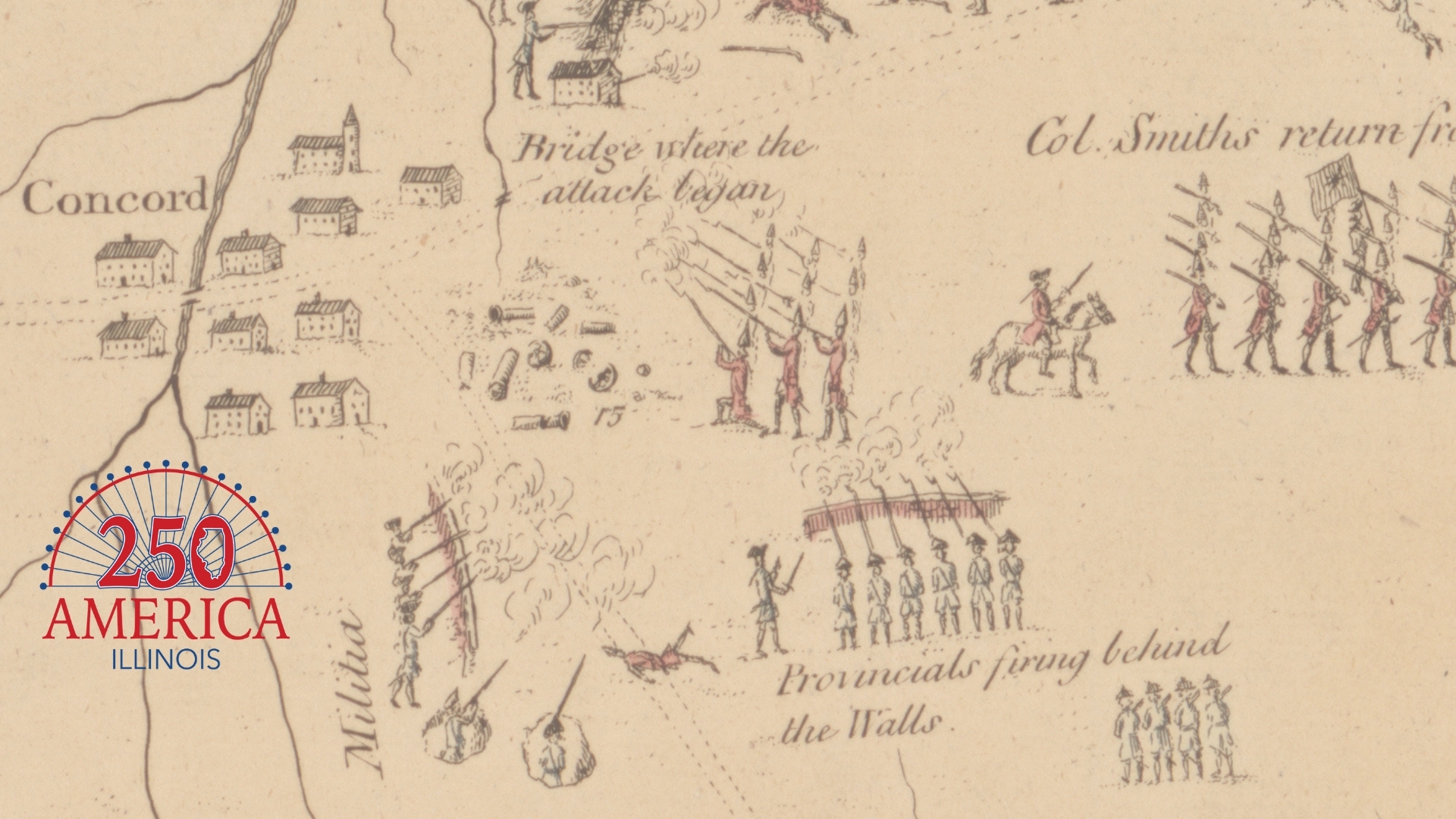
Throughout 2026, the Newberry will be commemorating America’s semiquincentennial—the 250th anniversary of the signing of the Declaration of Independence. Join us this year for a firsthand glimpse at the founding of the United States and for an exploration of the themes that have been present from the late 1700s through today.
The Newberry is proud to be a partner in Illinois America 250, an inclusive, statewide effort to bring together Illinoisans’ diverse perspectives about our history–and our future. Illinois America 250 has created a passport that highlights landmarks throughout the state.
The Newberry features many collecting areas relevant to early American history, from founding documents to Native American history, the westward expansion of the United States, the Civil War and Reconstruction, African American history, and American literature. Our collection materials include over 700 American Revolutionary pamphlets, and Thomas Jefferson’s annotated copy of The Federalist.
*A short narrative of the horrid massacre in Boston: perpetrated in the evening of the fifth day of March 1770. London: W. Bingley, 1770. Case 4A 1151.
Boston, December 17, 1773 : at a meeting of the people of Boston, and the neighboring towns at the Old South Meeting House in Boston… Boston: Edes and Gill, 1773. Vault Ruggles 35.
This very rare broadside gives an account of the dramatic events directly leading to the Boston Tea Party.
This is a reprint of the earlier editions of this narrative, printed in Boston (which the Newberry also holds; see Case E215.4 .B75 1770 and Case F 8441 .097, as well as the newspaper report in Wing broadside ZP 783 .E231). This edition is notable for its large folding frontispiece, derived from the famous Paul Revere image of the “Massacre.”
Journal of the proceedings of the Congress, held at Philadelphia, September 5, 1774. Philadelphia: William and Thomas Bradford, 1774. Vault Ruggles 345.
The first edition of the proceedings of the first Continental Congress, the body coordinating the colonies’ response to the “intolerable acts” imposed by the British in response to the Boston Tea Party.
A declaration by the representatives of the United Colonies of North-America, now met in general congress at Philadelphia: setting forth the causes and necessity of their taking up arms. Philadelphia: William and Thomas Bradford, 1775. Vault Ruggles 346 and Vault Ruggles 347.
The less famous declaration from July 6, 1775, written by John Dickinson after a draft by Thomas Jefferson in the aftermath of the Battle of Bunker Hill. It stops short of declaring independence but insists on the resolve of the colonists to defend their rights.
*Benjamin Stevens, Ticonderoga journal. February 19-May 26, 1776. Vault Case MS 5A 9.
A manuscript journal kept by a Connecticut soldier in the Continental Army defending Fort Ticonderoga in northern New York, including experiences as a prisoner of war captured by the British and their Indigenous allies.
*In Congress, July 4, 1776. A declaration by the representatives of the United States of America, in General Congress assembled…. Newport, RI: Samuel Southwick, July 13, 1776. Case broadside E221 .U57 1776.
Rhode Island broadside printing of the Declaration of Independence, printed just nine days after the 4th. It includes a notorious typo indicating that it was printed on June 13 rather than July 13. These printings of the Declaration predate the engrossed, signed copy that is now thought of as the “original” handwritten document on display in D.C.
Oath of allegiance of the Micmac tribe. 1778. Vault box Ayer MS 3134.
A contemporary manuscript copy of an oath of allegiance to King George III, taken by forty-one representatives of the Micmac or Mi’kmaq people at Mengouèche near Fort Howe (now Saint John, New Brunswick). One of many manuscript documents at the Newberry illustrating the importance of Indigenous people as allies on both sides of the conflict as well as strategic actors for their own interests.
The American Military Pocket Atlas, London: R. Sayer and J. Bennett, 1776, Vault Ruggles 9.
The famous “holster atlas,” designed for use in the field by British military officers and to be carried in pocket (or holster).
Sir Henry Clinton, atlas of battle plans. 1776-1783 (assembled ca 1783). Map4F 3701.S3 (various) and Map 7C 5.
A unique made-to-order atlas of 29 maps and plans for battles during the American Revolution, assembled for British General Henry Clinton.
Arent Schuyler De Peyster, Miscellanies. Dumfries, Scotland: C. Munro, 1813. folio Graff 1057.
This book by a British officer in charge of Forts Detroit and Michilimackinac during the Revolutionary War contains, in a footnote to a poem, the first published reference to Jean Baptiste Point DuSable. The Newberry also holds a letter by De Peyster instructing subordinates to travel to the Illinois country to investigate American sympathizers in 1778; in 1779, DuSable was arrested on suspicion of these charges. (Read a blog post on this item here.)
*Items denoted with an asterisk will be on view in the exhibition, Free and Independent, from April 9 through July 18. They will be unavailable to patrons through the reading rooms until late 2026.
Free and Independent: The Declaration of Independence and the Words that Made the United States
Hanson Gallery
April 9 – July 18
Curator: Eric Slauter, University of Chicago
Trienens Gallery
June 11 – September 19
Curator: Margaret Storey, DePaul University
Public Programs
Coffee Nation: How One Commodity Transformed the Early United States
Author Michelle McDonald in conversation with Eric Slauter
Thursday, May 7, 6pm
Brewing the Revolution: Enslaved Labor and Early American Beer
Lecture by scholar Travis Rupp and beer release
Friday, May 8, 6:30pm
Annual Colonial History Program: The Declaration of Independence*
Featuring scholar/author Danielle Allen and Scott Stephenson, in partnership with Society of Colonial Wars
Saturday, June 6, 2pm
*In partnership with the Museum of the American Revolution, a hand-sewn replica of General George Washington's dining tent will be on display in Washington Square Park from 10am to 4pm.
Picturing the News: A Panel Discussion with Political Cartoonists
Join a panel of political cartoonists in discussion about the role of cartoons in interpreting the news in a democracy and the ways that the current media landscape is influencing the artform.
Thursday, June 18, 6pm
A Statewide and National Reading of the Declaration of Independence
A live, simultaneous public reading of the Declaration of Independence with one and all in Chicago and across the country.
Wednesday, July 8, 5pm
NewberryFest: 250 Years of the United States
Come face-to-face with extraordinary items from our collection that are related to the Revolutionary period and its echoes over the past 250 years.
Saturday, July 18, 10am-2pm
Gardens of Resilience: A Panel Discussion
Exploring themes of resilience, agency, and hope, the conversation will amplify temporary exhibitions currently on view at the Newberry Library and the Chicago Botanic Garden which reflect on 250 years of American independence.
Thursday, August 27, 6pm-7pm
Teacher Programs
The French Revolution: Gender, Race, and Ethnicity
Thursday, January 29, 9:30am-12:30pm
Teaching the American Revolution at 250
Thursday, February 19, 9:30am-12:30pm
Teaching Reconstruction with *Freedom Was in Sight!*
Thursday, February 26, 9:30am-12:30pm
Teaching the American Revolution at 250
Friday, March 20, 9:30am-12:30pm
250 Years of Teaching with Maps
July 13 through 31, 2026
Bringing Premodern Studies to K-12 Classrooms: Reflecting on America 250
October 23, 9:30am-4:30pm
Adult Education
America’s Birth Certificate: The Declaration of Independence
Weekly on Wednesdays, April 22 through May 13, 5:30-7:30pm
Digitized Primary Sources
This diverse digital gallery of primary sources is a companion to the Newberry exhibition Free and Independent: The Declaration of Independence and the Words That Made the United States.
Digital Collections for the Classroom
- New Lessons for a New Empire
- Literature of the American Civil War
- Nineteenth-Century Currency
- US Imperialism in the Philippines
- Black Labor and the Great Migration
- Indigenous Chicago
Research Guides
The Newberry is an especially rich resource for the study of early American history, including perspectives of Indigenous and enslaved people as well as colonists, settlers, and citizens.
The Newberry maintains a list of scholarly and other publications about the library’s collections in American History.
Explore Revolutionary-period selections in our Bookshop! We have a curated set of items that complement our exhibition, Free and Independent: The Declaration of Independence and the Words That Made the United States. Available in-person and online.
Featured Events
Blog—Source Material
De Peyster and de Sable
Revolutionary War letter dated October 26, 1778, has tie to Jean Baptiste Pointe de Sable.
Learn MoreGet Involved
Blog—Source Material
“The Painter of the Presidents” Finds a Home at the Newberry
George P.A. Healy painted Arthur, Grant, Lincoln, and many more.
Learn More