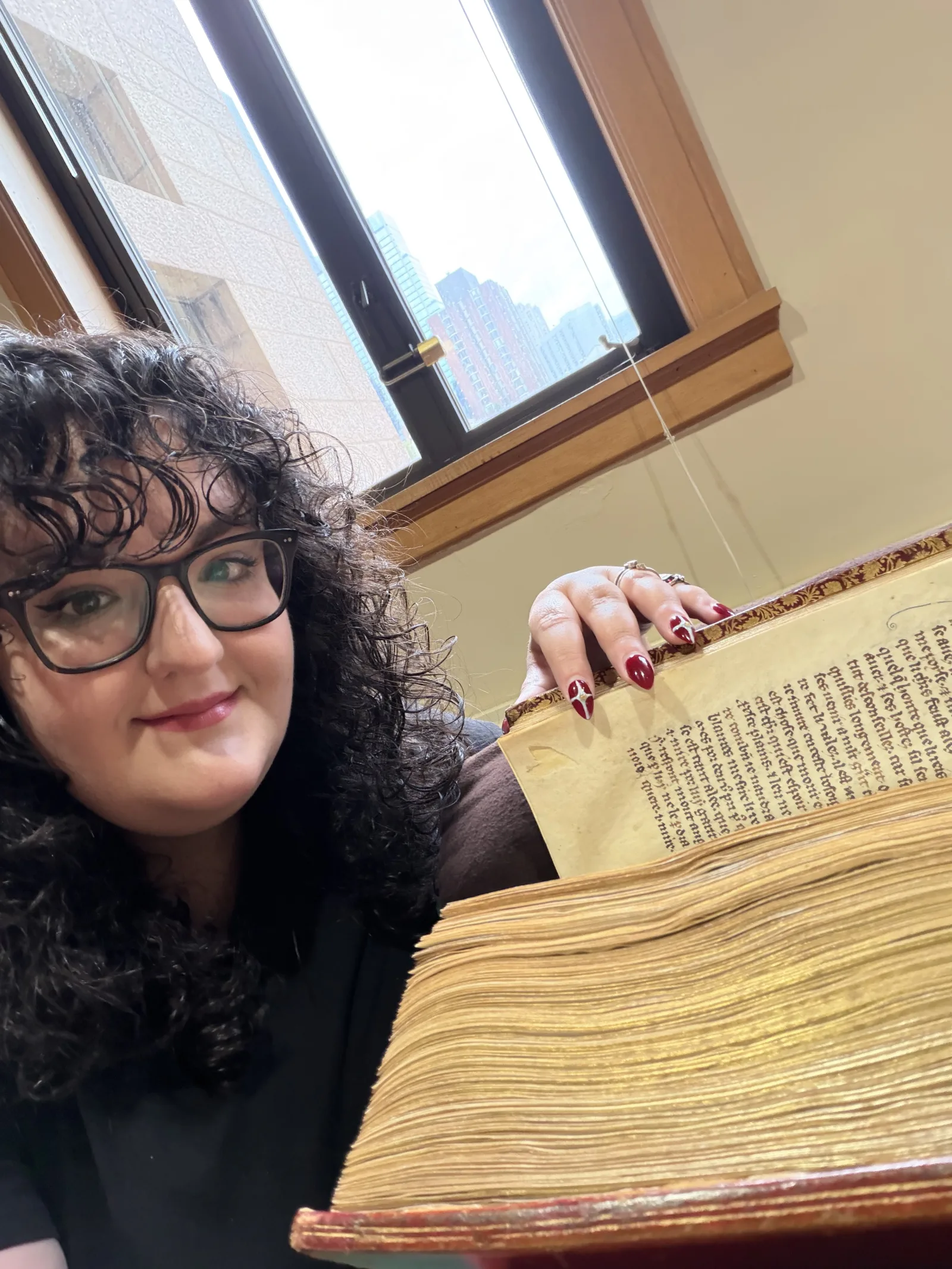
I recently had the pleasure of participating in the Recovering Hidden Histories seminar in which participants examined whose stories are suppressed in archives, how they are hidden, and how we as researchers can give them the proper attention they deserve. While I poured over MS 43, a stunning Book of Hours, and the Apocoalypsis Scanti Johannis block book to search for depictions of monstrous Jews, I couldn't help but think of comic books. Comics so vividly mark morality through character's distinct costuming, their clear story progressions through page planning, and eye-catching designs to keep the reader invested. There's no way I would see manuscripts the same way others read the Amazing Spider-Man comics if it weren't for my continuing relationship with the Newberry's CRS.
The first program I partook in as a medievalist was the 2024 Multidisciplinary Graduate Student Conference in Pre-Modern Studies. At the time as I nervous talked about disability in Bisclavret, I took the Middle Ages too seriously and saw it as something only those within the academy could access. Afterall, I hadn't been told differently. Yet, as the conference continued, I not only saw how much Lia, Chris, and Dylan of the CRS loved sharing the pre-modern world with anyone they could, but how much joy the graduate organizers shone with while sharing items from the collection. It was then I knew I wanted to be part of the Newberry's sharing spirit.
From there, the "Year of Julia" began. Granted, it's been more than a year at this point, but that Year was filled with my repeated participation at the Newberry's programs. A course on print culture and history showed me that I, a literary medievalist, could too dabble in art history confidently (and become more stylish as I was influenced by art historians who are now dear friends). Cartooning the Medieval later that summer brought medievalists and cartoonists together — the coolest people — and led me to collaborate with a cartoonist I met there on a Bisclavret comic that came out of my first paper I gave at the Newberry. The week after, I found myself at the MET Cloisters on their 100th anniversary as I attended a workshop called The Medieval in the Modern World. This collaboration between the Newberry and the Cloisters helped graduate students see what happend to medieval objects after the Middle Ages, and in turn helped me solidify my dissertation topic.
In fall of 2025, I presented on Gerald of Wales' Werewolves of Ossory and disability studies at the Medieval + Monsters conference. It was held between the Newberry and Dominican University, and it felt like a festival of medieval monster lovers rather than a wildly stressful, stogy academic conference. That fall semester, I also was able to attend a virtual English paleography course at Warwick because of Newberry connections and funding, and I finally know what a bucket r is and am stunned I can read manuscripts now.
The Year continued into what was a full circle moment: I was an organizer for the 2026 Grad Con, and as I showed Lancelot du Lac (VAULT folio Case MS 21) to other graduate students, I got to see the same Newberry happiness I felt on the faces of the conference attendants. Those good vibes continued as I began to research that same Lancelot du Lac for my own dissertation work, and I couldn't keep that smile off my face as I found myself back at the Newberry a month later for Recovering Hidden Histories in Archival Collections, an intensive summer course about finding the stories of people and events that are difficult to find in libraries and archival collections. I hope this Year continues as without it, I would not love the Middle Ages in the way I do now, and I hope I can continue to cultivate and share that delight with anyone I can.
Julia Salkind is a graduate student in the Department of English at Marquette University