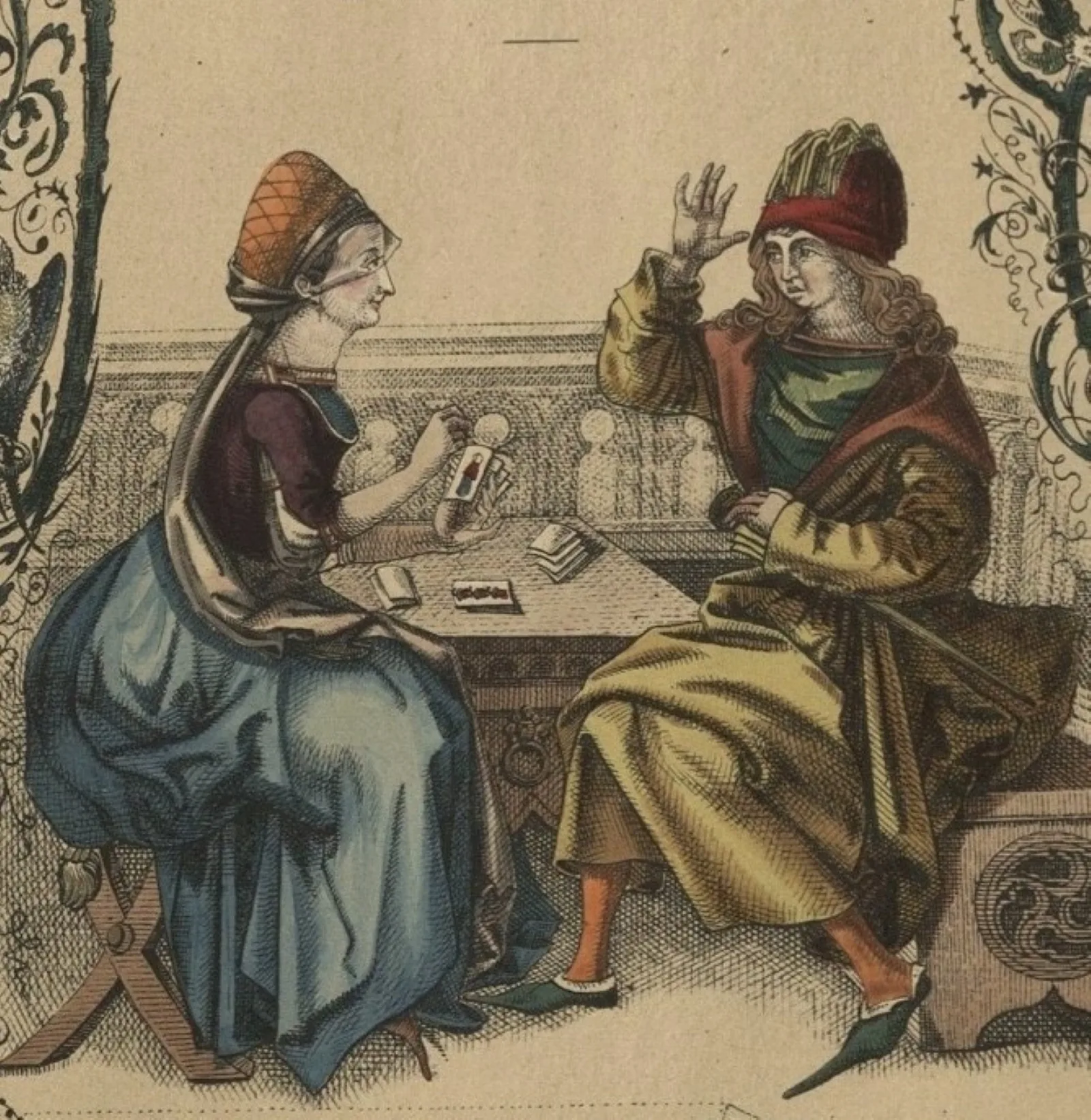
Divination, the practice of gaining insight through supernatural methods, has existed across cultures from ancient times to the present day. Playing cards are one of the most well-known divinatory mediums and have provided simple yet potent storyboards for “readers” to interpret since their introduction to Europe in the thirteenth century.
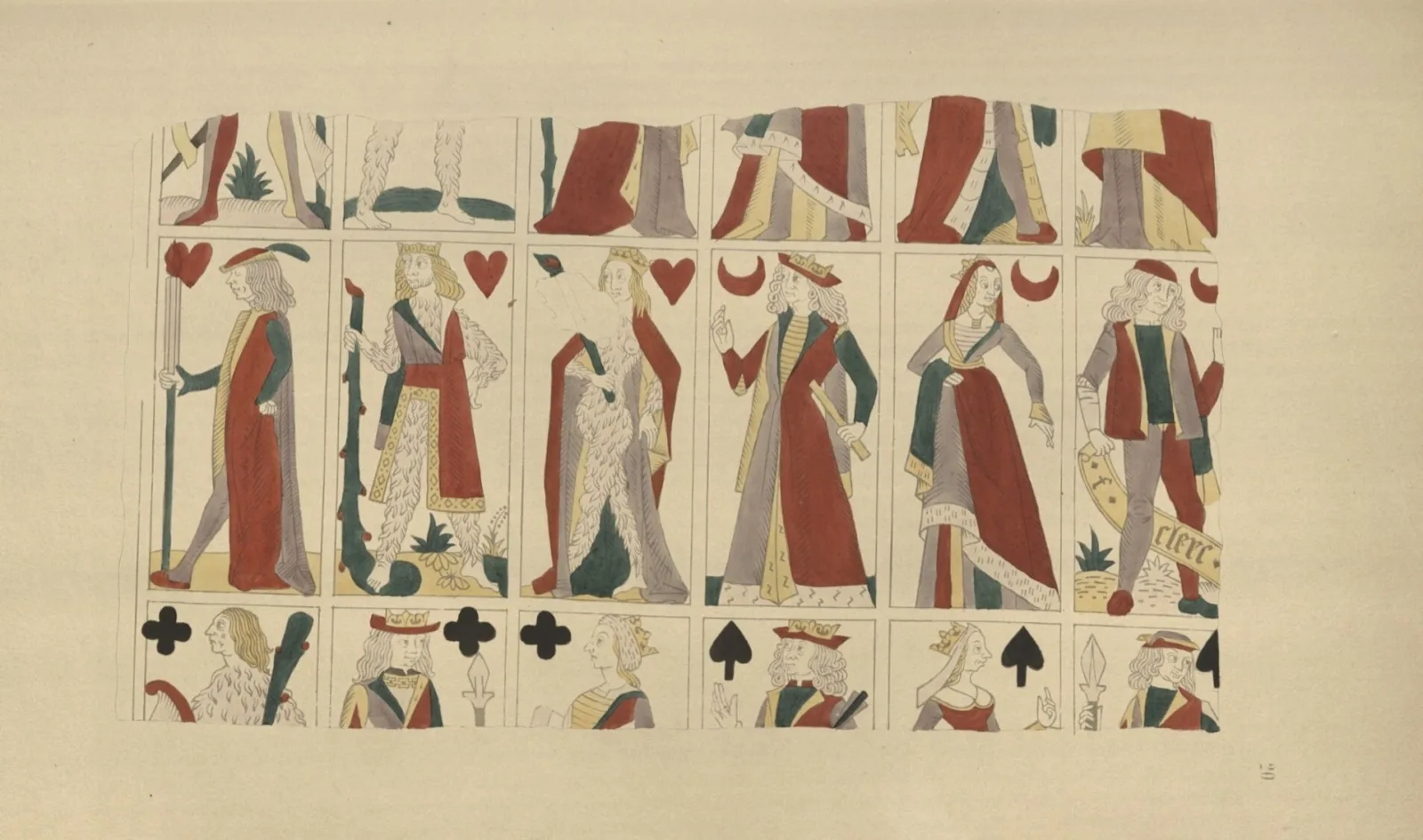
The Newberry’s 1844 copy of Jeux de cartes tarots…(oversize V 163 .66 1844) compiles many early “tarocchi” cards. These decks include a syncretic assemblage of spiritual and secular images, reflecting the visual landscape of the Mediterranean port cities where they were often produced. The first deck to utilize the standard 78-card structure of tarot was first printed in the 16th century and named after its place of origin, Marseilles. It contained the numeric and court cards of a gaming pack, but included twenty-one unique cards with striking illustrations of grand subjects like “Judgement” and “The Wheel of Fortune.”
The tarot does not have a decoding key or definite origin, and there is no central authority that can be consulted regarding the meaning behind its symbolism. However, occultists have long defined their practice as the search for hidden knowledge, and the tarot’s mysterious origin only furthered its status as a magical object. This lack of a canon prompted early occult scholars such as Eteilla, Eliphas Levi, and Papus to codify systems of “correspondences” between the symbols of the cards and their real-world applications.
The theory of correspondences is a central feature of Western esotericism, a tradition of hidden, obscure, or inner knowledge meant only for a small group of initiates, or knowledge that is inherently difficult to understand without specialized training. The theory posits that all earthly things are in possession of both mundane and divine attributes. The task of the occultist is to become aware of both. Everyday objects like flowers and foods could then be utilized in magic due to their connections to certain spirits. Mythology, folktales, and the arts could also have their esoteric meanings “decoded” through this same mode of perception - a story which heavily featured roses could indicate the influence of Venus, and contemplating that story could potentially attune oneself to the qualities of that planet (traditionally, love and luxury).
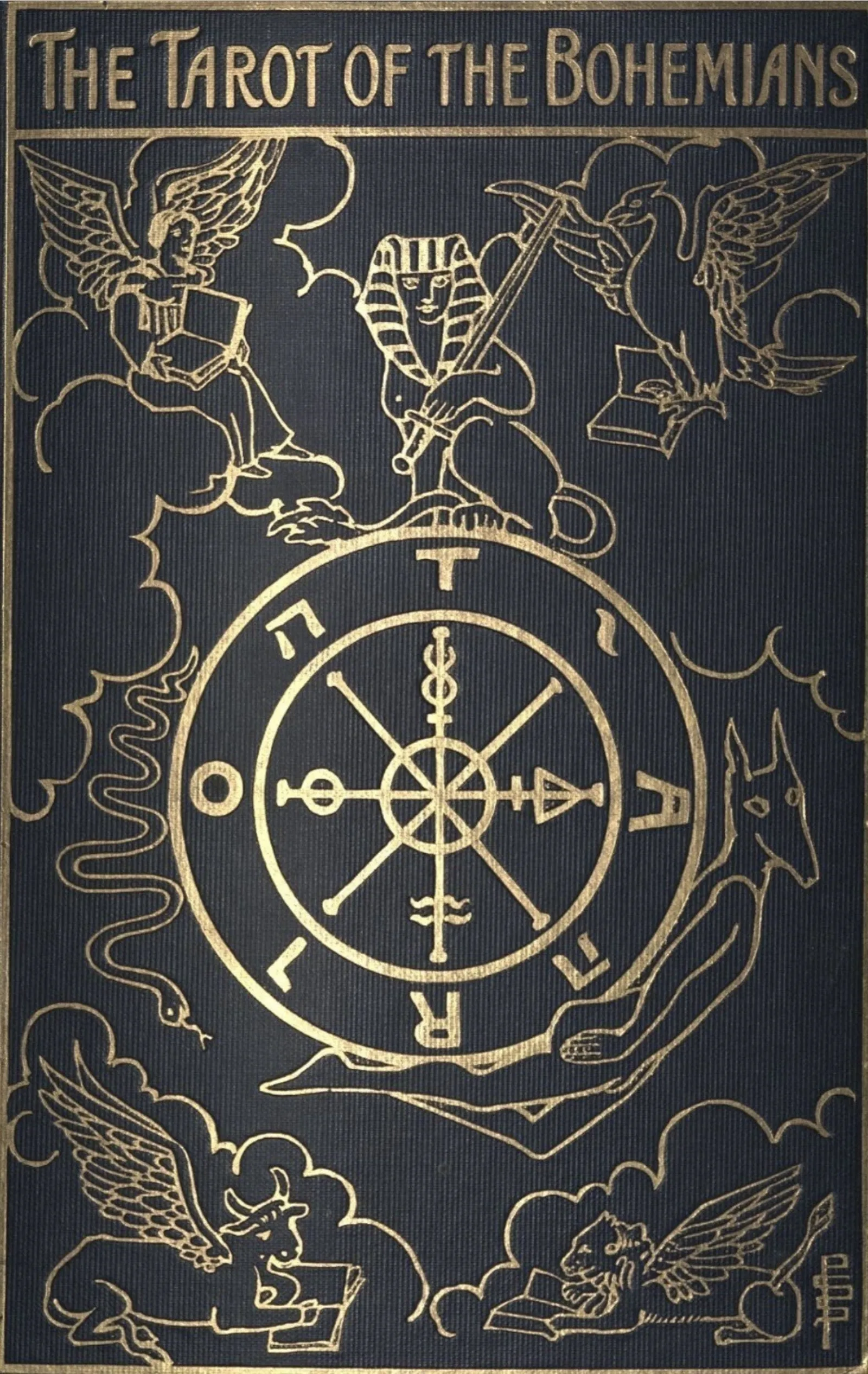
Tarot cards utilize networks of visual correspondences to indicate greater meanings within each card. The symbols used are drawn from a range of references, but harmonize in a way which creates a cohesive whole. This process of synthesis through which tarot cards are created is strongly reflected in the first explicitly occult deck, produced in 1909 by Arthur E. Waite. To this day, it remains the most widely used tarot deck of all time. The Rider-Waite-Smith deck is based in the correspondences used by the Hermetic Order of the Golden Dawn, but also synthesizes Christian imagery with alchemical and Kabbalistic symbols. Additionally, the deck’s illustrator, Pamela Coleman Smith, infused layers of folkloric and popular references into the cards. The intricacy of the resulting tableaus has the ability to evoke infinite interpretations.
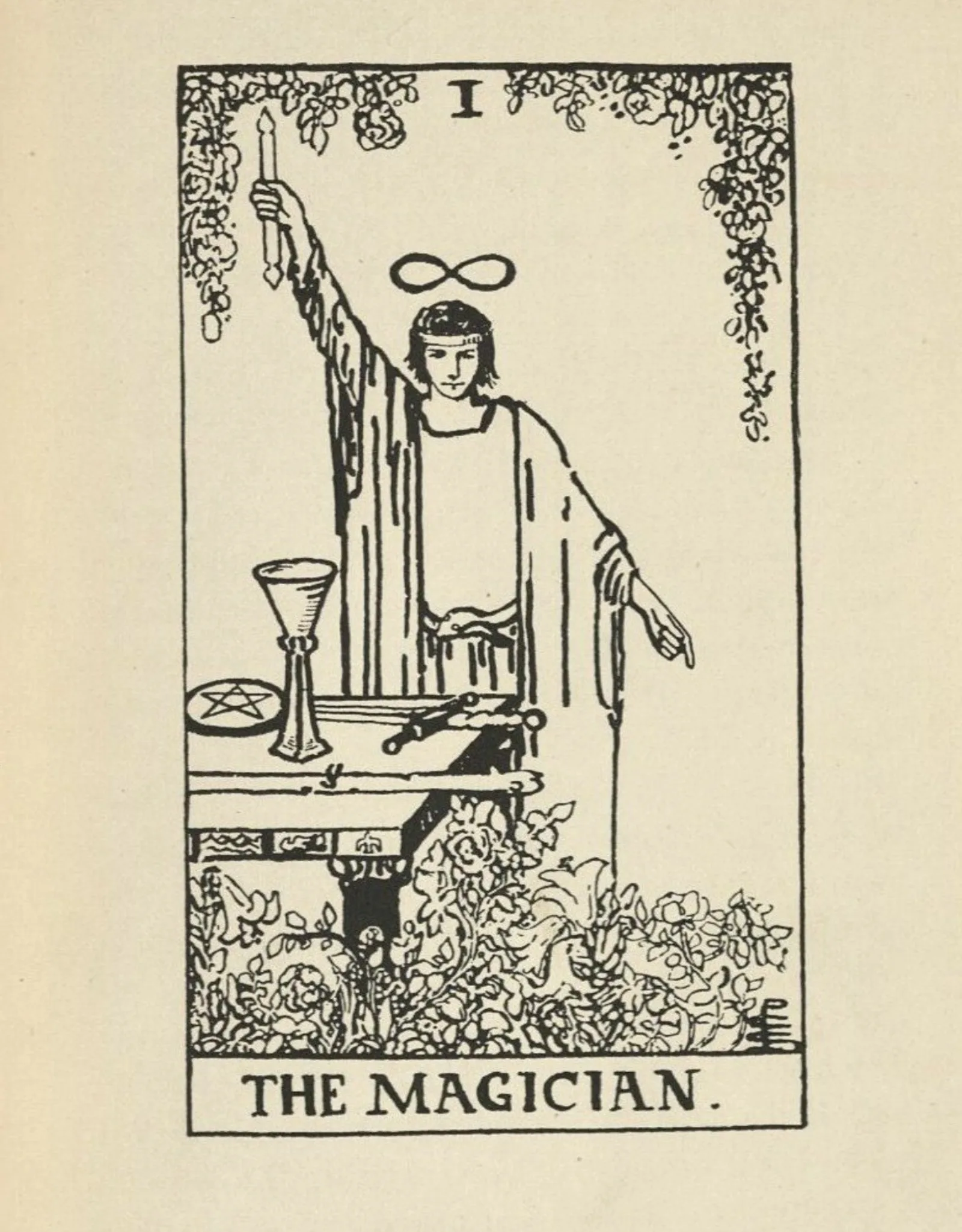
Looking at the Magician card in the Rider-Waite-Smith deck, we see a figure performing a magical act with one arm raised upwards while the other points to the ground. Some readers connect this posture with the famous occult motto “as above so below,” which references the previously described theory of correspondences. An occultist may be reminded of Eliphas Levi’s depiction of Baphomet, who is drawn in the same position. If one looks further into Levi’s works, they may come across other illustrations where he represents magicians making the same gesture. A scholar may recognize the posture from a famous illustration showing the literary sorcerer, Faust, standing in a similar manner. Someone in showbiz may see this as a stage magician distracting his audience with a bait-and-switch. These varied observations indicate aspects of the Magician card relating to power, knowledge, trickery, grandeur, and curiosity. While any, all, or none of these could be considered part of the “real” meaning, each are pathways for the interpreter to access a reservoir of associations relating to each card. This allows them to translate the complex visual language of tarot into a specific reading.
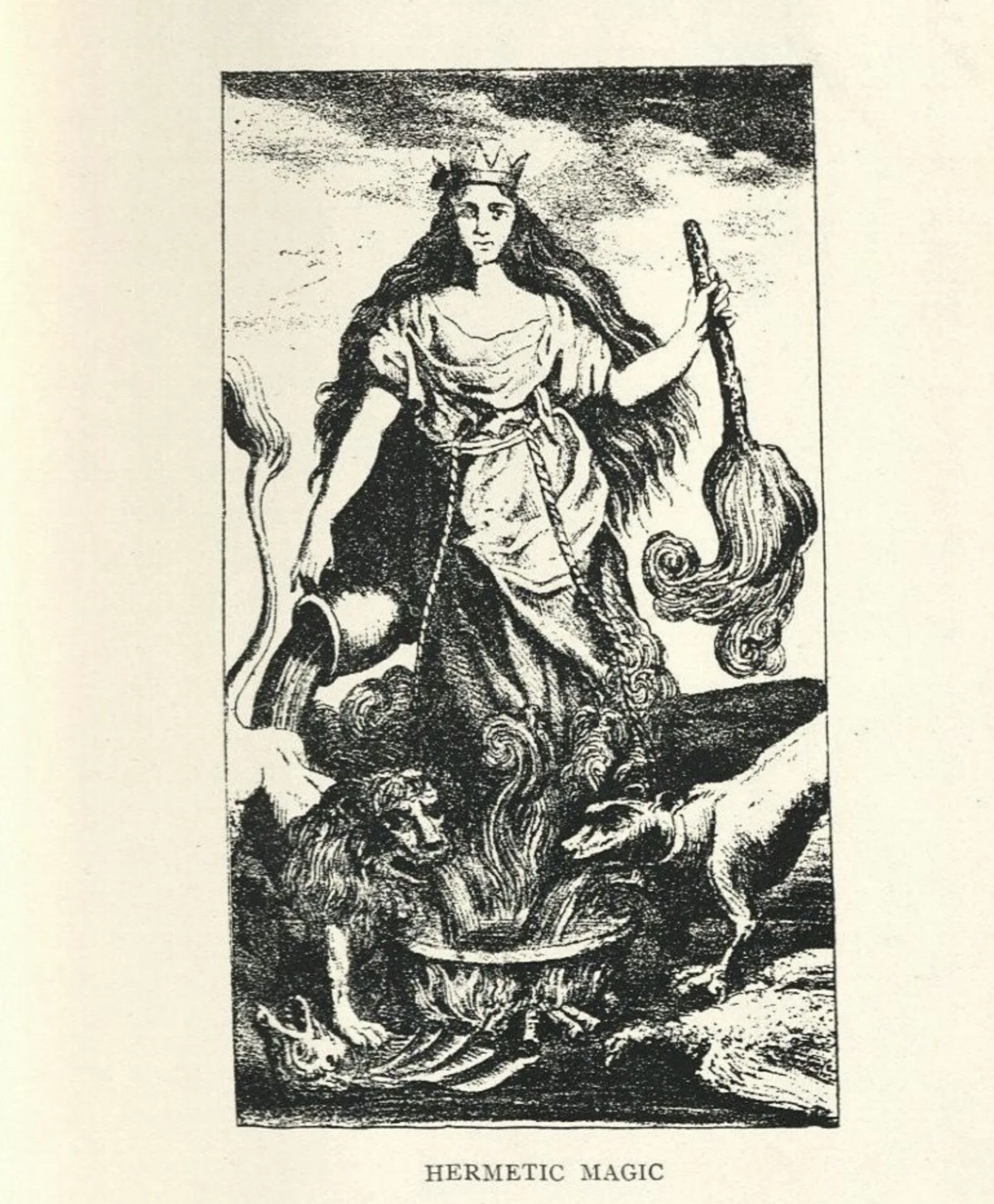
The fusion of creativity, spirituality, and research which defines the world of tarot is perhaps no better embodied than in the life and work of the infamous occultist Aleister Crowley. He wrote extensively about tarot throughout his life, and completed his own deck, known as the Thoth Tarot, just before he died in 1947. The Newberry has a substantial collection of Crowley’s works, but his poetry book entitled “Book of Lies” is perhaps most relevant in our discussion of the cards. Although many of the poems seem abstract, they employ Crowley’s famous technique of speaking in a symbolic “twilight language” that could only be understood by adepts. His poem “Waratah Blossoms,” is connected to “Strength” in tarot, a card he renamed “Lust."
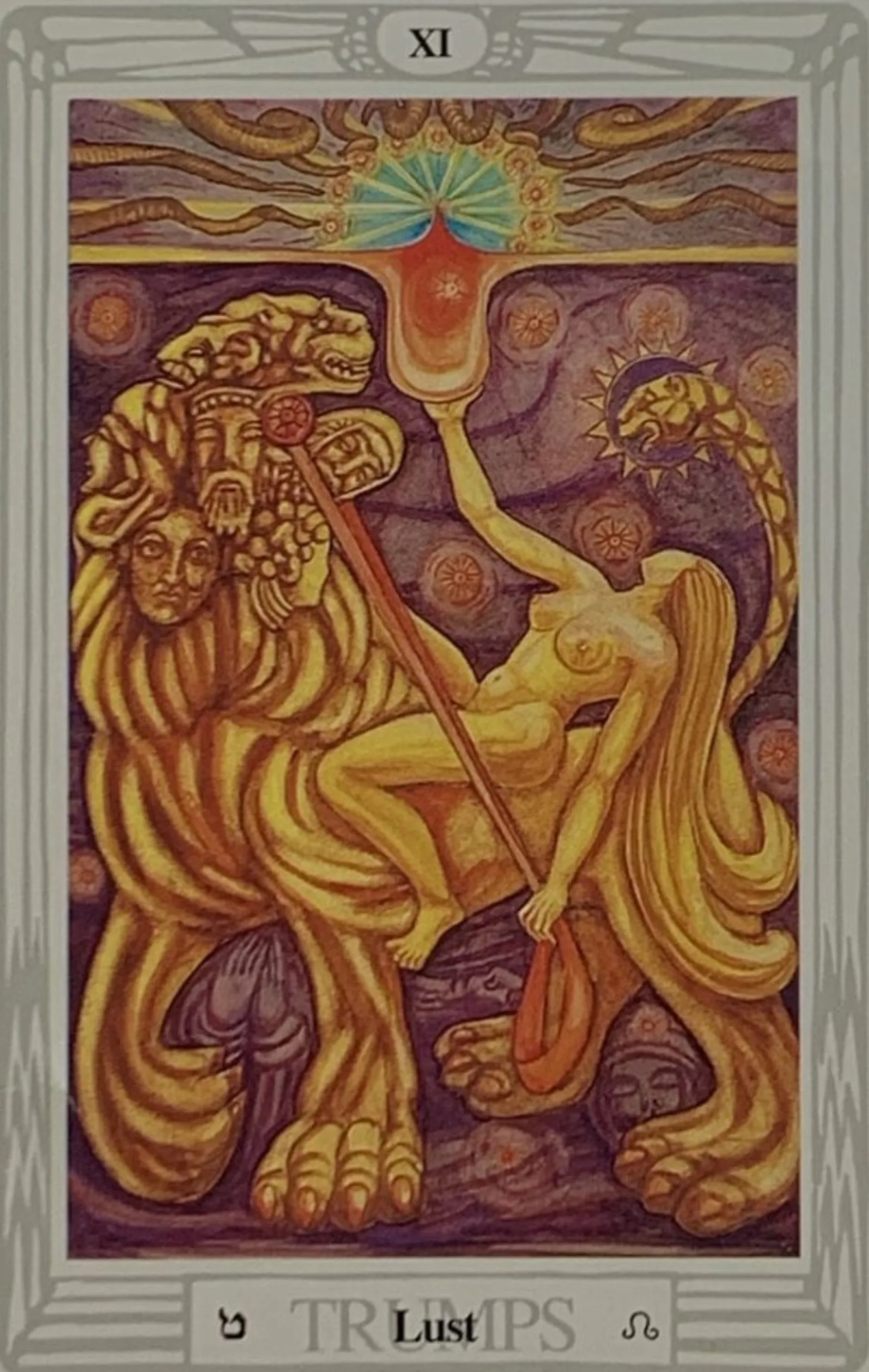
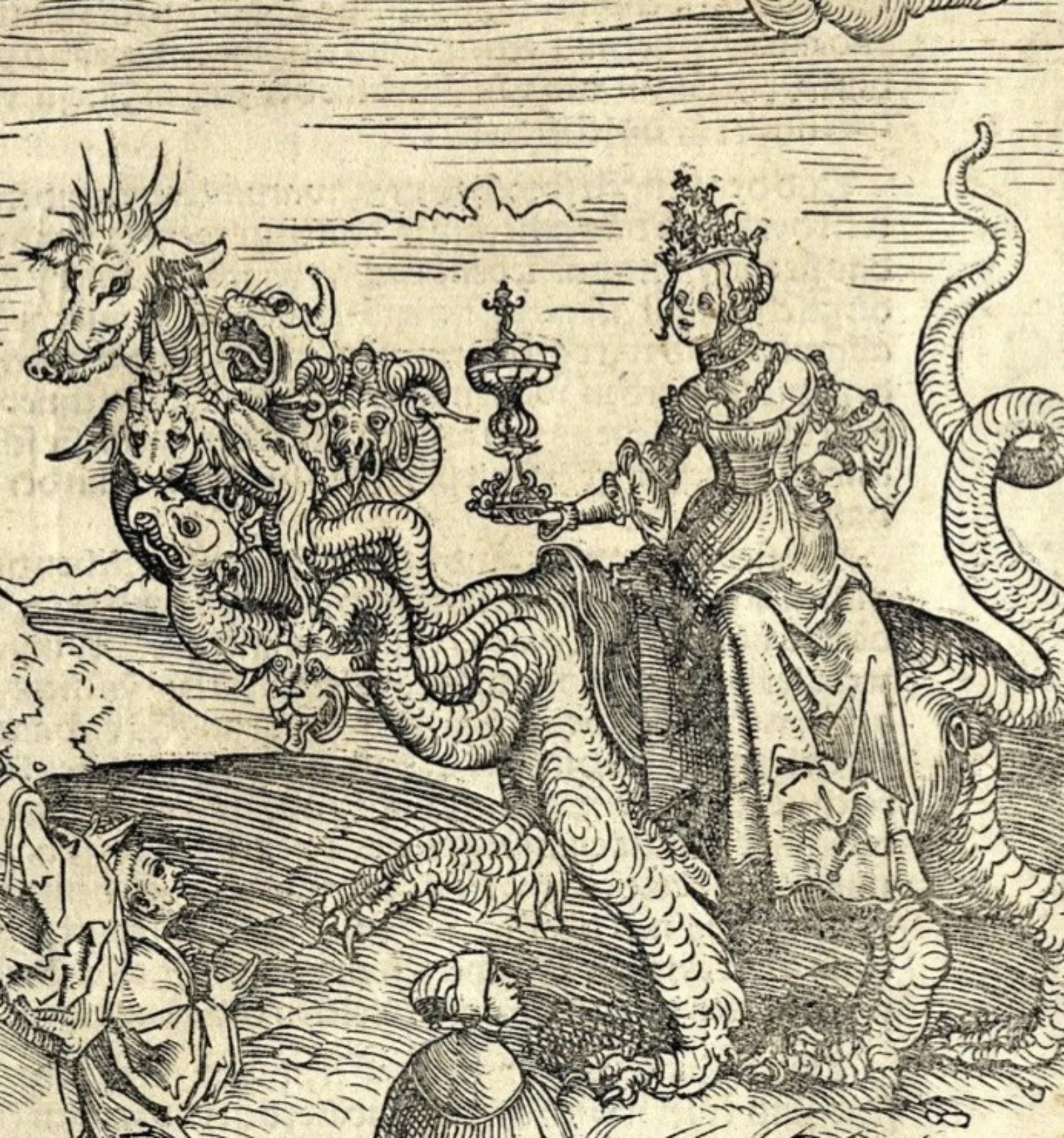
In the poem, he speaks of the “seven veils of the dancing girl” riding a seven-headed beast. Although the poem is as obscure as it is intense, for the initiate its imagery should evoke the “Whore of Babylon” from the Book of Revelation. An occult reinterpretation of this figure, known as Babalon, is a central figure in Crowley’s religion of Thelema. The lust card in the Thoth deck visually echoes his adaptation (and celebration) of this biblical harlot.
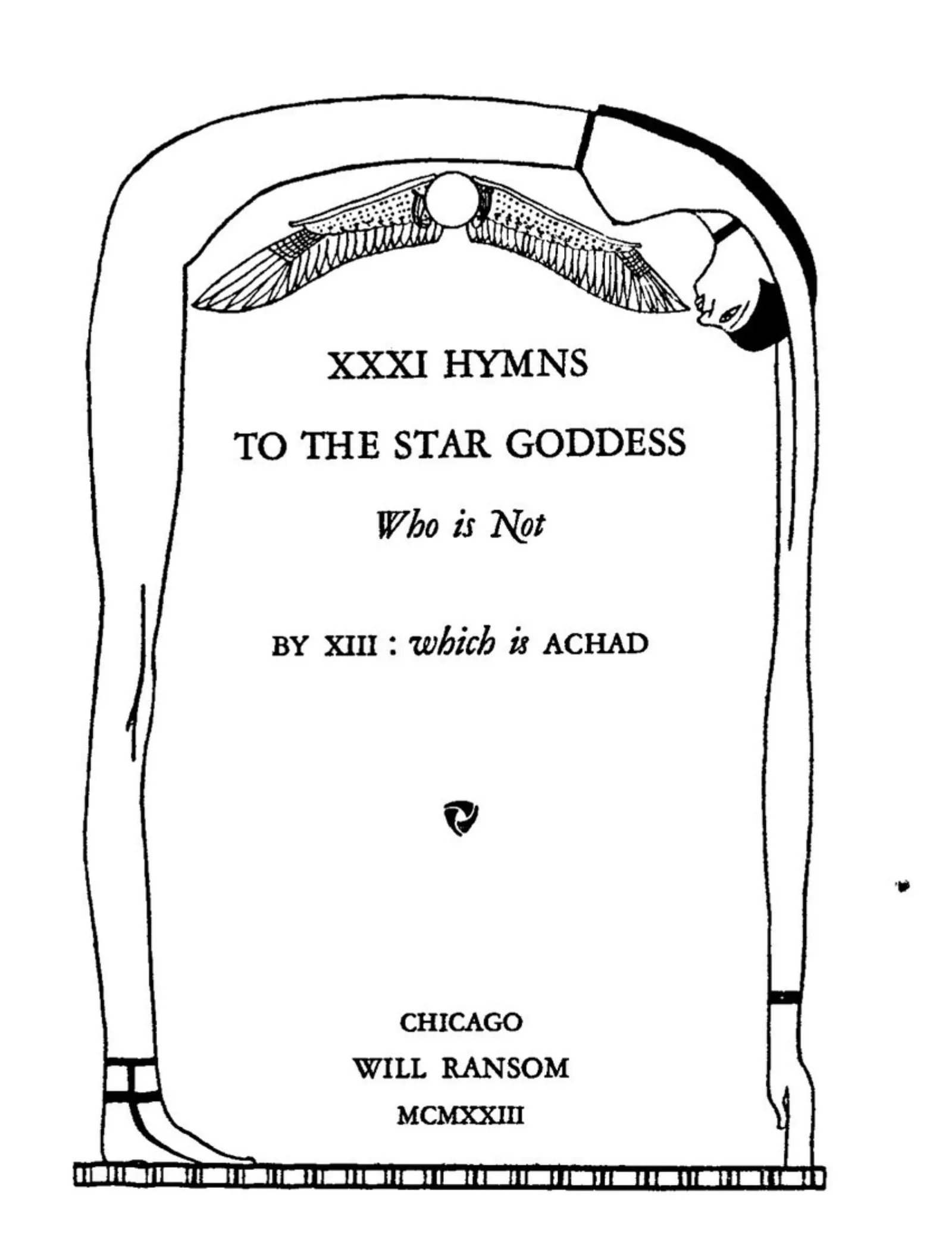
Crowley prioritized an experiential understanding of knowledge, and employed tarot as a meditative tool that allowed the initiate to tangibly engage with spiritual realities. The Newberry has a copy of “Hymns to the Star Goddess” by Crowley’s “spiritual son,” Frater Achad, who applied Crowley’s devotional approach to the goddess Nuit, depicted in the Star card. For practitioners such as these, a card transforms from a static image into a living spirit. The reader’s ability then relies not only upon their knowledge of a tarot card’s “meaning,” but their personal relationship with it.
Tarot has evolved from games using everyday playing cards into a distinct spiritual-creative tradition. Its images and the ideas behind them have influenced the creation of countless pieces of art, writing, and performance, while serving spiritual practitioners as a valuable contemplative tool. Tarot continuously proves its relevance through its influence upon the humanities and its growing mainstream popularity. While its level of visibility in our current age is perhaps at an all-time high, many of the tarot-related objects in the Newberry’s collection reinforce its historical significance and provide context for this boom in popularity.
Our tarot holdings align with our collection strength in Medieval, Renaissance, and Early Modern Studies. Visit the library or our Digital Collections to discover the rich history of tarot today.
About the Author
Isabella Strazzabosco is a multidisciplinary artist and former library assistant at the Newberry Library.