Scroll down for Spanish / Desplázate hacia abajo para español
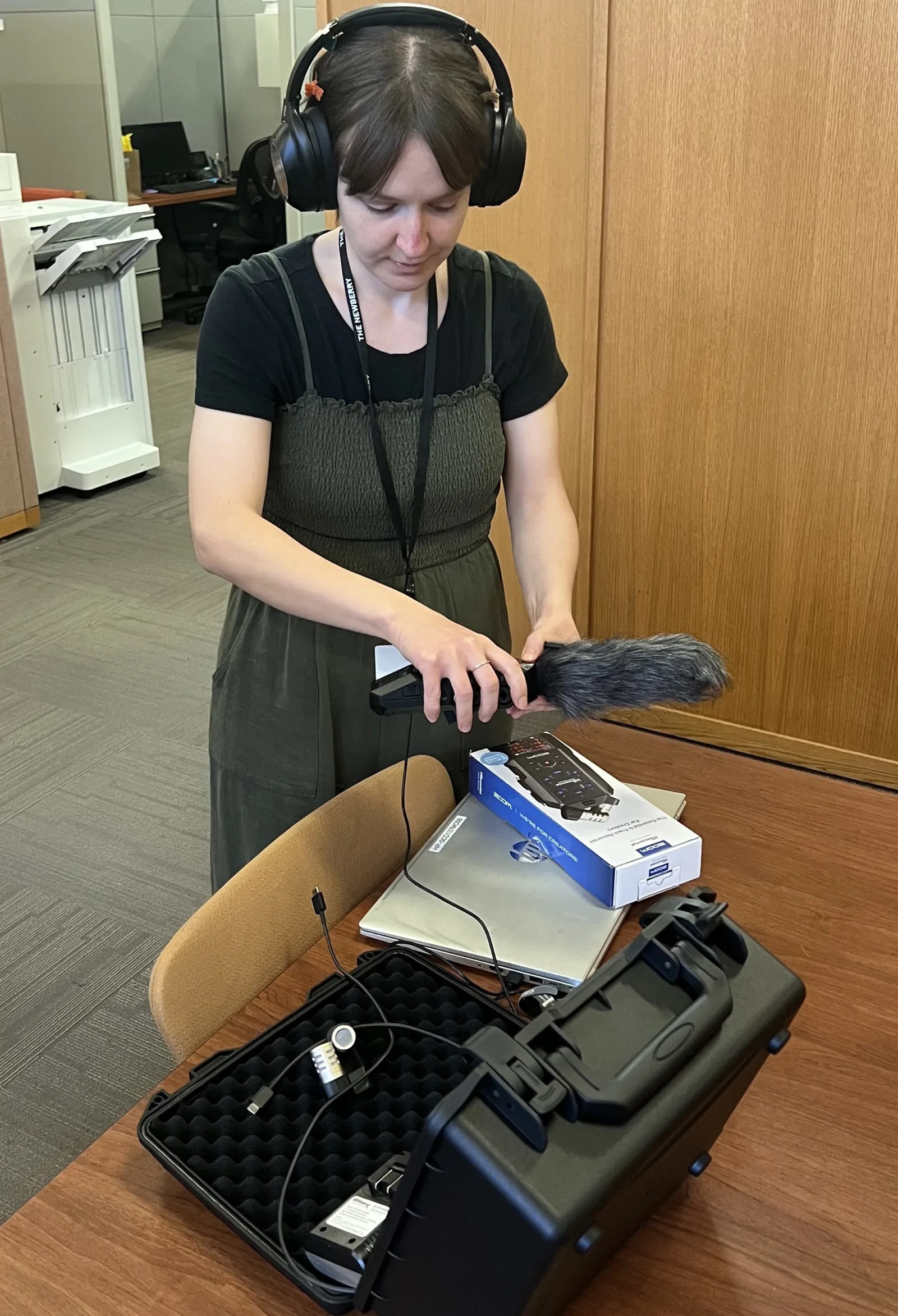
During summer 2026, I interned at the Newberry Library to work on the initiative Beyond Belief: Religion and Social Change in 1960s Chicago. I had the opportunity to work on the initiative’s oral history project, which I eagerly did. Before my internship, I had undertaken some oral history work during my own research as a PhD student at Northwestern University's Department of History, but without any formal guidance I found myself unsure whether the approach I was using was the best one. Thankfully, with some mentorship during my time at the Newberry and the opportunity to work on the Beyond Belief project, I learned how to confidently engage with oral histories as a research method and tool.
First, I learned the process of conducting oral history. To identify potential narrators—the term used to describe the individual being interviewed—I used research from Beyond Belief and the Newberry archives, as well as my own research. I cast a wide net, both because I knew that some people might be uninterested or unable to participate in the project and also because I wanted to record a variety of experiences. After arranging an interview, I reflected on the narrator’s background and used this information to draft a handful of broad questions with which to begin the conversation. I also had to mentally prepare to shed my usual introverted nature. Luckily, most people who offer to give an oral interview are eager to share their experiences and there is rarely lull in conversation. The questions I offered were open-ended to allow the narrator to lead the discussion, although sometimes if the narrator said something specific that piqued my interest I asked them to expand further on that topic.
After the interview process, we uploaded the recording, edited the transcript, and provided copies to the narrator in case they wanted to clarify anything they said. Each interview is a useful and interesting historical source in and of itself, and once Beyond Belief has conducted and processed all of the oral history project’s interviews the initiative will have a remarkable patchwork of historical retellings that bring 1960s Chicago to life.
Oral histories provide a distinctive source for researchers, uncovering unique insight into how an event affected individuals’ lives and how they interacted with historical processes. Narrators offer personalized accounts of what they remember, often detailing emotions, material conditions, and personal interactions. They bring history to life, humanizing and personalizing landmark events. Sometimes, assumptions or former research are challenged by an oral history that doesn’t fully align with what you expect to hear. This is one of the benefits of oral histories, as they demonstrate the complexities of the human condition and how we experience history. Most exciting to me, however, are the ways oral histories reveal how people understand their own place in history. They offer a way for everyday people to understand themselves participating in historical processes, as makers of history and agents of change. Oral histories elevate overlooked voices and empower narrators to see themselves as important historical agents.
I also greatly value oral histories for their accessibility. With a research topic, some preparation, a recording device, and a narrator, anyone can become an oral historian. A person could decide to collaborate with family members to record family oral histories or interview community members to capture local oral histories, for instance. Such projects could be expansive, interviewing a long list of folks, or could be concentrated on just one or two voices, depending on the boundaries of the project and narrators available.
This accessibility also means that I can continue pursuing my interest in oral history after I finish my internship at the Newberry Library. My goal is to incorporate an oral history project into the undergraduate class I’m designing at Northwestern University this year, as well as to begin an extensive oral history project as either a teacher, university faculty member, or independent scholar after receiving my doctorate degree. What this project might look like depends on where I’m located and the research project I design, based partly on that location. I see the current nebulousness of this future project as potential and possibility because wherever I go, I know there will be a story to capture and people to tell it.
Jan Michael is a a doctoral student in History at Northwestern University and a Chabraja Center Summer Intern for the Beyond Belief initiative.
Español
Durante el verano de 2026, hice una pasantía en la Biblioteca Newberry para trabajar en la iniciativa Más allá de la fe: religión y cambio social en el Chicago de la década de 1960. Tuve la oportunidad de participar en el proyecto de historia oral de la iniciativa, lo cual hice con mucho entusiasmo. Antes de mis prácticas, ya había realizado testimonios orales como parte de mi propia investigación como estudiante de doctorado en el Departamento de Historia de la Universidad Northwestern, pero sin ninguna orientación formal no estaba segura de estar empleando el mejor enfoque. Por suerte, gracias a la orientación que recibí durante mi estancia en la Newberry y a la oportunidad de trabajar en el proyecto Más allá de la fe, aprendí a utilizar con confianza la historia oral como método y herramienta de investigación.
Primero, me adiestré en el proceso de llevar a cabo la historia oral. Para identificar a posibles narradores —el término que se usa para describir a la persona que se entrevista—, utilicé la investigación de Más allá de la fe y los archivos de la Newberry, además de mi propia investigación. Amplié al máximo mi búsqueda de participantes, tanto porque sabía que algunas personas podrían no estar interesadas o no poder participar en el proyecto, como porque quería registrar una variedad de experiencias. Después de concertar una entrevista, reflexioné sobre el historial del narrador y usé esta información para redactar unas cuantas preguntas generales con las que iniciar la conversación. También tuve que prepararme mentalmente para dejar de lado mi naturaleza introvertida de siempre. Por suerte, la mayoría de las personas que se ofrecen a dar un testimonio oral están ansiosas por compartir sus experiencias y rara vez hay silencios incómodos en la conversación. Las preguntas que les planteé eran abiertas para permitir que el narrador dirigiera la conversación, aunque a veces, si el narrador decía algo específico que despertaba mi interés, le pedía que profundizara más en ese tema.
Después de la entrevista, subimos la grabación, editamos la transcripción y le dimos copias al narrador por si quería aclarar algo de lo que había dicho. Cada entrevista es una fuente histórica útil e interesante en sí misma, y una vez que Más allá de la fe haya realizado y procesado todas las entrevistas del proyecto de historia oral, la iniciativa contará con un notable mosaico de relatos históricos que darán vida al Chicago de los años 60.
Los testimonios orales son una fuente única para los investigadores, ya que revelan una perspectiva singular sobre cómo un evento afectó la vida de las personas y cómo interactuaron con los procesos históricos. Los narradores ofrecen relatos personales de lo que recuerdan, a menudo detallando emociones, condiciones materiales e interacciones personales. Le dan vida a la historia, humanizando y personalizando los eventos históricos. A veces, las suposiciones o investigaciones anteriores se ven cuestionadas por un testimonio oral que no coincide del todo con lo que uno espera escuchar. Este es uno de los beneficios de la historia oral, ya que pone de manifiesto las complejidades de la condición humana y la manera en que vivimos la historia. Sin embargo, lo que más me emociona es la manera en que la historia oral revela cómo entiende la gente su propio lugar en la historia. Ofrece a la gente común una manera de entenderse a sí misma como partícipe de los procesos históricos, como protagonista de la historia y agente de cambio. Los testimonios orales realzan voces que han sido pasadas por alto y empoderan a los narradores para que se reconozcan como importantes agentes históricos.
También valoro mucho la historia oral por su accesibilidad. Con un tema de investigación, un poco de preparación, un dispositivo de grabación y un narrador, cualquiera puede convertirse en historiador oral. Por ejemplo, alguien podría decidir colaborar con sus familiares para grabar testimonios orales de la familia o entrevistar a miembros de la comunidad para recopilar testimonios orales locales. Estos proyectos pueden ser de gran alcance, entretejiendo los testimonios de diversas personas, o pueden centrarse solo en una o dos voces, dependiendo de los límites del proyecto y de los narradores disponibles.
Esta accesibilidad también significa que podré seguir cultivando mi interés por la historia oral después de terminar mi pasantía en la Biblioteca Newberry. Mi meta es incorporar un proyecto de historia oral en la clase de pregrado que estoy diseñando este año en la Universidad Northwestern, así como iniciar un proyecto extenso de historia oral ya sea como maestra, profesora universitaria o investigadora independiente después de obtener mi doctorado. La forma que pueda adoptar este proyecto dependerá del lugar donde me encuentre y del proyecto de investigación que diseñe, en parte, en función de ese lugar. Considero la imprecisión actual de este futuro proyecto como un espacio de potencial y posibilidades, porque, adondequiera que vaya, sé que habrá una historia que recoger y personas que la cuenten.
Jan Michael es estudiante de doctorado en Historia en la Universidad Northwestern y pasante de verano del Centro Chabraja para la iniciativa Más allá de la fe.