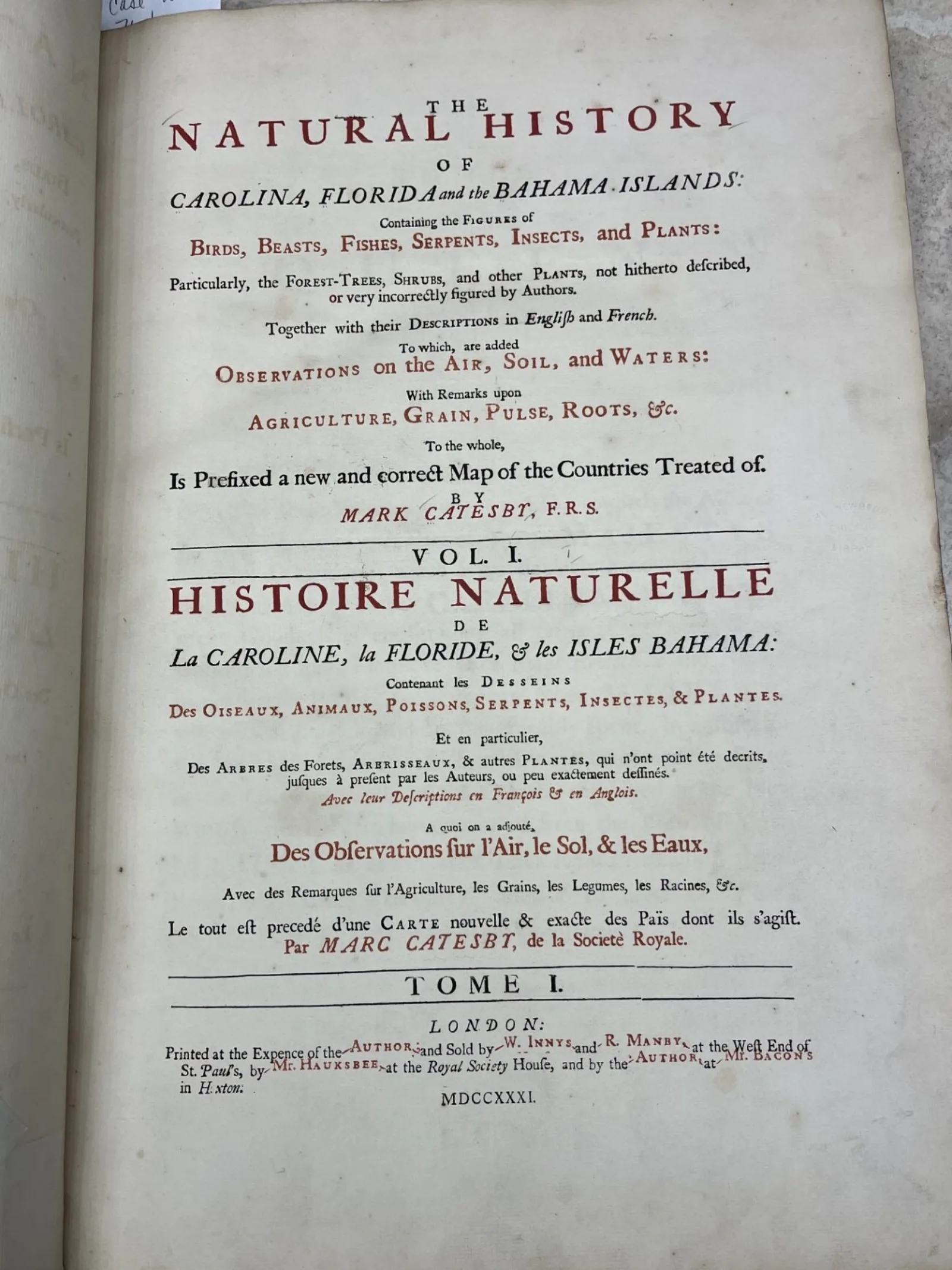
In preparing for my 2025 exhibition on birds and the humanities, I kept encountering two copies of Mark Catesby’s 1743 Natural History of Carolina, Florida, and the Bahama Islands in the Newberry’s collection. It took me a remarkably long time to realize I had been requesting two versions of the work—and that the two weren’t identical.
Soon I heard from the Newberry’s Custodian of the John M. Wing Foundation on the History of Printing, Jill Gage, that one of the copies may have been owned by George Edwards, the “father of British ornithology.” Edwards was a contemporary of Catesby’s and it’s presumed he hand-colored the engravings in Natural History. He received the Copley Medal from the Royal Society in 1750 for his sustained achievements in science.
But why did the Newberry have two copies? And how did we get them?
That required turning to the library’s first accession books from the late 1880s and early 1890s, a handwritten chronicle of early acquisitions. The Newberry keeps these volumes as part of its Modern Manuscripts, and they are available to anyone for review—including the public. It also required learning more about the library’s initial collecting strategy under the leadership of Librarian William Frederick Poole.
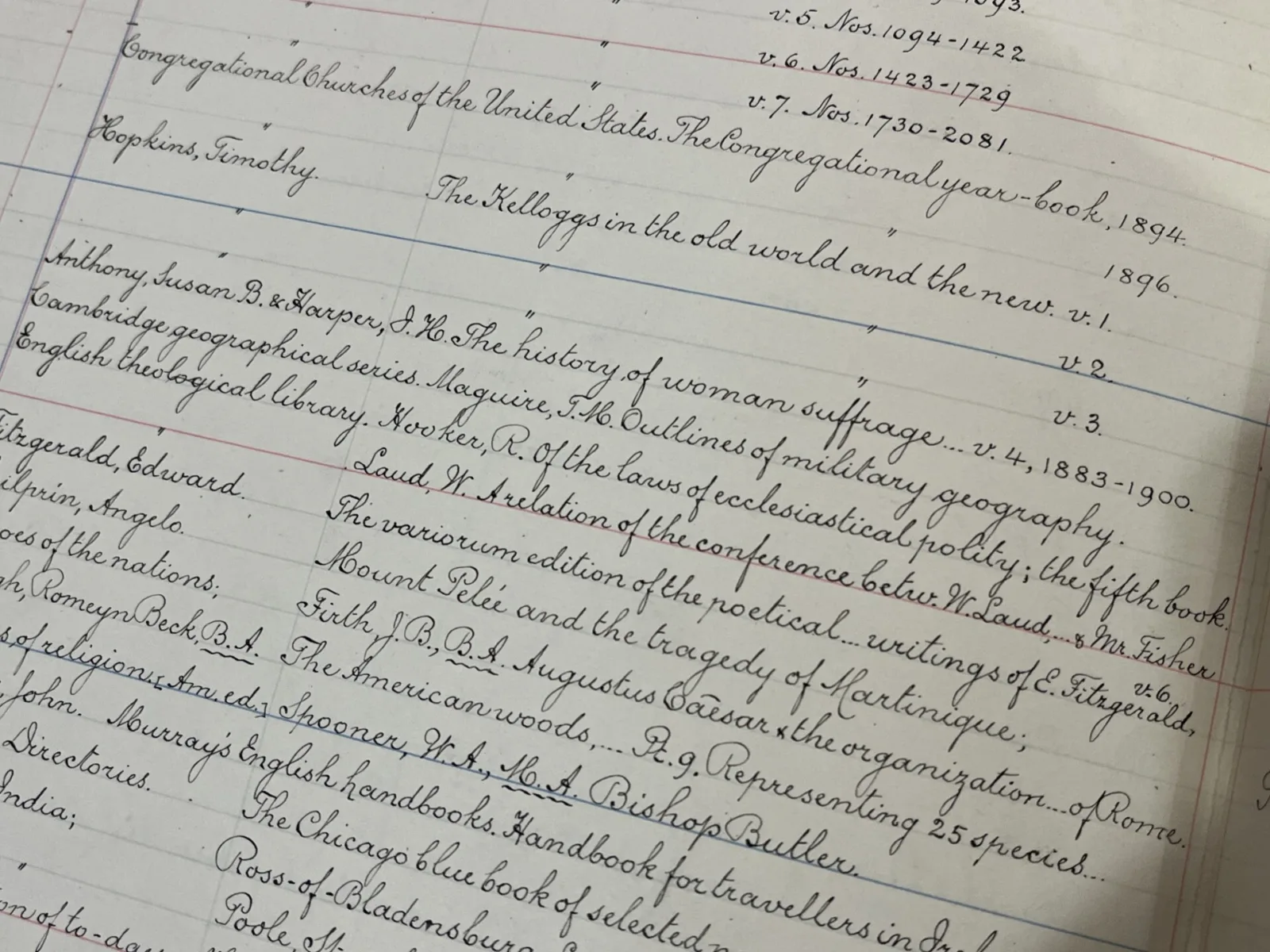
Here is a look at what I’ve learned with the help of Newberry Curator Emeritus Paul Gehl.
Edwards copy, dated 1743, purchased in 1889, $40.80
The Edwards copy came in via the Newberry’s agent in London, Bernard Quaritch Ltd, a dealer that bought it at auction from Sotheby’s, in 1889. “They were probably hired to bid and given an authorized limit,” Paul told me, “but that’s only speculation. They also could have bought it for stock and turned around and asked [the Newberry] if they were interested.”
There’s a handwritten note in one of the two-volume set stating that the works once belonged to “Lord Crawford.” A quick online search shows that there were two prominent Lord Crawfords in England at the time: one a brewer and one a member of Parliament. How it went from Catesby to Edwards to Crawford remains unknown. “We may not know if it was actually owned by Lord Crawford,” Paul said. “The note may have come from an American.”
This copy of Catesby may carry more significance as an “association” copy, since it has a tie to an important individual, a friend of the author, or in this case the book’s colorist (thought to be Edwards). “It can add a little premium to the price,” Paul said.
Probasco copy, dated 1754, purchased in 1890, $33.33
Prior to joining the Newberry, Poole was the head librarian at the Cincinnati Public Library. There he was sure to have had a relationship with Henry Probasco, a prominent businessman and book collector in Cincinnati (Probasco’s mansion is a historic site in Cincinnati to this day). Probasco decided to sell his collection en bloc in the late 1880s. It was one of the first two rare book collections the Newberry acquired in 1889 (the other being the Bonaparte linguistics collection).
“Poole had to convince the trustees to not just buy subjects but bibliophile books, too,” Paul says.
In the 1873 introduction of a catalog of his books, Probasco wrote: “Without any pretensions, therefore, to consideration as a Library, which it is not, it may claim the attention of bibliophiles as possessing that peculiar interest which attaches to any valuable collection of books as reflecting to some degree the individuality and personal tastes of its owner.” Probasco went on to state that many “important additions” to his collection were made during an “eighteen months’ tour” in 1866-67. Those included rare illustrated works in the natural sciences, and one wonders if among those were the Catesby volumes.
In conclusion, there are several questions left unanswered by this brief investigation. What was Quaritch’s motivation in bidding on the Catesby? How did “Lord Crawford” factor into the story? How, when, and where did Probasco acquire his copy? These are questions that may yield further answers with enough time and continued study.
Bob Dolgan is the Director of Communications and Marketing at the Newberry.