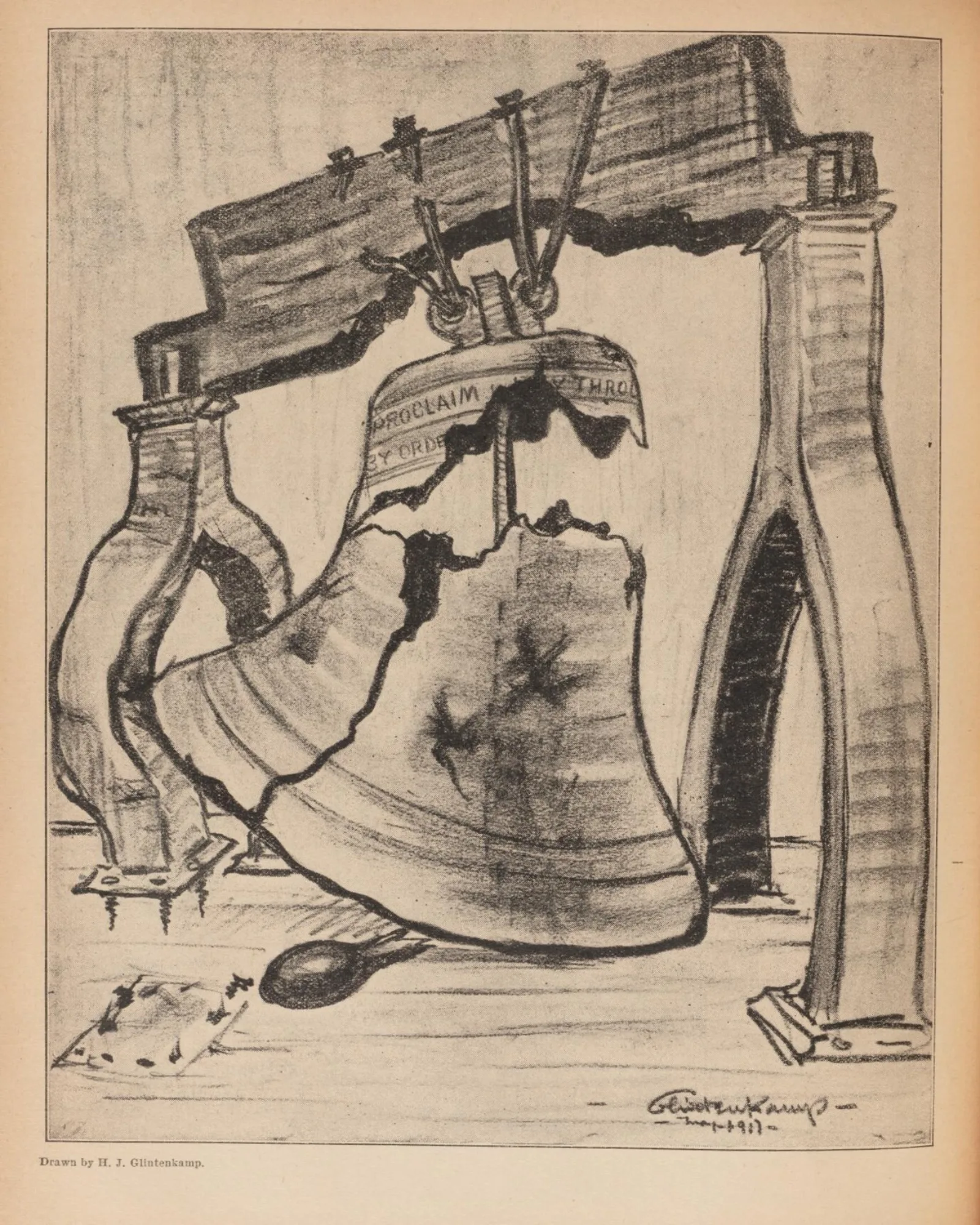
The Masses was an American socialist magazine that ran from 1911 to 1917, known for its modern, iconoclastic art and commentary. The magazine is featured several times in the Newberry exhibition, Conceived in Liberty: Cartoons, Caricatures, and Illustrations in the Wartime US, 1812-1918, for its anti-war speech, but The Masses was influential on many political topics, including women’s liberation. In an August 1911 article titled “Women Suffrage and Socialism,” Josephine Conger-Kaneko argued, “There are two significant movements in the world to-day–that of the working class for economic freedom, and that of the woman for political freedom… It is the instinct against class and sex oppression finding expression for the first time in the world’s history.”
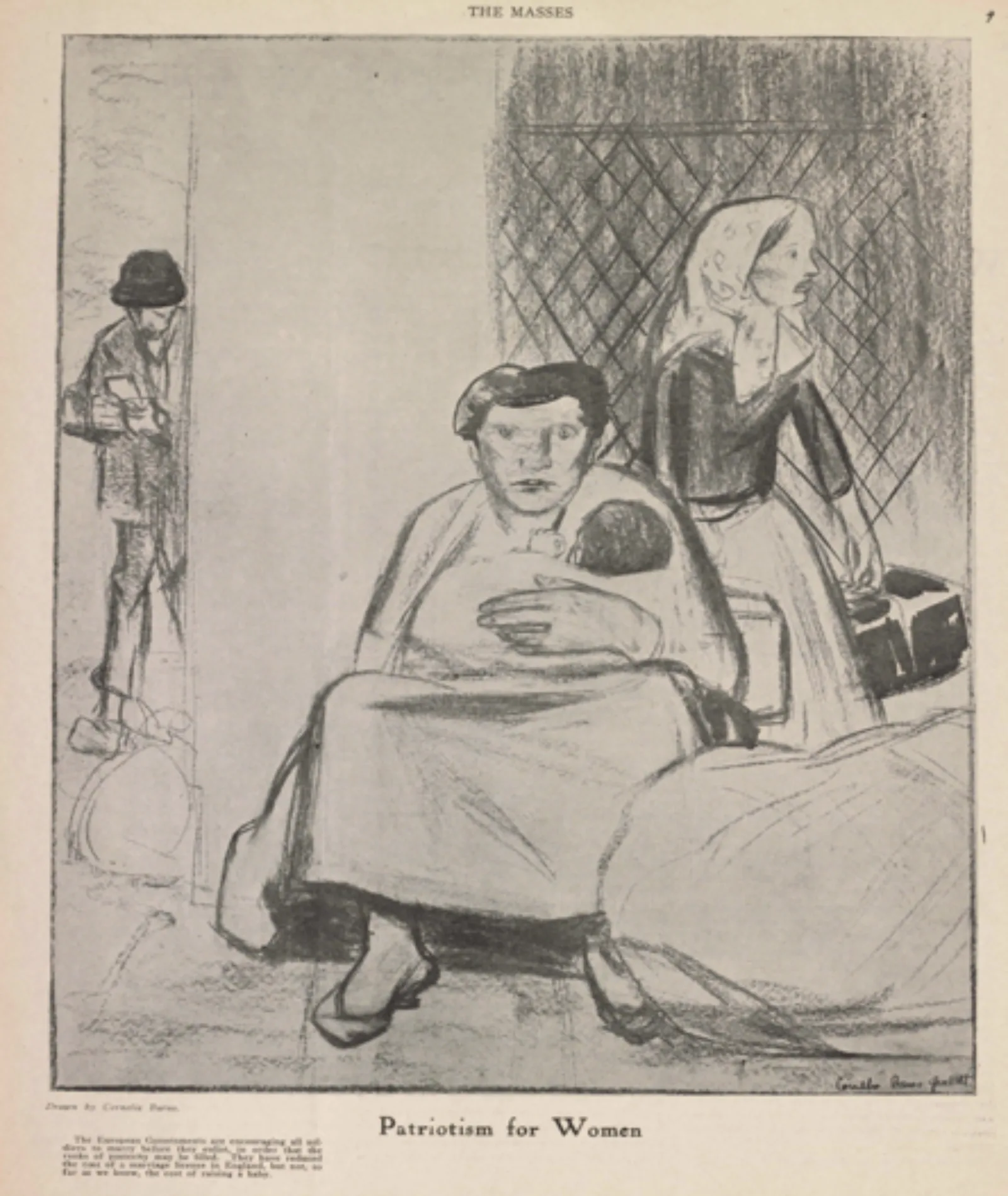
By 1915, The Masses had endorsed the movement for women’s suffrage, but the new movement for birth control was a notably more frequent focus of its illustrations and cartoons. Upon the outbreak of World War I in Europe, Cornelia Barns, an American political cartoonist, feminist, and socialist who was one of the few female contributors to the magazine, drew the illustration, “Patriotism for Women,” in response to reports that European governments were encouraging soldiers to get married before seeing action “in order that the ranks of posterity may be filled.” Babies severely limited women’s economic freedom, as the editors noted acerbically in the caption in the bottom left corner: “They have reduced the cost of a marriage license in England, but not, so far as we know, the cost of raising a baby.” (Barns went on to become the art editor and associate editor for nurse and birth control advocate Margaret Sanger’s Birth Control Review in 1921.)
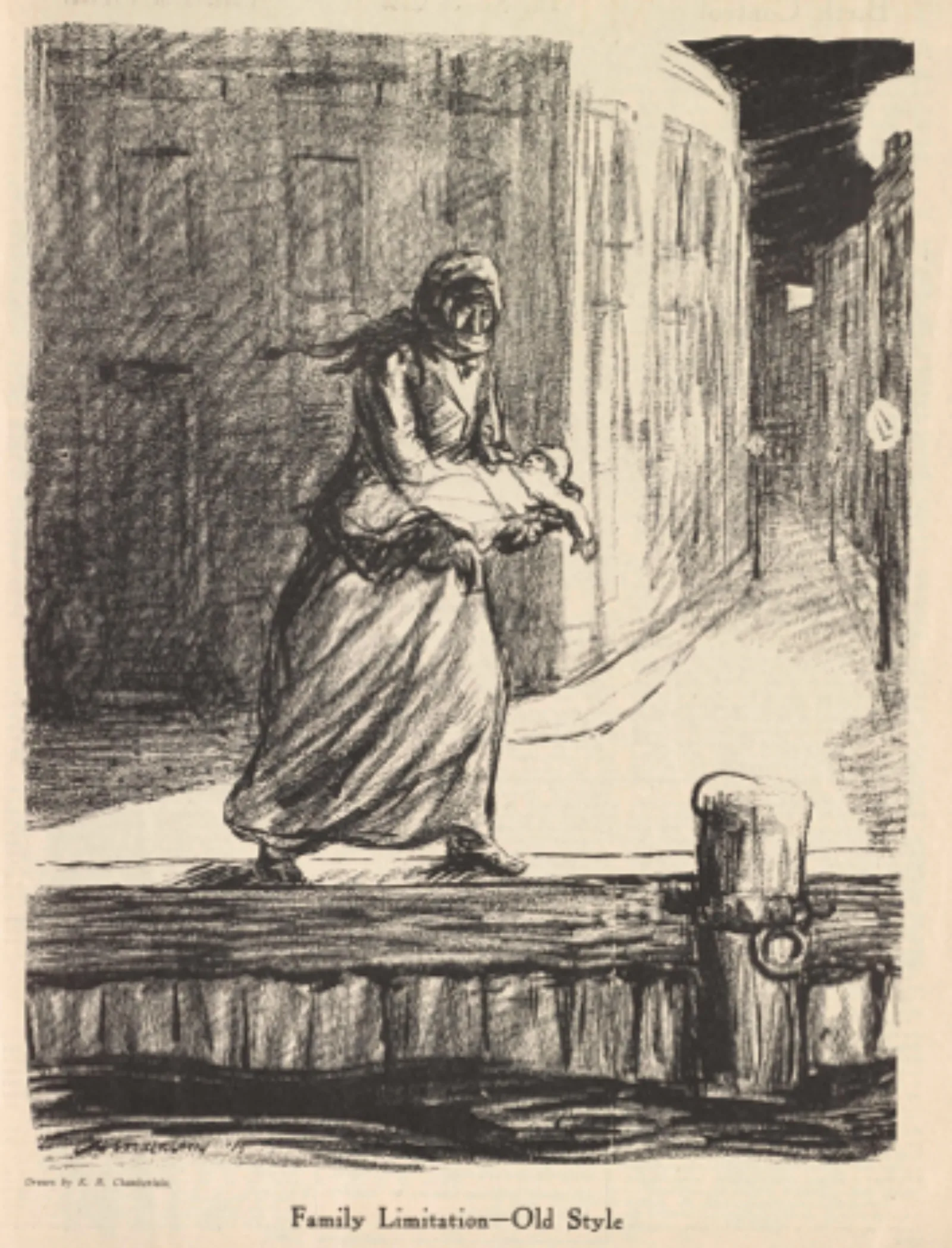
The magazine also tied “old world” ways to birth control limitations. In K. R. Chamberlain’s “Family Limitation—Old Style,” forcing women to bear children they could not afford to care for was presented as a relic of barbarism (a charge The Masses and other pacifists of the time also leveled against the war itself). Chamberlain’s drawing shows a woman alone on a moonlit street, head and mouth covered by a scarf, taking a bundled infant to the edge of a river to throw it in. Its title—"Family Limitation"—was the same as given by Margaret Sanger to her pamphlet on contraception, written from jail in 1914.
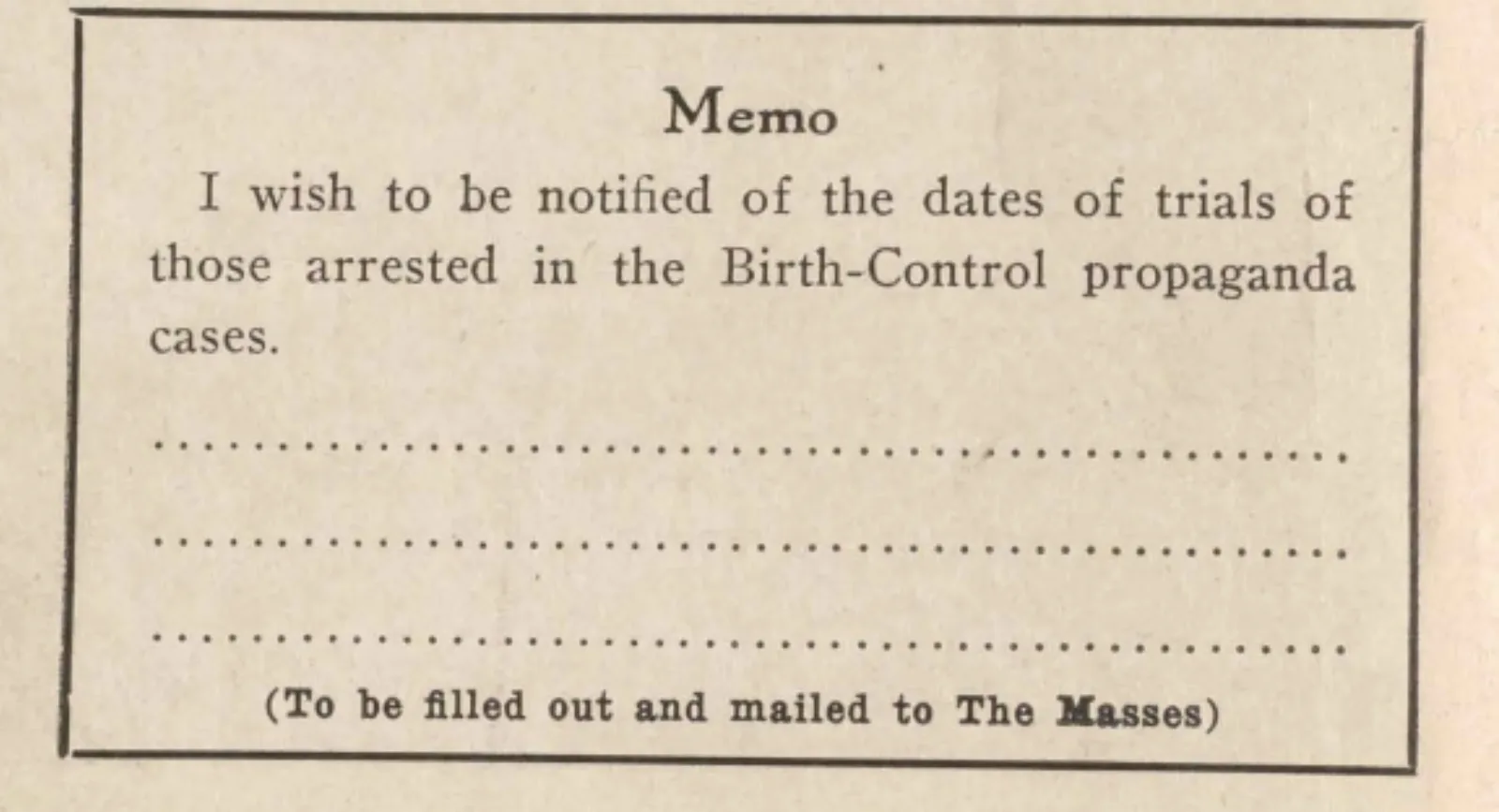
Advertisements featuring Sanger’s publications were frequently featured in The Masses beginning in mid-1915, for which the magazine was sanctioned by The New York Society for the Prevention of Vice, a private organization led by politician Anthony Comstock that worked closely with the New York police to censor material about sex education. When activists Sanger and her estranged husband William Sanger were arrested for distributing Family Limitation in violation of the Comstock Act of 1873–a law that deemed both contraception and information about contraception obscene – The Masses reported closely on their trials as evidence of the class dimensions of the anti-birth control movement. Readers interested in doing more in support of the movement could submit this memo slip to The Masses to receive updates on the trials. Readers were also invited to participate in the magazine’s fundraising effort for The Sanger Fund (readers raised $93.56, or $3,096.18 in today’s money).
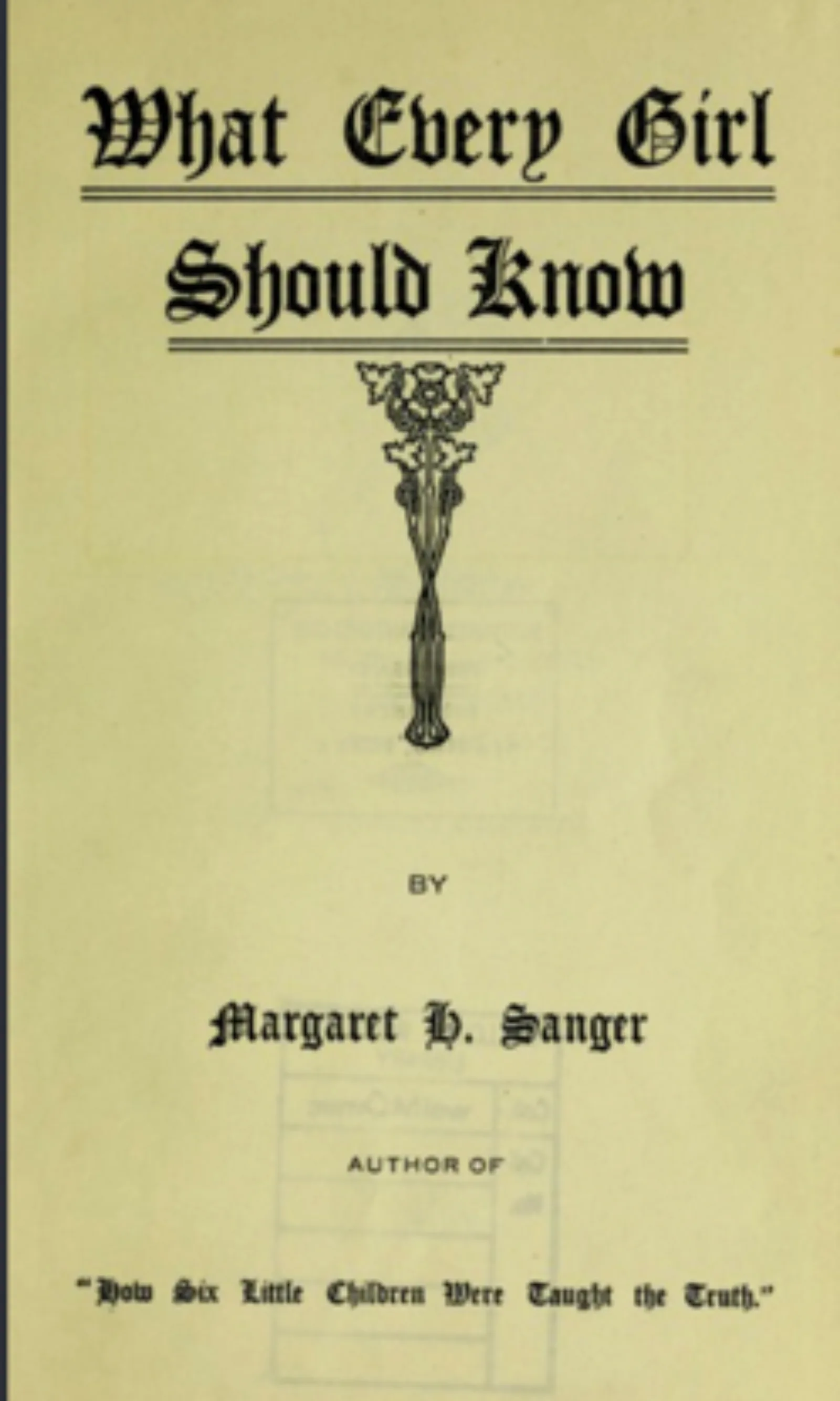
The Newberry Library possesses both the 1914 edition of this pamphlet and a 1922 edition of Margaret Sanger’s pioneering sex education essays, What Every Girl Should Know (originally published in 1916).
The Masses focused on birth control as part of a larger commitment to exploring the role of women in a capitalist society through the lens of female self-fulfillment and self-determination. With World War I raging in Europe, democratic freedoms being defended at fronts abroad were, in the view of The Masses, denied to women at home who were unable to access the knowledge necessary to empower and free them from the constraints their society forced upon them.
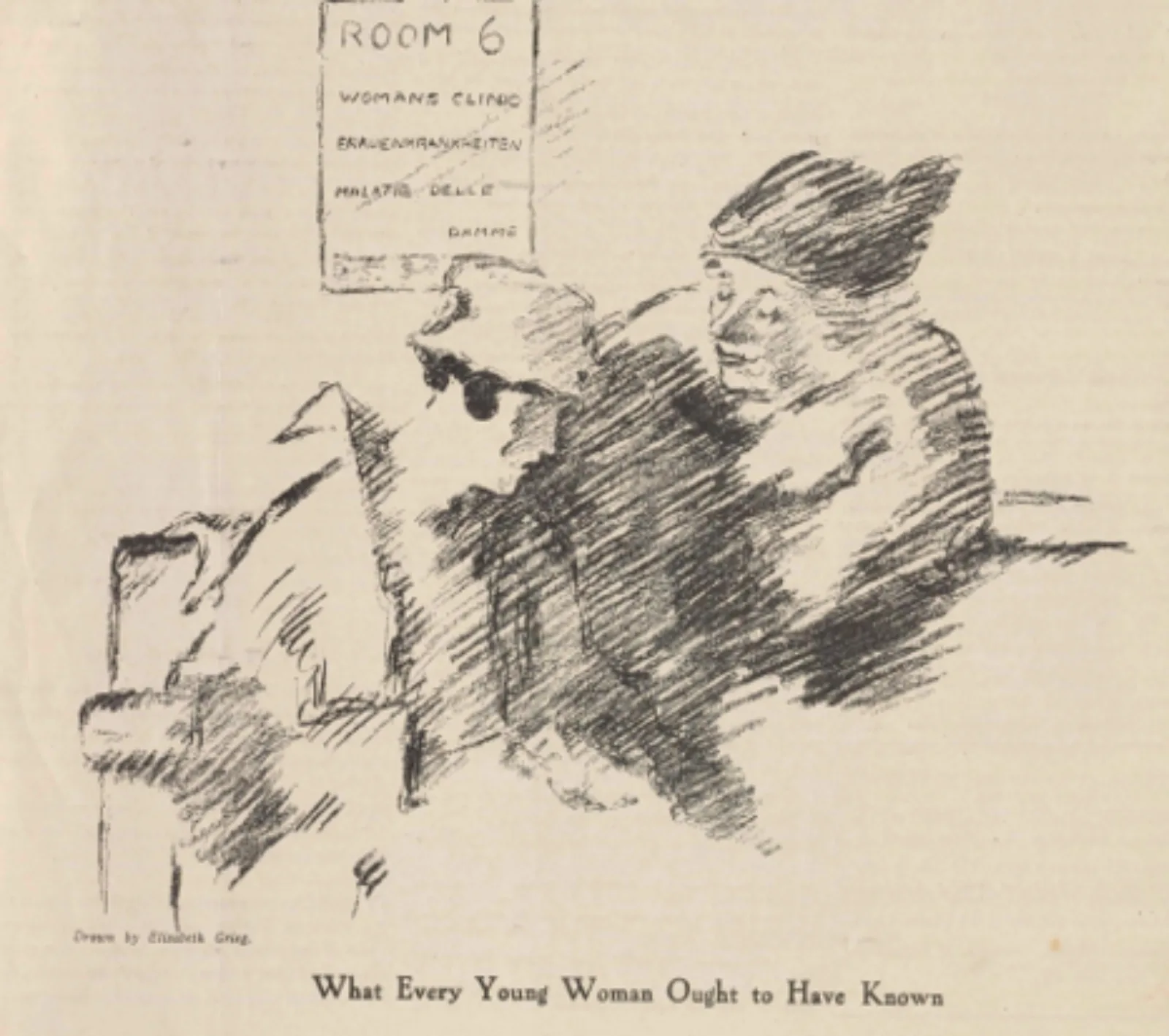
Elizabeth Grieg played on Sanger’s infamous title in the caption for her drawing, “What Every Young Woman Ought to Have Known,” featuring an older woman ministering to a younger one in front of a sign for a Room 6 “Women’s Clinic,” with German and Italian translations inscribed beneath. In this image, the embargo on sex education for women, including immigrant women, condemned them to unwanted pregnancies that limited their freedom in a society that would not promise to help care for the children who resulted. The image accompanied a number of letters to the editor under the heading, “Progress or Comstock? By Our Readers.” The piece included pledges of support and donations, as well as a lengthy defense of William Sanger by Upton Sinclair. But the lead letter was from Mrs. Mariam E. Oatman-Blachley of New York, in which she declared that she would like to be “one of a thousand women to sign a statement” with various resolutions in support of birth control, including one that stated: “We believe this control makes for personal and domestic happiness, and lifts us out of the hands of fate and makes us self-directing human beings.”
A number of the items on view in Conceived in Liberty reveal that WWI was a powerful catalyst for women’s efforts to gain the right to self-determination, both in the United States and abroad. But the same pattern existed for other groups and in other eras. Wartime brings the question of liberty into sharp focus, eliciting passionate and conflicting responses and creating opportunities for those on the margins to reshape and revolutionize the social order. Artists reflected these moments of social change in their work, highlighting the centrality of liberty to the identity of the United States, even when unfulfilled.
Margaret Storey is a Professor of History at the College of Liberal Arts and Sciences at DePaul University and curator of the Newberry exhibition, "Conceived in Liberty: Cartoons, Caricatures, and Illustrations in the Wartime US, 1812-1918."
Ruby Hayden is a junior at DePaul University majoring in anthropology and museum studies as well as a former Newberry Exhibitions Intern.