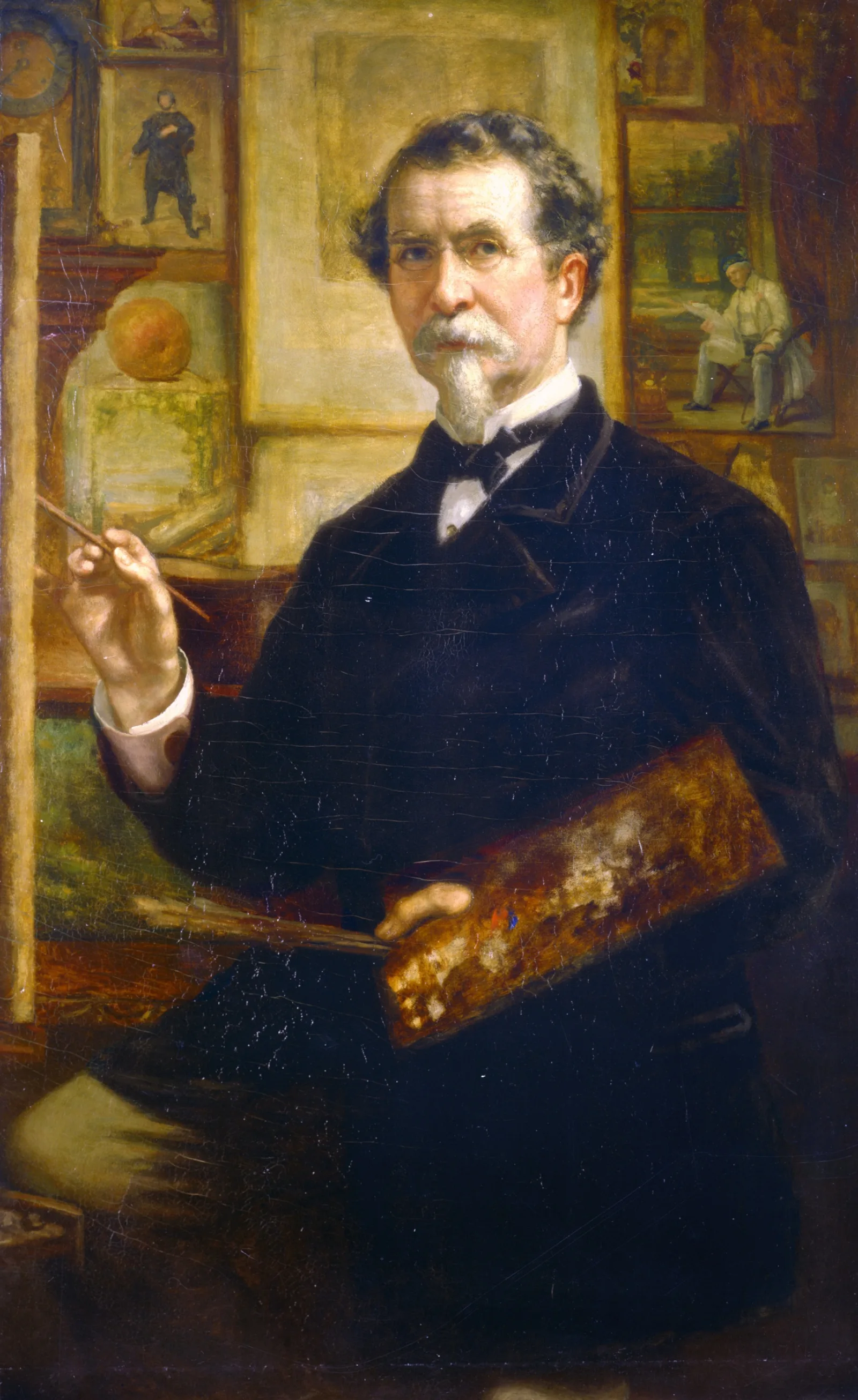
George P. A. Healy was one of the most prolific and popular portrait painters of the nineteenth century, and several of works adorn the Newberry. He was the first American artist invited to submit a self-portrait to the Uffizi Gallery. Born in 1813 to an Irish Sea captain in Boston, Healy began by copying the works of great masters. His first bit of encouragement came from portraitist Thomas Sully. After seeing Healy’s works, Sully firmly stated that he should make painting his profession. At the age of 18, Healy secured a studio in Boston and hung his shield out, but now he needed sitters. A few trickled in, but he wasn’t making much money. Healy knew he still had much more to learn and wanted to study with a master. Healy headed to Europe and studied with French painter Baron Gros.
In Paris, Healy took in many American visitors. One of those visitors is railroad tycoon and Chicago’s first mayor, William Butler Ogden. In 1855, at the invitation of Ogden, Healy moved to Chicago. Ogden was a major contributor to the cultural and artistic growth of the city, which meant plenty of potential sitters for Healy. Ogden offered his home to Healy for a year while he set up his studio. Healy found the city primitive compared to Paris but with a bold, progressive outlook. In Healy’s autobiography, Reminiscences of a Portrait Painter, Healy describes the streets of Chicago being composed of rough planks, the enormous size of our rats, and the excessive mud, however, he goes on to state, “the wooded North side, especially where Mr. Ogden and his friends live is a garden city.” After about a year, Healy asked his family to join him.
In 1867, Healy returned to Europe but continued to identify Chicago as his home. That same year Healy began working on “The Peacemakers,” one of his most famous works. It depicts the historic meeting of Generals Grant and Sherman, President Lincoln, and Admiral Porter in March of 1865. Healy was not present at the meeting, so he based the painting on previous individual portraits of the four men and notes given to him on their positions.
The original life size portrait was given to the Calumet Club; however, the Club and the portrait burned in a fire in 1893. The Newberry holds three of Healy’s four studies for this work: Lincoln, Grant, and Porter. Our collection also holds a portrait of General Sherman; but it was not a study for “The Peacemakers.” It was Sherman, however, who wrote to Grant expressing Healy’s interest in making “The Peacemakers.” Grant was hesitant at first, but because it was Healy he agreed. Healy and Grant got to know each other on a more personal level, having extensive conversations about their children.
In total, Healy painted eleven U.S. presidents. The Newberry holds three portraits of presidents in our collection. In addition to Lincoln and Grant, we also have a portrait of President Chester Arthur. The sixteenth president was a frequent subject for Healy. He painted President Lincoln both from life when he was living in Springfield and when in office in Washington. He also painted portraits of Lincoln posthumously. These were based on earlier studies, photographs, and notes provided by Lincoln’s son, Robert T. Lincoln. It has been said that artist Kehinde Wiley’s presidential portrait of President Barack Obama was influenced by Healy’s portrait of Lincoln.
In 1886, shortly before returning to Chicago, Healy gave the Newberry Library some forty paintings. Some of these are not currently in the collection because they were given or exchanged with Healy family members. In the years following, portraits were added by other sources, including a portrait of Mrs. R.H. Winslow, given to the Newberry by author David McCullough. In total, the Newberry has a collection of forty-three portraits by Healy.
To view the portraits in the reading room, take one of our public tours available throughout the week. If you want to use our reading rooms, all you need to do is stop by the Welcome Center in the lobby of the library. While there you can view the portraits Healy did of the Newberry's founder, Walter Newberry, and his daughter, Julia.
About the author
Jo Ellen McKillop Dickie is Reference Services Librarian and Selector for Reference.
America 250 at the Newberry