The year is 1348. It is a summer afternoon in July in Florence. Pepo degli Albizzi walks along the Arno River, wondering whether anyone still has supplies of a particular incense from the East. A physician had mentioned that burning it in a small clay brazier would cleanse a house of disease.
He fails. Apparently, all the remaining supply has already been sent to Via dei Legnaiuoli. He opens his pocket and takes out a few dark, rocky pieces. They are nothing more than ordinary pine resin, but perhaps the families do not have to know.
He tries to be careful as he walks back toward the western bank of the river. People have been burning the bodies of the sick near Santa Trinita. Several years earlier, the great flood had destroyed the bridge, and no one had yet found the time to rebuild it. The smoke grows thicker, bitter and humid. He wonders whether the beans stored in Orsanmichele are still safe. He might not have time to stop there today, though he heard that Bernardo Daddi had recently completed a new painting for the building.
Suddenly, two children wearing long hats run past him, close enough to knock the large ledger from his hands. He bends down and brushes the dust from the corner of its red leather cover. Some people say it was children like these who brought the disease. When he looks up to catch another glimpse of them, they have already disappeared around the corner. Behind them, two guards rush forward, stones in hand.
Schiata and Paola used to run like that, Pepo thinks. Their condition has worsened these past few days. His fingernails tap against the buckle of the ledger as he continues home. He cannot bear to lose another sibling. After all, he no longer has enough money to pay even for the simplest burial. Giovanna, his young stepmother, had already spent the last of what he had saved.
She should never have married into this family, he sighs.
As he walks past the piazza before the Palazzo della Signoria, Pepo holds his breath, expecting another wave of smoke. Instead, the wind carries a loose sheet of paper announcing yet another Genoese victory. Nearby, servants chat about a newly elected king somewhere to the north.
He is almost home. At the end of the street, he catches sight of the unfinished church. He wonders whether anyone will ever complete it for the Virgin. Perhaps that is why she has abandoned this city.
Standing before his house, Pepo opens the ledger. He has always liked the leather Antonio uses, the shopkeeper near the Baptistery. The smell reminds him of his father, who died the previous month, not long before his young second wife.
On the most recent page, his fingers trace his own handwriting.
Who’s next? Another nephew? Another sibling?
His nose begins to itch as he remembers playing with young Giano.
Another cart carrying bodies passes the neighboring house. Among them are faces he recognizes from behind the rood screen only days before. Pepo turns away and steps inside. He closes his hand around the pieces of resin until their sharp edges press into his skin. In his palm, they look like diamonds stained with blood.
I have always wanted to write about this scene since I first became familiar with the Albizzi ledger (VAULT oversize Case MS 27) at the Newberry. It is always included in the first lecture of Professor Christopher Nygren’s Introduction to the Renaissance course, who is also my PhD advisor at the University of Pittsburgh. When discussing the brutality of the Black Death, Prof. Nygren often connects the ledger to the experiences students had during the COVID-19 pandemic. He then encourages them to compare their own post-pandemic lives with the emergence of humanism in Renaissance Italy.
Over the past two years, I have found myself returning to Chicago frequently. I am fortunate to be a student at a consortium institution, and Center Director Lia Markey has been incredibly supportive of my research. Most recently, I returned to the Center for Renaissance Studies to participate in the 2026 Italian Paleography institute led by Professor Maddalena Signorini.
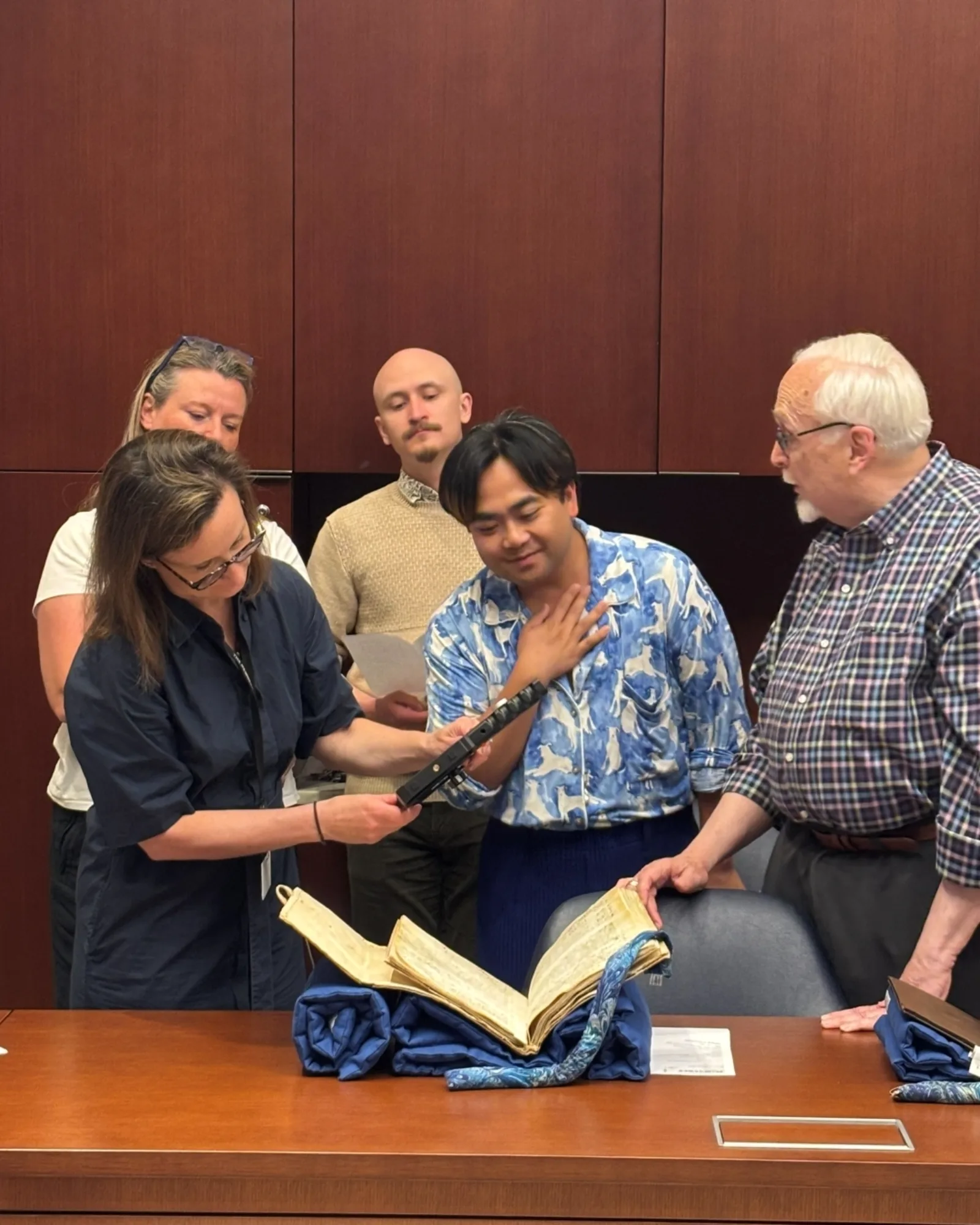
On a Wednesday afternoon, while we gathered in the ITW Seminar Room to examine a selection of materials presented by Nora and Paul, I was delighted, and a little surprised, to see the Ledger of Pepo degli Albizzi. For some reason, perhaps because it has always felt like such an emotional document, I had never requested to see it myself.
In just half a page, Pepo recorded the names of the family members he lost during June and July of 1348. I have often wondered how much it took for a man to write down those names and dates. Although many art historians begin their introduction to the Renaissance with Boccaccio and the impact of the Black Death, few begin with the names of ordinary people. These names are fragments of history that survived almost by accident. They have nothing to do with painting or sculpture, yet their existence testifies to the vitality of Florence. Pepo and his family are Florence itself. As time passes, it does not stop us from grieving for their loss.
I am especially grateful for this workshop because it allowed me to read Pepo’s mercantesca handwriting myself rather than relying on a transcription. Following each stroke of his pen offered another layer of connection between manuscripts and those who study them. To me, this is the true meaning of studying paleography.
At the beginning of the institute, I asked Prof. Signorini whether every document is ultimately meant to be read and understood. I understand that many manuscripts, especially clerical records, were never intended to circulate widely. Yet perhaps out of a romantic inclination, I still believe that reading them allows us to form a personal connection with the people who wrote them. As readers centuries later, we are able to give these writers one more chance to let their words live again. And perhaps, by truly understanding these materials, we are also given the chance to feel the weight of history itself.
Zixiao Huang is a graduate student in the Department of History of Art and Architecture at the University of Pittsburgh.