Class Description
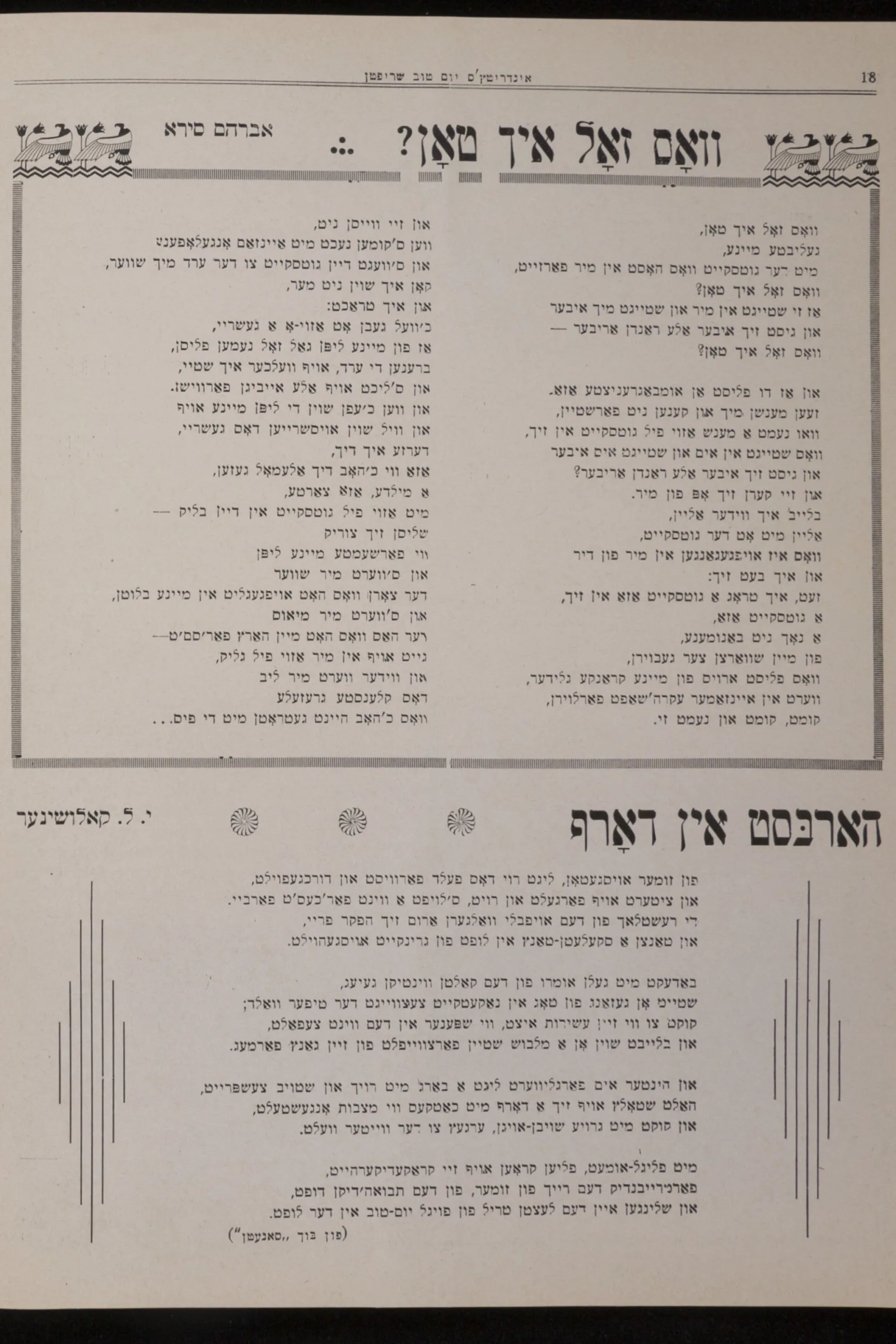
It’s hard enough to write fiction, but try writing in a language you fear may not be a language at all. This six-week course is a survey of the wide world of Yiddish literature from the nineteenth and twentieth centuries, primarily focusing on the short story form (but some stories set in verse will find their way in as well). Literature in Yiddish, the primary language of daily life for most Ashkenazi Jews in Eastern Europe, was international in scope by the 1920s and writers in the United States, Poland, the Soviet Union, Argentina, Mexico, and beyond turned to the short story as a vehicle for imitating local voices, delivering social critique, or dreamily painting small-town life. Over the years, the Yiddish short story drew on religious tales, colloquialisms, crime reports, languages of neighboring communities, and psychological novels.
Authors include Sholem Aleichem, Y. L. Peretz, Dovid Bergelson, Rokhl Brokhes, Moyshe-Leyb Halpern, Chicago Yiddish author Philip P. Bregstone, Isaac Bashevis Singer, Chava Rosenfarb, Frume Halpern, and Avrom Sutzkever. Taught in English translation; no prior knowledge of Yiddish required.
Samuel Page is a PhD candidate at Stanford University, where he researches and teaches Yiddish and Russian literature.
All virtual classes are recorded and made available to participants registered in the class. These recordings are password-protected and available for up to two weeks after the class ends.
What to Expect
Format: Virtual
Class Capacity: 20
Class Style: Mix of lecture and discussion; participation encouraged
Materials List
Required
- Instructor-Distributed Materials
First Assignment
Please read the following:
- Sholem Aleichem, “The Pot”
- Sholem Aleichem, “To the Reader” (from Railroad Stories)
- Sholem Aleichem, “The Man from Buenos Aires”
- Y. L. Peretz, “In the Mail Coach”
- Y. L. Peretz, “If Not Higher”
Please write down one or two thoughts for discussion.
A Brief Syllabus
- Origins in Eastern European Voices
- Getting Political
- Mysticism and Demons
- Dreamscapes
- The Suffering of Others
- Yiddish in Every Land
Cost and Registration
6 Sessions, $245 ($220.50 for Newberry members, seniors, and students). Learn about becoming a member.
We offer our classes at three different price options: Regular ($245), Community Supported ($225), and Sponsor ($265). Following the models of other institutions, we want to ensure that our classes are accessible to a wider audience while continuing to support our instructors. You may choose the price that best fits your situation when registering through Learning Stream.
To register multiple people for this class, please go through the course calendar in Learning Stream, our registration platform. When you select the course and register, you’ll be prompted to add another registrant.
Having trouble signing up? Take a look at our step-by-step guide to registration by clicking here.
RegisterThe views and opinions expressed in this class and/or by the instructor are not necessarily representative of the Newberry. We aim to ensure that in our classes, participants can have respectful disagreement to foster critical thinking. This is a space to challenge and expand our own worldviews to work towards better understanding and appreciating humanity.
Support the Newberry
Your generosity is vital in keeping the library’s programs, exhibitions, and reading rooms free and accessible to everyone.
Make a GiftQuestions?
Call us at (312) 255-3700 or send us an email at adulteducation@newberry.org.
We are in office Tuesday through Thursday, 10 am–6 pm CT.
We are available by email Tuesday through Saturday.