LGBTQ+
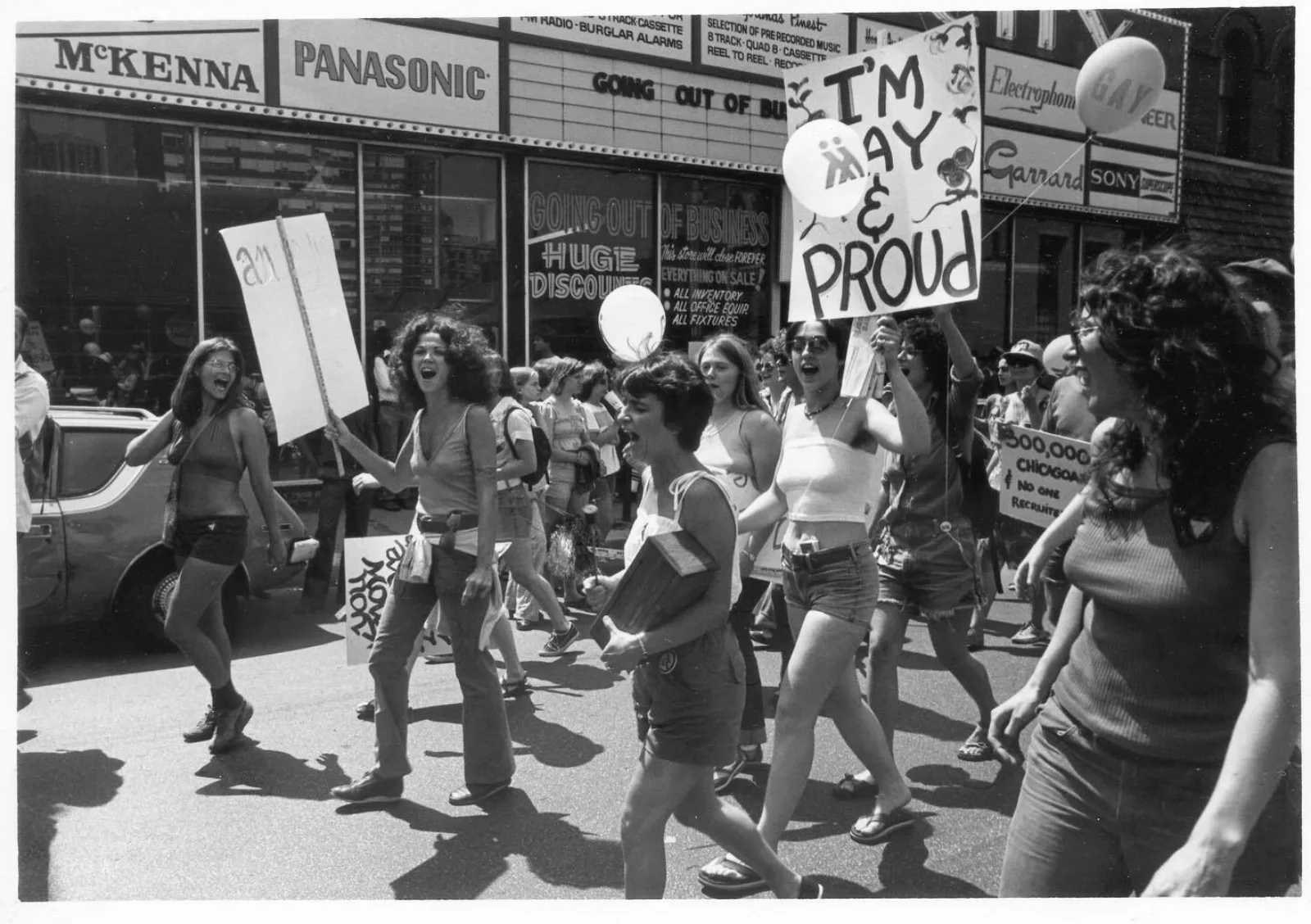
The Newberry holds numerous primary and secondary sources related to Lesbian, Gay, Bisexual, Transgender, Queer, Two-Spirit, and Intersex individuals throughout history and particularly in the Midwest, including books, papers, diaries, photographs, maps, and ephemera.
Please note that the Newberry preserves and provides access to historical materials, some of which contain harmful language and imagery. These items reflect the society in which they were produced and do not reflect the values of the Newberry.
Use the sections below to explore. Please call the reference desk at (312) 255-3512 with questions about our holdings, or contact a librarian with research questions.
(Illustrated above: Scene from Chicago Gay Pride Parade, 1976. Photo by Eunice Hundseth Militanté.)
Newberry Library Catalog:
Search the online catalog by author, title, or keywords such as lesbian, bisexual, homosexual, same-sex, transgender, queer, two-spirit, LGBTQ, etc.
Choose “Held by Library” to find physical items held at the Newberry and Sort By to see the newest or oldest materials. Use the Advanced Search to search for multiple terms or phrases in different fields and to search for materials created during a specific year or range of years. For more information about searching the online catalog, please see our Guide to PrimoVE.
Modern Manuscripts & Archives at the Newberry: Search finding aids
Search by the keyword(s) suggested above or browse by topic or subjects and filter results for relevant terms.
Newberry Digital Collections: Search digitized collection items
Browse all and use relevant filters or search by the keyword(s) listed above.
Databases
https://www.newberry.org/collection/use-in-person/databases
- The experience and impact of LGBTQ+ Americans as recorded by the news media, 1705 to today. On-site resource.
Newberry Source Material Blog
Hidden History to Radical Pride: LGBTQ+ Archives at the Newberry
- Newberry collection items that offer glimpses into the last century of LGBTQ+ history.
Expanding Horizons: Finding Intersex People in Early Modern Germany
- Article about a newly-discovered, eighteenth-century poem about intersex individuals.
De la Croix, St. Sukie. Chicago Whispers: A History of LGBT Chicago Before Stonewall. Madison: The University of Wisconsin Press, 2012. Call number: HQ76.3.U52 I443 2012
Elledge, Jim. The Boys of Fairy Town: Sodomites, Female Impersonators, Third-Sexers, Pansies, Queers, and Sex Morons in Chicago’s First Century. Chicago Review Press Incorporated, 2019. Call number: HQ76.3 U52.I4445 2018
D’Emilio, John. Queer Legacies: Stories from Chicago’s LGBTQ Archives. Chicago : University of Chicago Press, 2020. Call number: HQ76.3.U52 I444 2020
Baim, Tracy and Kirk Williamson. Windy City Times at 35: A Collection of Covers from Windy City Times, Outlines, Blacklines, En La Vida and More. Chicago, Illinois : Lambda Publications Inc./Windy City Times/ Windy City Media Group, 2021. Call number: HQ76.95.U5 B34 2021
Karlin, Rick & St. Sukie de la Croix. Last Call Chicago: A History of 1001 LGBTQ-Friendly Taverns, Haunts & Hangouts. Cathedral City, CA : Rattling Good Yarns Press, 2022. Call number: folio HQ75.26.C55 K37 2022
Katz, Jonathan D., et al. The First Homosexuals: The Birth of a New Identity 1869-1939. Edited by Jonathan D. Katz with Johnny Willis. Monacelli, a Phaidon Company, 2025. Call number: folio N8217.H67 F57 2025
Murray, Jacqueline. From Texts to Bodies: Sexes, Genders, and Sexualities in Premodern Europe. Routledge, Taylor & Francis Group, 2026. Call number: HQ1147.E85 M88 2025
Premodern Sources
Theodor de Bry, Americae pars quarta (America, part four), Frankfurt am Main: Feyerabend, 1594. Particularly see plate XXII of conquistador “Balboa’s Dogs Attacking a Group of Panamanian Sodomites.” This image was exhibited in the 2025 The First Homosexuals exhibition. Call number: VAULT Ayer 110 .B9 1590 v. 4.
Scaglia, Giacomo, Breve racconto dell'amicitia, mostruosa nella perfettione... (Brief account of the friendship, monstrous in its perfection...), Venice, 1627. Seventeenth-century defense of a homosexual relationship. Call number: Case HQ76.2.I73 B74 1627
Heylwagen, Cornelius. Stam Buch, 1727-1758. Eighteenth-century autograph album with occasionally phallic or otherwise suggestive illustrations and texts, including a newly-discovered poem about intersex individuals. Call number: VAULT Case MS 5471
Performing Arts
Throughout its history, the Newberry has collected a variety of materials relating to the performing arts in Chicago including dance treatises, theater programs, broadsides, as well as the papers of dancers, journalists, and performing arts critics.
Dill Pickle Club
The collection of Dill Pickle Club records and memorabilia presents a glimpse of the Bohemian lifestyle of Chicago in the teens, twenties and early thirties of the twentieth century.
City Entertainment and Travel Guides
Chicago Reader, 1971-2004 (most dates). Call number: Microfilm 1398
Damron’s Men's Travel Guides and Address Books – varying dates 1978-2001. Call number: Baskes HQ75.26.U6 B63 1977 and others.
Inn Places, 1987. USA and international gay accommodations. Call number: Case TX907.2 .I56
Columbia Fun Maps, 1995-2013. Popular LGBTQ+ maps, which includes local ads for businesses. Call number: Case G3701.E635 1995 .C65
Women’s Traveller 98 Lesbian Guide, 1998. Call number: Baskes E158 .W66 1998
Diaries, Literature, and Photography
Wing, John M., The Chicago Diaries of John M. Wing: 1865-1866, edited by Robert Williams and with a preface by Paul F. Gehl. Wing was a Chicago-based journalist, publisher, extra-illustrator, and confirmed bachelor, who endowed the John M. Wing Foundation on the History of Printing Collection at the Newberry. The nine original diaries are now digitized. Call number: Wing Z989.W73 A3 2002a
Eunice Hundseth Militanté, Gay Pride Parade Photographs, 1970-1987. Militanté was a lesbian activist, feminist and photographer who documented early Pride Parades in Chicago. Call number: Midwest MS Militanté
Kenneth Martin and John Dooley, Scrapbook, 1984-1991. Call number: Oversize Midwest MS 352
Indigenous Queer and Two-Spirit Resources
LaFortune, Richard (Anguksuar), Debra Williams. Two Spirit: Native Media & Community Briefing. Minneapolis: Two Spirit Press Room, [2005]. Call number: Ayer folio E98.S48 .L34 2005
Whitehead, Joshua. Full-metal Indigiqueer: Poems, 2017 Call number: Ayer PR9199.4.W4745 F85 2017
Melt, H. There are trans people here, 2021. Call number: Case PS3613.E464 T54 2021
Monkman, Kent, & Gisèle Gordon. The memoirs of Miss Chief Eagle Testickle : a true and exact accounting of the history of Turtle Island = Okiskisiwina okimâwiskwêw kihêw mitisoway. Toronto: McClelland & Stewart, 2023. Call number: Ayer N6549.M646 A2 2023
Resources at other local libraries
Gerber / Hart LGBTQ+ Library & Archives
Note that this guide is not meant to be exhaustive; additional materials may be discovered and accessed via the Newberry’s catalogs.
Many collection materials have been digitized and can be viewed directly in our Digital Collections and Spotlight. For access to physical materials, please refer to guidelines for using the collections in person on the Newberry’s website.
The following definitions are from A Glossary of Archival and Records Terminology copyrighted by the Society of American Archivists. Consult the glossary for 2,000+ additional entries.
Archives: 1. Materials created or received by a person, family, or organization, public or private, in the conduct of their affairs and preserved because of the enduring value contained in the information they contain or as evidence of the functions and responsibilities of their creator, especially those materials maintained using the principles of provenance, original order, and collective control; permanent records. - 2. The division within an organization responsible for maintaining the organization's records of enduring value. - 3. An organization that collects the records of individuals, families, or other organizations; a collecting archives. - 4. The professional discipline of administering such collections and organizations. - 5. The building (or portion thereof) housing archival collections. - 6. A published collection of scholarly papers, especially as a periodical.
Archival description: 1. The process of analyzing, organizing, and recording details about the formal elements of a record or collection of records, such as creator, title, dates, extent, and contents, to facilitate the work's identification, management, and understanding. - 2. The product of such a process.
Administrative Records: A document that has been preserved because it facilitates the operations and management of an agency, but which does not relate directly to programs that help the agency achieve its mission.
EAD (encoded archival description): A standard used to mark up (encode) finding aids that reflects the hierarchical nature of archival collections and that provides a structure for describing the whole of a collection, as well as its components.
Ephemera: Materials, usually printed documents, created for a specific, limited purpose, and generally designed to be discarded after use.
Finding aid: 1. A tool that facilitates discovery of information within a collection of records. - 2. A description of records that gives the repository physical and intellectual control over the materials and that assists users to gain access to and understand the materials.
Inventory: 1. A list of things. - 2. Description · A finding aid that includes, at a minimum, a list of the series in a collection. - 3. Records management · The process of surveying the records in an office, typically at the series level.
Primary source: Material that contains firsthand accounts of events and that was created contemporaneous to those events or later recalled by an eyewitness.
Provenance: 1. The origin or source of something. - 2. Information regarding the origins, custody, and ownership of an item or collection.
Rights management: A system that identifies intellectual property rights relevant to particular works and that can provide individuals with access to those works on the basis of permissions to the individuals.
Secondary source: 1. A work that is not based on direct observation of or evidence directly associated with the subject, but instead relies on sources of information. - 2. A work commenting on another work (primary sources), such as reviews, criticism, and commentaries.
Scope and Content: A narrative statement summarizing the characteristics of the described materials, the functions and activities that produced them, and the types of information contained therein.