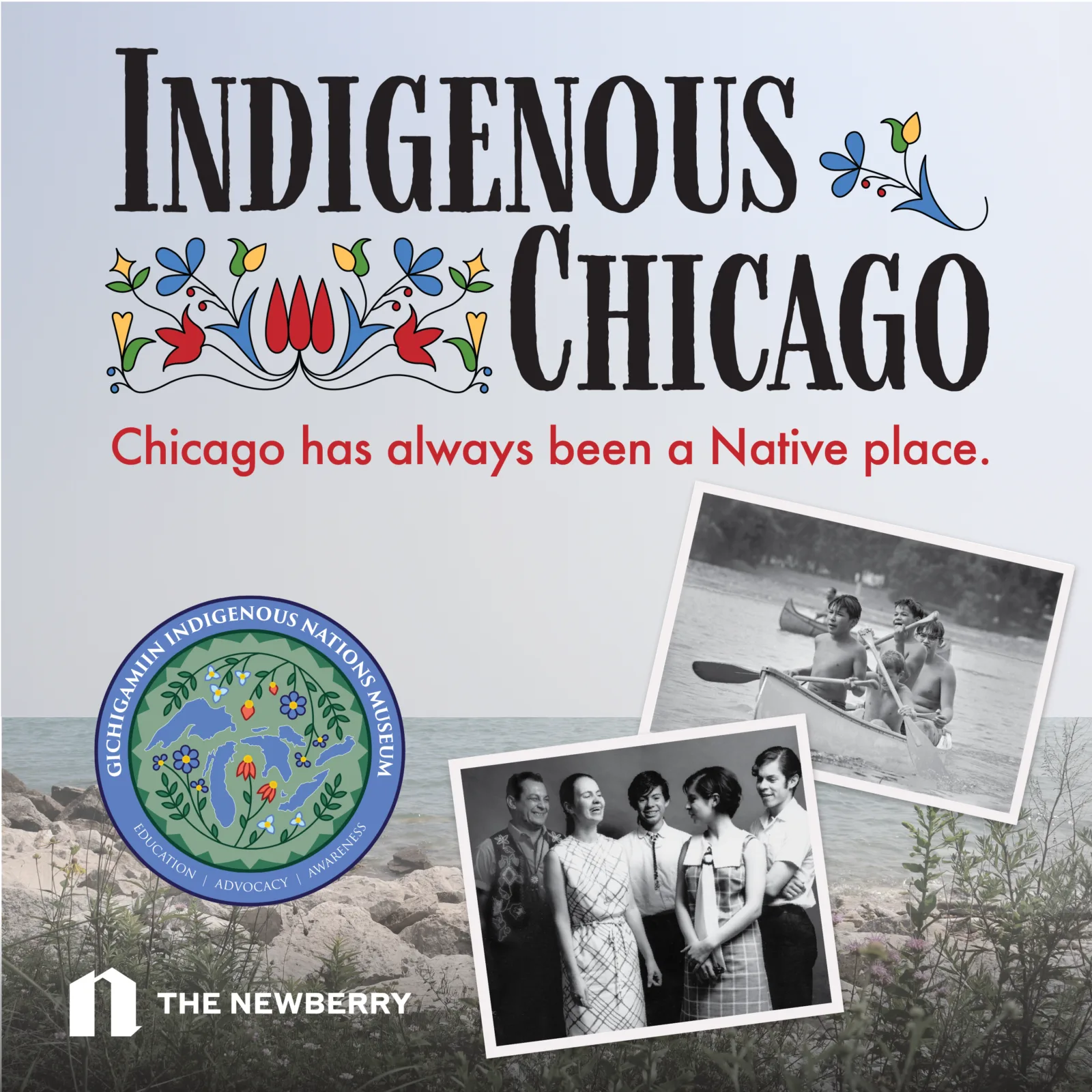
An exhibition first developed and displayed at the Newberry is gaining an extended life thanks to a collaboration with the Gichigamiin Indigenous Nations Museum. Indigenous Chicago has drawn on the Newberry’s Ayer Indigenous Studies Collection and new work by Native artists to center Indigenous voices, examine the effects of settler colonialism and imagine Indigenous futures. It was developed through five years of collaboration among the Newberry, tribal nations, and members of the Chicago Native community.
“We are thrilled to see the life of the project extended at the Gichigamiin Indigenous Nations Museum,” said Astrida Orle Tantillo, President and Librarian, Newberry Library. “The installation of the ‘Indigenous Chicago’ exhibition at Gichigamiin, a Native-led museum, aligns with the project’s central goals to center Indigenous voices and stories.”
Indigenous Chicago was first on display at the Newberry from September 12, 2024, through January 4, 2025. The exhibition explores more than 500 years of Native history including the Potawatomi, Odawa, Ojibwe, Peoria, Kaskaskia, Myaamia, Wea, Sauk, Meskwaki, Ho-Chunk, Kickapoo and Mascouten peoples, whose homelands include Chicago, and of the urban Native community that calls the city home today. Commissioned pieces such as regalia by Camille “Katahtu'ntha” Billie (Oneida and Diné), a graphic novel by Jim Terry (Ho-Chunk), and teaching blankets by Jason Wesaw (Pokagon Band of Potawatomi) also will be shown at Gichigamiin (formerly the Mitchell Museum of the American Indian), located at 3001 Central Street in Evanston.
The Newberry’s D’Arcy McNickle Center for American Indian and Indigenous Studies led the development of Indigenous Chicago with a twenty-five-member advisory council that included tribal representatives, members of the Chicago Native community, and Indigenous scholars. Free digital maps, walking tours, high school curricula and oral histories are available at www.indigenous-chicago.org.
Thank you to our funders
The Indigenous Chicago project has been supported by the Terra Foundation for American Art, the Gaylord and Dorothy Donnelley Foundation, the Richard H. Driehaus Foundation, The Elizabeth Morse Charitable Trust, The Field Foundation of Illinois, The Whiting Foundation, The Research for Indigenous Social Action and Equity Center at the University of Michigan, and Carleton College.
Planning for Indigenous Chicago was generously supported by the Mellon Foundation.