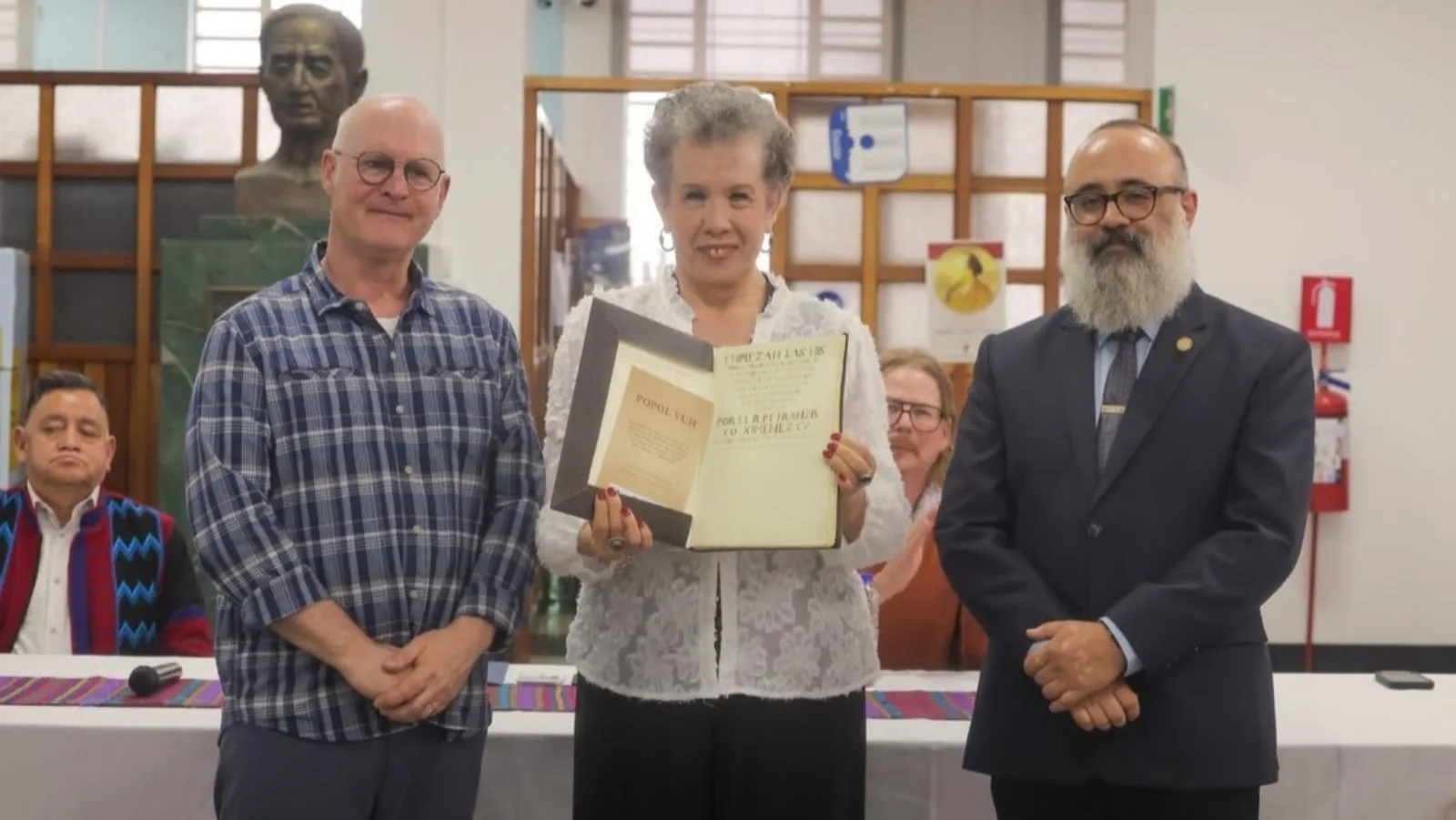
The Newberry has housed Francisco Ximénez's manuscript transcription and translation of the Popol Vuh for 115 years and has increasingly made it available through cataloging, photography, and digitization, as well as facsimiles distributed to a variety of Guatemalan officials and Indigenous leaders. Until recently, the facsimiles had not made their way to public libraries. That changed this year—thanks to the Newberry and Latin American Studies scholar Walter Little—when four facsimiles were presented to municipal libraries in Quetzaltenango (May 29), Guatemala City (June 1), San Marcos (June 3), and Santa Cruz del Quiché (June 5).
The seeds of Popol Vuh digitization at the Newberry date to 2002, when the Institute for the Study and Preservation of Ancient Religious Texts at Brigham Young University approached the library about a partnership between the two institutions to create a digital facsimile of the Popul Vuh on DVD-ROM, with accompanying scholarly translations and notes. The Newberry’s Digital Initiatives and Services and Conservation departments teamed up to conserve and digitize the manuscript, including disbinding the manuscript for digitization by Photographer and Digitization Specialist Catherine Gass, and rebinding after digitization. Digital images of each page were printed to create high-quality facsimiles. Barb Korbel, Project Conservator, and Kim Nichols, Director of Conservation, later finished the copies by cutting, sewing, and binding the loose sheets together in the fashion of the original.
Little became acquainted with the Newberry and the Popol Vuh while conducting research for his Master’s and doctoral degrees in anthropology from the University of Illinois Chicago and University of Illinois Urbana-Champaign. Little, now Professor of Anthropology and Latin American Studies at the University of Albany, SUNY, and other scholars recognized the need for a publicly available facsimile copy during Popol Vuh Week 2025, hosted at the National Library of Guatemala. As a member of the International Popol Wuj Committee, Little, along with his cohorts at the Adrián Inés Chávez Center for Mayan Studies, identified the reserve facsimiles held at the Newberry as the perfect solution to the manuscript's relative inaccessibility in Guatemala, where some communities have little to no internet access. The teams worked with library staff to distribute the texts to Guatemalan public libraries during spring and summer of this year. Little said, “It was the first time such reproductions were made accessible to the general public and, especially, school children.”
In addition to the facsimiles, the Newberry has provided Professor Little with the digital files from the original printing run. He is now working with Guatemalan publisher Cholsamaj to produce more copies in the future.