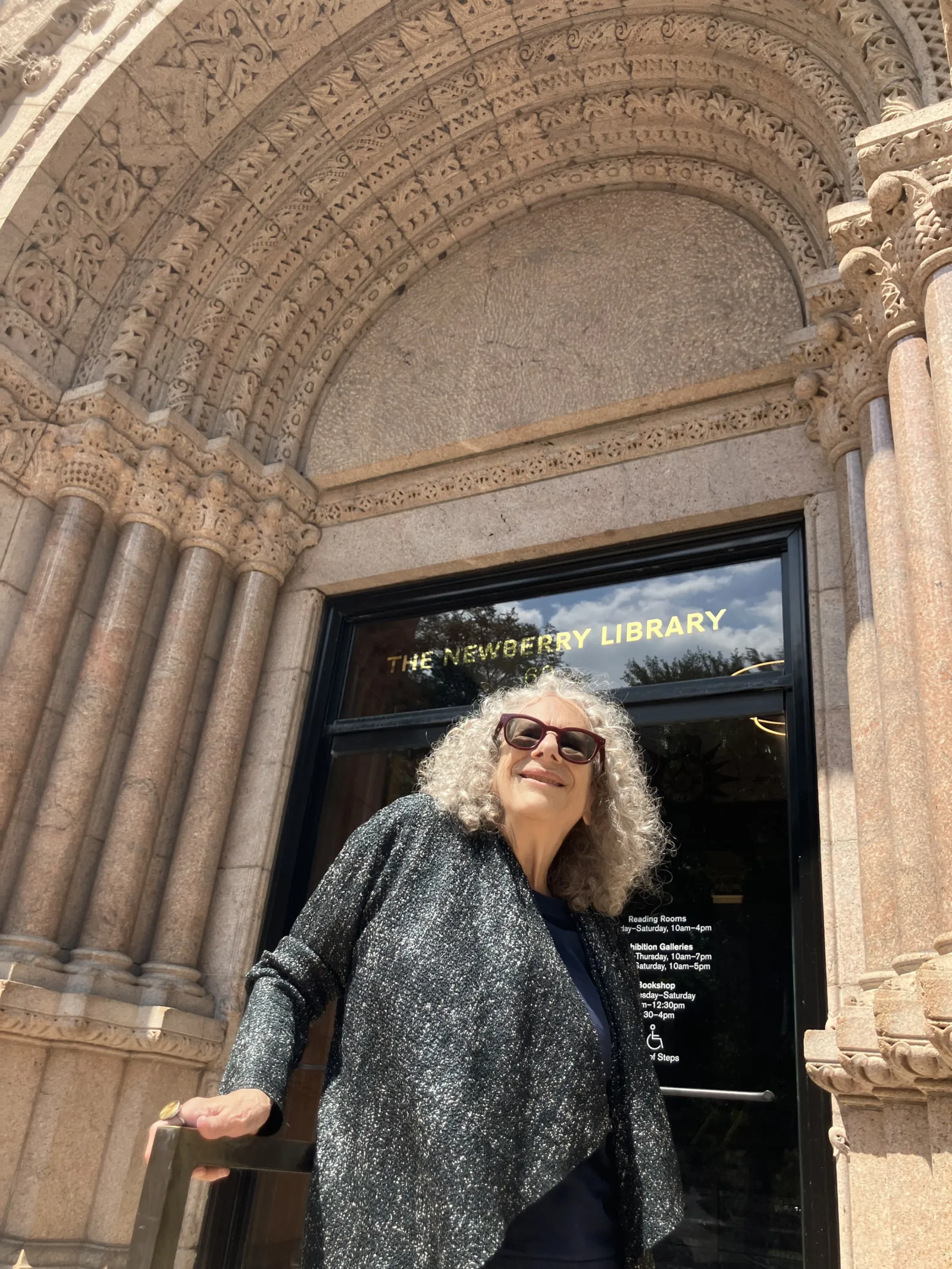
As I am now in the last chapter – I hope a long one – of my scholarly life, I think of how important the Newberry Library, particularly the Center for Renaissance Studies, has been to how my career has progressed.
I grew up in the Chicago area and received my Ph.D. in 1976 from Tufts University and had a number of years where I first adjuncted and then had visiting appointments. When I was a Visiting Assistant Professor at the University of Iowa from 1982-84 I was fortunate enough to get to to know Mary Beth Rose, who was then the Associate Director of Center for Renaissance Studies. And I was so glad whenever I was in Chicago that I could go to the Newberry and do research.
In 1983 Mary Beth organized a conference, Changing Perspectives on Women in the Renaissance on Women in the Renaissance, sponsored by the Center, and asked me to be among the scholars who would present a paper. My paper was “John Foxe and the Responsibilities of Queenship.” In 1985, the year Mary Beth became Director of the Center, the book she edited from the papers was published.
Two other events in the 1980s at the Newberry Library really changed my whole career path in such positive and memorable ways.
That same year I was accepted into the National Endowment in the Humanities summer Institute on paleography and research at the Newberry. The first two weeks were led by Professor Mark Kishlansky and then there were four weeks of intensive paleography led by Dr. Diana Greenway. Truly, this seminar was so pivotal to my work. I had not had paleographical training in my Ph.D. program and now this opened up so much in terms of my research. And both Mark and Diana were so wonderful and supportive to all of us in the institute. I also made a life-long friend with another institute member, Martha Skeeters, now Professor Emerita after a long career at the University of Oklahoma. I also spent what time I could at the Newberry working on revising my dissertation into a book, which came out in 1988, Propaganda in the English Reformation: Heroic and Villainous Images of King John.
I had finally been hired into a tenure-track position at SUNY/New Paltz in 1984. From the time I was very young I had been fascinated with Queen Elizabeth I. As I was completing the book on the changing image of King John, I knew my next book would be on Queen Elizabeth. I was so fortunate to receive the Monticello College Foundation Fellowship, which was granted to a scholar doing work on women, which allowed me to spent the first six months of 1987 at the Newberry Library doing the research that would eventually lead to the publication in 1994 of The Heart and Stomach of a King: Elizabeth I and the Politics of Sex and Power. Without the paleography institute and the Monticello fellowship I would not have the career I have.
I had the wonderful opportunity to work more on Queen Elizabeth at the Newberry Library when in 2002, Professor Clark Hulse asked me to serve as the Senior Historical Consultant for the exhibition he was curating, Elizabeth I: Ruler and Legend (see the catalog here), co-sponsored with the American Library Association. I spent the summer of 2002 working at the Newberry Library on the exhibit. I had also applied for a National Endowment for the Humanities year-long fellowship to work on my new book project on dreams and interpretations of dreams during the English Renaissance. I took it for the year 2003, so that I was able to be at the Newberry while the exhibit was on, and I am so grateful to Clark not only to be asked to participate, but for the brilliant exhibit that was created. My book, Dreaming the English Renaissance: Politics and Desire in Court and Culture, was published in 2008.
I was so pleased when Lia Markey asked me to be one of the instructors for the dissertation seminar for the 2020-21 academic year. We decided to ask Linda Austern to be my co-instructor. I had known Linda and admired her scholarship for a very long time, but working with her was a revelation in terms of her commitment to teaching and our students. The topic of the seminar was "Gender, Power, Culture," with a specific focus on the early modern period. As it turned out, because of the pandemic, we had to do the entire seminar on Zoom. It was scheduled for two meetings in the fall and two in the spring but Linda and I added to optional sessions as well for the students to help them prepare for presenting at conferences, publishing, and the job hunt. The staff at the Center, especially Lia and Christopher Fletcher were so helpful with presentations from the Newberry collections during our Zoom classes. Especially in such a hard time, I think the students gained so much from this opportunity.
This past academic year, 2025-2026, Linda and I offered the same dissertation seminar again. We had so many applications from excellent, accomplished students that it was a difficult decision to narrow it down to twelve students. Those in the seminar were spectacular. We did two sessions each semester, the first on Zoom and the second in person. I was beyond thrilled when the Newberry Library agreed to present my one-woman play, Elizabeth I: In Her Own Words, on Thursday, November 20, 2025 with our in-person meeting the following day.
With incredibly talented equity actor Tamara Meneghini, I had been working and reworking this play for a number of years. We had, among a number of places, presented it at the Edinburgh Fringe in 2024 with great reviews and it was wonderful to do it at the Newberry Library. The seminar students loved it and were also so glad to have the opportunity to talk with Tamara the following day after we had finished the class.
Our spring meetings, where students presented and discussed their dissertation research, were so valuable. At our final meeting, April 17, 2026 we had a great class, that officially ended at 12:30, and then lunch. We invited those who wished to continue our conversation to go with us to the lobby of the Claridge House Hotel, a few blocks away, and we sat around a large table and talked and had coffee as some students stayed and others came and went. It didn’t end until 3:45. I was so overwhelmed by how hardworking and dedicated these students were and how they had formed bonds with each other to continue supporting each others’ work. I have also been in touch with several of the students since the seminar via Zoom to talk further with them about their research. One has invited me to be a keynote at a conference she helped organize, and I have put together a session with two of them for the Queen Elizabeth I Society next year. I have also invited others to participate in the Society and at the South Central Renaissance Conference with which the society meets.
As well as teaching the seminar, in November I also taught a two-week Adult Education class at the Newberry Library on Queen Elizabeth and the significance of gifts. Those who participated were so thoughtful and interesting. I enjoyed it so much this summer have taught a two-week class on Joan of Arc, her life and her afterlife, and will be teaching a one-class course on Richard III in November.
Because I am of the age when I must take the required minimum distribution of my retirement funds, I have been able to help fund the international symposium "Spanish Habsburg Women: Objects, Ritual, and Religion in the Early Modern World" which took place on April 17–18, 2025. The research presented at the conference was so remarkable that the organizers are now publishing a collection based on the symposium in my co-edited series, New Interdisciplinary Approaches to Early Modern Culture: Confluences and Contexts. I am so thrilled that I am also able to support the symposium, Early Modern TransArchives 2.0 which will be held at the Newberry in November 2026.
I am also leaving part of my retirement fund to the Newberry for fellowships and programs. I mention this not to be bragging about it, but to encourage others to consider using the required minimum distributions and for considering part of what they leave to the Center for Renaissance Studies as it not only made such a great difference in my professional career but also does for so many others.
Carole Levin is the Willa Cather Emerita Professor of History at the University of Nebraska.